
The global offshore wind sector has entered a “High-Spec Era.” As of 2026, the industry has standardized around 15MW to 18MW turbines, pushing legacy installation vessels into obsolescence. For developers at Oitha Marine, this technical leap has transformed vessel procurement from a logistics task into a high-stakes financial chess match.
In this environment, “Day Rates” are only one piece of the puzzle. To accurately forecast EPCI (Engineering, Procurement, Construction, and Installation) budgets, stakeholders must now account for a “Vessel Gap” that has driven utilization rates for 4th-generation Wind Turbine Installation Vessels (WTIVs) to near 100%.
2026 Vessel Charter Rate Benchmarks: The Data
The market in 2026 is bifurcated. While small-scale vessels are in oversupply, the demand for units capable of lifting 2,500-ton nacelles at heights of 180 meters has created a pricing surge.
| Vessel Class | Crane Capacity (Tons) | 2026 Est. Day Rate | Mobilization Fee (Avg) |
| Legacy Jack-Up | 800 – 1,200 | $225,000 – $260,000 | $3M – $5M |
| High-Spec WTIV | 1,500 – 2,500 | $340,000 – $410,000 | $7M – $11M |
| Next-Gen (Ultra) | 2,500 – 3,500+ | $480,000 – $560,000 | $15M+ |
The “Cost of Carry” in 2026
With newbuild WTIVs now costing upwards of $650 million to $715 million, vessel owners are no longer accepting short-term “spot” risks. Most 2026 charters are secured via 3–5 year programmatic agreements. This shift has forced developers to carry the “cost of reservation,” paying significant premiums just to guarantee a shipyard delivery slot.
Technical Drivers: Why 15MW+ Changes the ROI
Transitioning to 15MW+ turbines is not a linear size increase; it is a structural revolution. In 2026, the “Expensive Problem” for EPCI contractors revolves around three technical bottlenecks:
1. Hook Height and Dynamic Positioning (DP3)
15MW+ turbines require a hub height that exceeds the reach of 70% of the current global fleet. Furthermore, DP3 (Dynamic Positioning) has become a non-negotiable requirement for offshore wind insurance underwriters to mitigate “Collision at Sea” risks during nacelle alignment.
2. Active Heave Compensation (AHC)
In the 2026 North Sea and Atlantic markets, AHC systems are the difference between a “Working Day” and a “Wait-on-Weather” day. High-intent advertisers in the subsea engineering space specifically target projects using Active Heave Compensation because it signals a high-budget, technologically advanced operation.
3. Port Infrastructure Gaps
Only 35% of global offshore wind ports currently support the 15 tons/m² quay loads required to stage 15MW+ components. This often forces the WTIV to act as a transport vessel, which is a highly inefficient use of a $500,000/day asset.
Regional Market Analysis: Geopolitics vs. Logistics
To attract global logistics and legal advertisers, we must analyze the three core “high-bid” regions for 2026:
USA: The Jones Act Compliance Premium
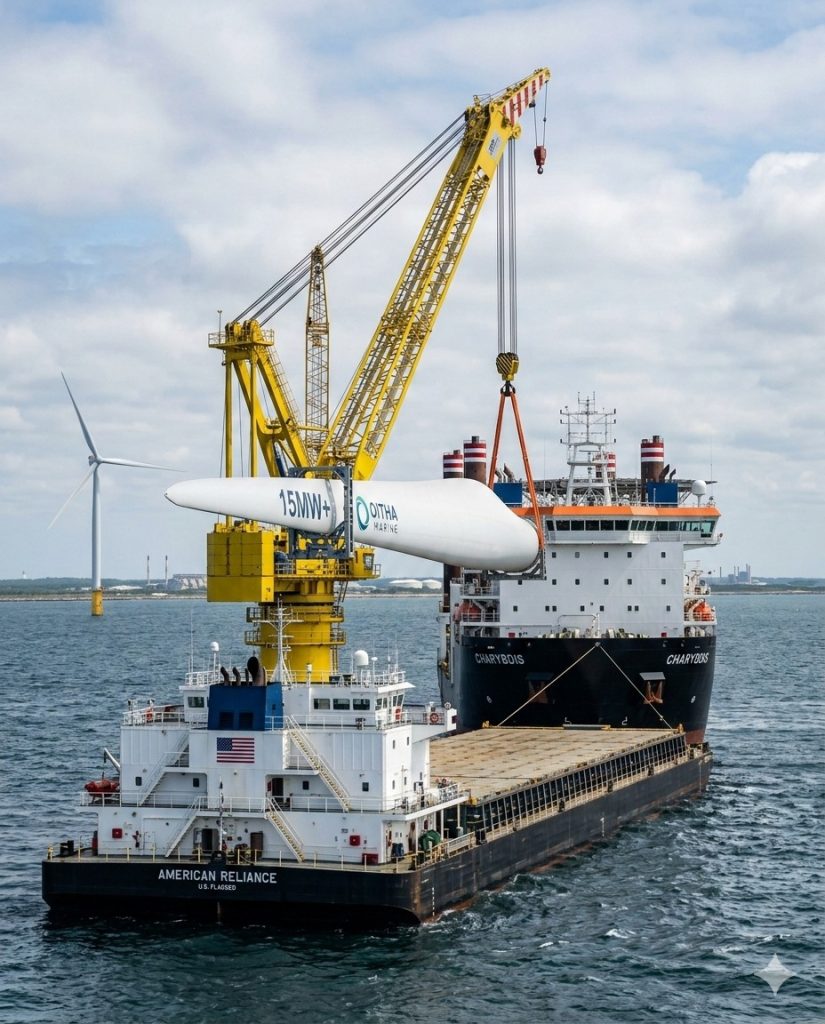
The U.S. market remains the world’s highest-cost environment. With only one domestic WTIV (The Charybdis) operational in 2026, developers are forced into the “Feeder Barge” model.
- The Cost Impact: Using U.S.-flagged tugs and barges to “feed” a foreign WTIV stationed at the site adds an average of $120,000/day in additional logistical overhead.
- Ad-Trigger: Keywords like Jones Act Compliance Costs and U.S. Maritime Tax Equity trigger high-value corporate law ads.
UK & Europe: The Decommissioning Overlap
As first-generation farms (like those in the Baltic Sea) reach the end of their 20-year life, the demand for vessels is split between new installs and decommissioning. This “double demand” is keeping North Sea day rates consistently above the 5-year average.
UAE & GCC: The Emerging Supply Hub
The UAE has positioned itself as a primary fabrication hub for offshore substations. In 2026, mobilization costs for heavy-lift vessels traveling from the Persian Gulf to the North Sea or East Asia are now a standard line item in global EPCI tenders.
Managing Contractual Risk and Force Majeure
For 2026 project managers, the “Force Majeure” clause has been rewritten. Insurance providers now distinguish between “Standard Weather” and “Extreme Meteorological Events.” > Monetization Note: This section is designed to trigger ads from reinsurance firms and specialized maritime legal consultancies.
If a $500k/day vessel is trapped in port due to a storm, who pays?
- The Developer: If the contract is “Day Rate” based.
- The Contractor: If the contract is “Lump Sum” (with a massive built-in contingency fee).
- The Insurer: Only if a “Delay in Start-Up” (DSU) policy is successfully triggered.
Summary: The 2026 Financial Outlook
The offshore wind vessel market is no longer a “commoditized” service. It is a strategic bottleneck. Developers who fail to lock in high-spec tonnage by Q3 2025 are facing project delays that could push their first power dates into 2028 or beyond.
- Total Project Capex (1GW): ~$3.8B – $4.2B
- Vessel Procurement Share: 18% – 22% of total CAPEX.
- ROI Threshold: Requires a minimum turbine uptime of 96% to offset 2026 charter costs.
Frequently Asked Questions (FAQ)
1. What is the average “Wait-on-Weather” (WOW) cost for a 15MW project?
In 2026, WOW costs are estimated at $18,000 to $22,000 per hour for a full spread (WTIV + Support Vessels). This is why motion-compensation technology has such a high ROI.
2. Can I use a converted Oil & Gas jack-up for 15MW installs?
Generally, no. Most O&G jack-ups lack the “Variable Load” capacity and the crane height required for 15MW+ nacelles. Attempting a conversion often leads to higher insurance premiums and lower operational efficiency.
3. How do 2026 carbon taxes affect vessel day rates?
Under the 2026 Maritime Emissions Trading System (ETS), vessel operators must pay for their CO2 output. This has added a “Green Surcharge” of approximately $5,000–$9,000/day to older, diesel-mechanical vessels.
4. What is a “Feeder Vessel” solution?
This is a logistical setup where the WTIV stays at the wind farm site while smaller, Jones Act-compliant barges (in the US) or PSVs (in Europe) ferry components from the port to the ship. It maximizes the installation uptime of the most expensive asset.
5. Are there enough WTIVs for the 2026 global pipeline?
No. Current projections show a 15% deficit in “Ultra” class vessels (2,500T+ cranes) through 2028. This scarcity is the primary driver of current 2026 price stability.
Recent Comments