
As of March 2026, the International Maritime Organization’s (IMO) Carbon Intensity Indicator (CII) has entered its most aggressive phase. For shipowners operating in the Atlantic and Indian Ocean corridors, the 2% annual reduction factor has effectively “pushed” older tonnage into the D and E rating categories.
The “Expensive Problem” for 2026 is no longer just the cost of steel replacement or engine overhaul; it is the Commercial Death Sentence of a non-compliant vessel. In this environment, CFOs are forced to choose: allocate massive CAPEX (Capital Expenditure) for retrofitting during the next dry dock or risk the Market-Driven “Fines” that erode asset value and charterability.
The 2026 Dry Docking Landscape: A Financial Pivot
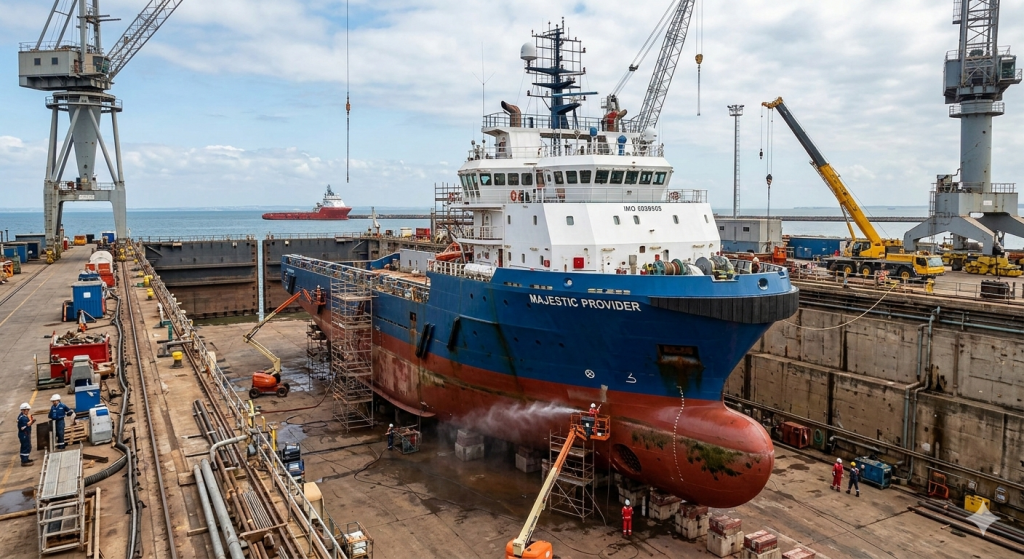
Dry docking in 2026 has evolved into a “Sustainability Event.” According to recent market data, the global dry docking services market is projected to reach $15.9 Billion this year, driven by the mandatory installation of Energy Saving Devices (ESDs).
The “Stay Still” Penalty
If a vessel maintains exactly the same operational profile in 2026 as it did in 2023, its CII rating will likely drop by at least one grade.
- The Baseline: By 2026, required CII values are roughly 11% more stringent than the 2019 reference level.
- The Consequence: Vessels rated ‘E’ for a single year or ‘D’ for three consecutive years must implement a Mandatory Corrective Action Plan under SEEMP Part III.
CAPEX Analysis: The Cost of Eco-Retrofitting
To avoid being “rated out” of the market, shipowners are investing in technical upgrades during their 2026 special surveys. Below is a budget comparison for a typical Suezmax tanker:
| Retrofit Technology | Estimated CAPEX (2026) | Projected Fuel Saving | CII Impact |
| High-Performance Silicone Coating | $150,000 – $250,000 | 5% – 8% | Immediate 1-grade buffer |
| Mewis Duct / Wake Equalizing Duct | $180,000 – $300,000 | 4% – 6% | Long-term stability |
| Engine Power Limitation (EPL) | $50,000 – $80,000 | Operational dependent | High technical compliance |
| AI-Driven Route Optimization | $15,000/year (SaaS) | 7% – 10% | Dynamic improvement |
Strategist’s Note: For African shipowners, the Return on Investment (ROI) on a $250k coating system is often achieved in less than 14 months purely through fuel savings and the avoidance of “Carbon Surcharges” in European ports.
The Comparison: Fines, Penalties, and “Shadow Costs”
While the IMO does not yet impose a direct “Global Carbon Fine,” the market-driven penalties in 2026 are far more severe.
1. Charter Rate Discounts (The “D/E Grade” Penalty)
Major charterers in 2026 now include “CII Minimums” in their vetting protocols.
- D-Rated Ships: Face charter rate discounts of 5% to 15% compared to C-rated equivalents.
- E-Rated Ships: Are increasingly “uncharterable” for long-haul voyages to the UK or EU, effectively limiting them to lower-value regional coastal trade.
2. Financing Friction (The Poseidon Principles)
Banks in South Africa and Nigeria are aligning with the Poseidon Principles. A poor CII rating can:
- Trigger Covenant Reviews in existing loan agreements.
- Increase Interest Margins by 50–100 basis points.
- Result in a 20% Lower Resale Value on the S&P (Sale and Purchase) market.
The African Context: Financing the Gap
In Nigeria, the Cabotage Vessel Financing Fund (CVFF), estimated at $700 million, is finally becoming a strategic lever for eco-retrofitting. For startup founders in Kenya and South Africa, the rise of “Charter-Led Debt” is allowing owners to finance dry docking costs against future green-certified earnings.
Operational Strategy: The “2.5-Year” Window
In 2026, the strategy has shifted from “waiting for the 5-year survey” to Intermediate Docking Audits.
- Phase 1 (Pre-Docking): Conduct a “Digital Twin” simulation to see which retrofit provides the best CII boost for your specific trade route (e.g., Lagos to Rotterdam).
- Phase 2 (In-Dock): Prioritize Hull Performance and Propulsion Efficiency. These are “Low-Hang” CAPEX items with the highest impact on carbon intensity.
- Phase 3 (Post-Dock): Continuous monitoring via AI Maintenance Software to ensure the technical gains aren’t lost to poor operational handling.
Frequently Asked Questions (FAQ)
1. What is the most cost-effective retrofit for an older vessel in 2026?
Engine Power Limitation (EPL) and High-Performance Coatings are the most cost-effective. EPL is a technical fix that limits maximum speed to reduce emissions, while coatings provide a 5%+ efficiency gain with almost no operational downtime once applied in dry dock.
2. Are there direct fines for an ‘E’ rating in 2026?
The IMO requires a Corrective Action Plan in the SEEMP. While the IMO doesn’t fine you directly, regional regulations like the EU ETS (which now covers 100% of emissions) will effectively “fine” you through massive carbon permit costs.
3. Can I use the Nigerian CVFF to fund my dry docking?
As of early 2026, there is a significant push by the Ministry of Marine and Blue Economy to prioritize CVFF disbursements for “Green Upgrades.” This is specifically targeted at indigenous owners to help them compete in international waters.
4. How much does a “Special Survey” dry docking cost for a Suezmax in 2026?
Excluding retrofits, a standard Suezmax dry docking in a yard like Dubai Drydocks or Durban typically ranges from $800,000 to $1.2 Million, depending on the extent of steel work and machinery overhaul.
5. Why is AI software mentioned in a dry docking budget?
Because Predictive Maintenance can extend the time between expensive dockings. In 2026, using IoT sensors to monitor hull fouling can help you delay a “clean and paint” event, saving hundreds of thousands in off-hire time.
Final Strategist’s Conclusion: The “Compliance ROI”
In 2026, the most expensive docking is the one that doesn’t include an eco-retrofit. A ship that exits the yard with a ‘D’ rating is a liability that will face higher port fees, higher insurance premiums, and lower charter rates.
For African fleet owners, the goal is to leverage the 2026 Financing Recapitalization in the banking sector to move from “Survival” to “Efficiency.”
Recent Comments