
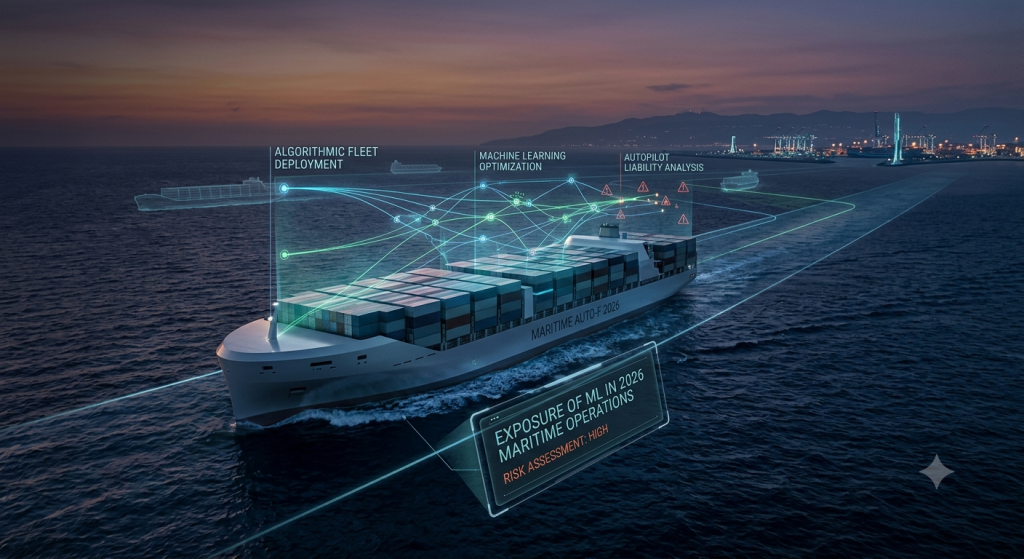
In the high-yield maritime asset markets of 2026, the deployment of unvetted Machine Learning (ML) routing engines and black-box artificial intelligence systems has shifted from a competitive advantage to a significant balance sheet exposure. For institutional asset managers, sovereign wealth allocators, and shipowners operating across the US, UK, Singapore, and the UAE, the blind integration of automated navigation and autonomous chartering engines introduces catastrophic systemic vulnerabilities, including immediate policy forfeitures, structural carbon taxation penalties, and technical defaults on leveraged debt facilities.
The Economic Impact: Algorithmic Deviations, NOI Compression, and Financing Defaults
The “Million-Dollar Problem” of 2026 maritime operations is defined by the financial consequences of black-box machine learning models shifting physical assets into high-risk environments without human oversight or structural underwriting alignment. When an AI-driven voyage optimization platform dynamically alters a vessel’s heading to maximize fuel efficiency, it processes hydrodynamic data, weather forecasts, and spot market spot rates. However, these pure mathematical optimizations routinely fail to account for the complex legal, financial, and geopolitical realities that govern the international maritime capital stack.
Debt Facility Vulnerability and Financing Contagion
A single automated voyage alteration that directs a vessel into contested waters or triggers an unexpected port delay can compromise an operator’s entire financial structure. If an autonomous chartering engine locks in a multi-month fixed time-charter based on flawed market forecasts, or an AI routing error extends a voyage by several days, the resulting cash flow compression impacts the operator’s balance sheet.
[Black-Box AI Voyage Optimization Error] —> [Unplanned Deviation or Asset Detention]
|
v
[Erosion of Top-Line Charter Revenue]
|
v
[Breach of Debt Service Coverage Ratio (DSCR)]
|
+———————————+———————————+
| |
v v
[Senior Secured Debt Acceleration] [High-Cost Mezzanine Financing Triggers]
(Primary Lenders Freeze Credit Lines) (Equity Yield & Project IRR Destruction)
This unexpected drop in revenue compresses the shipowner’s net operating income (NOI), causing an immediate breach of the Debt Service Coverage Ratio (DSCR) and minimum liquidity covenants. In today’s volatile financial environment, primary institutional lenders move quickly to enforce protective terms.
A technical covenant breach gives banks the right to freeze revolving credit lines or demand an accelerated restructuring of Senior Secured Debt & Mezzanine Financing agreements. Forcing an asset manager to rely on high-yield mezzanine debt to maintain operational liquidity introduces significant basis point surcharges, lowering the fund’s internal rate of return (IRR) and damaging institutional investor confidence.
The True Cost of Microeconomic Algorithmic Failures
When AI fleet deployment platforms optimize routes purely for speed or fuel consumption, they often introduce hidden, compounding operational expenses.
| AI System Vector | Automated Engineering Action | Multi-Year Financial Exposure Profile |
| Autonomous Dynamic Speed Optimization | Rapid, automated throttle adjustments to maintain a fixed ETA. | Accelerated thermal wear on main engine components, leading to unbudgeted auxiliary machinery overhauls. |
| Algorithmic Bunkering Procurement | Automated selection of alternative low-cost marine fuel blenders. | Increased probability of loading off-specification fuel, causing severe line purges and extended off-hire periods. |
| Black-Box Weather Routing Loops | Re-routing assets around minor weather systems based on legacy data sets. | Unnecessary additions of voyage days, driving up crew overhead, port dues, and daily operational cash burn. |
Failing to implement human-in-the-loop validation for automated voyage execution platforms ensures continuous profit erosion. A bulk carrier or container asset operating under unverified algorithmic guidance carries an elevated risk profile, increasing daily operating expenses (OPEX) and exposing owners to major financial liabilities when automated systems fail to align with the terms of contemporary charter-party warranties.
The Compliance/Legal Framework: The 2026 Regulatory Enforcement Grid
The modern regulatory environment treats automated maritime decisions with the same scrutiny as human choices. The connection between algorithmic tracking, international trade compliance, and regional environmental legislation has created an enforcement grid where an unverified automated decision can instantly halt a corporate enterprise.
+—————————————–+
| 2026 MARITIME REGLATORY ENFORCEMENT |
+—————————————–+
| – JWLA-032 Underwriting Restraints |
| – EU ETS Phase-In (CO2 & Methane Slip) |
| – OFAC Sanctions Automated Screening |
+—————————————–+
|
v
+———————————————————–+
| Severe Operational Levies, Policy Forfeitures, & Seizures |
+———————————————————–+
I. Geopolitical Hull Underwriting Realities: The Impact of JWLA-032
The global maritime hull and machinery insurance market has adjusted its terms to manage the rise of autonomous guidance systems. The Joint War Committee (JWC) Circulars, specifically the active JWLA-032 protocol, place strict operational obligations on shipowners.
Under JWLA-032, underwriters use continuous satellite telemetry to monitor vessel behavior within high-risk geographic areas. If an automated optimization engine triggers an unverified heading change that crosses a listed war-risk boundary without advanced notification, underwriters can declare an immediate breach of warranty terms.
This can result in the automatic suspension of Asset Seizure & Hull War Risk cover, leaving the asset owner, hull financiers, and private equity investors completely unhedged against total asset loss from kinetic threats, drone strikes, or state-sponsored detentions.
[Autonomous Heading Change (No Human Sign-Off)] —> [Crossing of Listed JWC Hull Boundary]
|
v
[Satellite Telemetry Automated Underwriter Audit]
|
v
[Immediate Breach of Policy Navigation Warranties]
|
v
[Asset Seizure & Hull War Risk Coverage Voided]
II. Automated Operational Risks: AI Navigation Liability in Volatile Lanes
The practical exposure of autonomous steering systems is clearly demonstrated by AI-driven navigation liability in the Red Sea and other high-conflict transit lanes. When an algorithmic routing platform detects an active threat, such as an uncrewed aerial vehicle (UAV) or a localized kinetic hazard, its automated response parameters may execute sharp evasive maneuvers or increase engine output to maximum thermal limits.
If these rapid adjustments cause an emergency engine shutdown or a loss of steering control within a narrow transit lane, the vessel can block critical fairways or run aground.
Determining liability for the resulting salvage fees, cargo damage, and supply chain disruptions leads to multi-jurisdictional legal disputes. Because traditional maritime law is built around human crew accountability, assigning liability between the software vendor, the ship manager, and the system engineer generates significant, multi-million-dollar Arbitration & Litigation Costs.
III. The Environmental Burden: Methane Slip and Capital Tracking Liabilities
The integration of automated routing systems also creates direct liability under regional carbon taxation frameworks. The EU ETS Phase-In costs for methane slip and carbon dioxide emissions mean that any automated system optimizing for pure speed over structured environmental compliance presents a significant financial risk.
Modern carbon taxation penalizes not just main engine fuel consumption, but also the unmitigated emissions from auxiliary boilers and diesel generator sets during port stays and extended anchorage wait times.
If an AI engine schedules a voyage to arrive ahead of an available berth slot, the vessel will idle at anchor, burning auxiliary fuel and driving up its emissions profile.
Failing to properly monitor, report, and offset these automated emissions imbalances creates an immediate ESG Disclosure Liability. This exposure can disqualify the shipowner from green financing programs, trigger automated divestment mandates from institutional sustainability funds, and draw enforcement actions from financial regulators for misrepresenting material environmental compliance costs.
IV. Geopolitical Sourcing and Compliance Risks: Automated OFAC Tracking Failures
Autonomous chartering and cargo matching software must navigate strict international trade barriers. Current enforcement rules dictate that OFAC Sanctions Compliance applies directly to every participant in the maritime supply chain, including underlying cargo owners, ultimate beneficial owners (UBOs), bunker fuel blenders, and intermediate ship repair facilities.
Many automated freight matching platforms use shallow scraping algorithms to verify counterparty data. If an autonomous system matches an asset with a cargo linked to a sanctioned entity, or selects a bunkering hub that uses components from a restricted region, the vessel faces immediate port detention or asset seizure.
Underwriters treat any contact with sanctioned supply chains as a fundamental breach of contract terms, which can result in the automatic denial of claims and leave the asset vulnerable to regulatory Asset Seizure.
Strategic Recommendations: 3 Actionable Steps for the CEO
I. Implement Standardized AI Safeguards and Human-in-the-Loop Policies
Cease allowing autonomous routing engines to transmit heading adjustments directly to a vessel’s bridge without verification. Mandate a strict operational policy requiring all AI-suggested speed or route alterations to be reviewed and approved by a certified marine superintendent and the vessel’s master before implementation.
Ensure your technical teams document every validation in an unalterable digital logbook. This rigorous audit trail helps defend your operations against breach-of-warranty claims under Joint War Committee (JWC) Circulars if an automated system creates an operational issue.
II. Restructure Operational Risks via Parametric Insurance Hedges
Traditional hull and cargo insurance policies do not cover the indirect financial losses caused by software errors or algorithmic routing failures. Corporate leaders should integrate specialized Parametric Insurance Premiums into their operational budgets.
These parametric policies utilize objective data triggers—such as a documented software failure or an automated route deviation that delays an asset past a specific time window—to execute immediate cash payouts without requiring a lengthy claims adjustments process. This immediate liquidity helps keep your operations funded, protecting your Senior Secured Debt facilities from covenant defaults driven by unexpected vessel down-time.
III. Incorporate Strong Technology Vetting and Indemnification in Charter Contracts
When negotiating charter-party agreements and purchasing fleet optimization software, ensure your legal teams insert explicit, multi-tier indemnification clauses regarding algorithmic performance. Require all software vendors to carry robust technology errors and omissions (E&O) coverage that explicitly covers maritime liabilities.
Clearly assign the financial risks of automated routing errors, including unexpected carbon taxes and port delays, to the technology provider or the charterer if they insist on using an unverified third-party optimization engine. This proactive contractual structure minimizes your exposure to unexpected legal liabilities and helps lower potential Arbitration & Litigation Costs.
Specialized Digital Risk and Underwriting Advisory
Navigating the operational and regulatory complexities of modern maritime AI systems requires a partner with deep risk management expertise. Managing changing Joint War Committee (JWC) Circulars, volatile high-conflict transit corridors, and strict international trade compliance demands specialized advisory support. Traditional, off-the-shelf marine policies are no longer adequate to protect high-value maritime investments from sudden algorithmic liabilities, environmental penalties, or Asset Seizure & Hull War Risk events.
We provide the Professional Advisory Services and Specialized Insurance Cover required to protect your fleet from these systemic disruptions. Whether you are restructuring financing across Senior Secured Debt & Mezzanine Financing or defending your firm against unexpected subrogation claims involving ESG Disclosure Liability, our underwriter-led risk solutions help ensure your fleet remains compliant, efficient, and fully insurable.
FAQ: 2026 Maritime AI Risk and Asset Protection
Q: How can an autonomous voyage optimization platform cause a default on a vessel’s Senior Secured Debt?
A: If an AI engine makes an unverified route alteration that leads to a port detention or an extended off-hire period, top-line revenue stops instantly. This revenue drop compresses the company’s Net Operating Income (NOI), which can trigger immediate breaches of Debt Service Coverage Ratio (DSCR) covenants within lending agreements, allowing banks to accelerate debt repayment schedules.
Q: Why does AI-driven navigation liability in the Red Sea pose a direct threat to hull and war-risk policies?
A: Under current JWLA-032 protocols, underwriters can review a vessel’s technical logs following an incident. If the investigation shows that an automated system steered the asset into a high-risk area without human sign-off, insurers can declare a breach of navigation warranties and deny coverage for Asset Seizure & Hull War Risk claims.
Q: How do the EU ETS Phase-In costs for methane slip interact with automated voyage management?
A: If an AI optimization platform optimizes exclusively for speed, it may schedule port arrivals ahead of available berth slots. This forces the vessel to idle at anchor, burning auxiliary fuel, increasing its emissions profile, and creating an unhedged operational expense and a reportable ESG Disclosure Liability.
Q: Can a shipowner utilize Parametric Insurance Premiums to hedge against software-driven fleet disruptions?
A: Yes. Specialized parametric policies can be structured to trigger immediate cash payouts based on objective, data-driven parameters—such as a system-wide software malfunction or an unverified route deviation—providing immediate liquidity to help meet fixed financial obligations.
Q: What steps should a shipping firm take to ensure OFAC Sanctions Compliance when using autonomous chartering software?
A: Chartering agreements must include strict clauses requiring technology vendors to use multi-tier data validation. Legal teams should insert explicit indemnification terms that shift all financial liabilities from automated screening errors directly to the software provider, reducing potential Arbitration & Litigation Costs.
Extended Analysis: Technical System Architecture and Risk Mitigation
The Black-Box Problem in Hydrodynamic Modeling
The core exposure within modern maritime AI deployment lies in the misalignment between a machine learning model’s training data and real-world maritime conditions. Most voyage optimization platforms rely on neural networks trained on historical weather data, basic satellite imagery, and standard hull performance models.
+—————————————————————–+
| THE ALGORITHMIC COGNITIVE GAP |
+—————————————————————–+
| Neural Network Processes Idealized Open-Ocean Hydrodynamics |
| -> Encounters Real-World Kinetic Threats & Localized Conficts |
| -> Executes Extreme Evasive Maneuvers or Rapid Throttle Shifts |
| -> Overloads Vessel Machinery and Tripping Circuit Breakers |
| -> Immediate Blackout & Loss of Steering in Critical Corridors |
+—————————————————————–+
When an automated navigation system encounters an unpredicted hazard, its algorithms can trigger extreme responses, such as abrupt rudder adjustments or rapid throttle shifts. These sudden adjustments can overload auxiliary systems, trip circuit breakers, cause electrical blackouts, and leave the vessel adrift in high-risk waters.
Quantitative Vulnerabilities in Automated Freight Matching
In the automated chartering market, algorithms match vessels with cargoes based on proximity, cargo capacity, and spot market rates. However, these systems often fail to adequately evaluate counterparty risks across complex ownership networks.
+————————————————————+
| AUTOMATED CHARTERING LIABILITY CHAIN |
+————————————————————+
| AI Platform Matches Vessel with High-Yield Cargo |
| -> Verifies Primary Shell Company Documentation |
| -> Fails to Identify Underlying Sanctioned Beneficiaries |
| -> Triggers Port Detentions and International Trade Audits|
| -> Automatic Loss of Commercial Underwriting Cover |
+————————————————————+
When an autonomous platform accepts a high-yield contract without verifying multi-tier ownership records, it exposes the shipowner to severe penalties. Identifying hidden connections to sanctioned entities after a cargo is loaded can lead to sudden regulatory enforcement, port detentions, and the immediate cancellation of hull insurance policies.
Hardware and Software Integration Failures on Automated Bridges
Modern autonomous vessels rely on an interconnected network of sensors, including radar, digital charting systems, and satellite communication links. If a software update introduces errors or a sensor experiences an electrical fault, the automated navigation engine receives compromised data.
+———————————————————————–+
| SENSOR DEGRADATION ERROR PATHWAY |
+———————————————————————–+
| Sensor Glitch or Satellite Signal Attenuation |
| -> Algorithmic Miscalculation of Localized Drift Vectors |
| -> Automated Heading Alterations Into Restricted Territorial Waters |
| -> Port State Control Detentions & Complex Sovereignty Disputes |
+———————————————————————–+
If an algorithm miscalculates local environmental drift vectors due to a sensor error, it can steer the vessel into restricted waters. Resolving the resulting port state detentions, regulatory fines, and cargo delays requires extensive legal intervention, driving up corporate administrative expenses and highlighting the need for robust human oversight.
Conclusion: Safeguarding Portfolio Value through Rigorous Maintenance
Operating a modern international fleet requires an integrated management approach that connects technical fleet operations with proactive regulatory compliance and structured risk transfer. Relying blindly on autonomous systems without rigorous validation exposes a maritime enterprise to severe financial and legal liabilities. By enforcing strict human-in-the-loop validation policies, incorporating robust technology indemnifications, and securing advanced parametric hedges, you protect your fleet from sudden operational and financial disruptions.
The underwriting expertise and specialized risk management solutions required to guide your portfolio through these changing technical and regulatory environments. Protect your capital, safeguard your returns, and build a compliant corporate infrastructure designed to withstand modern operational challenges.
Recent Comments