
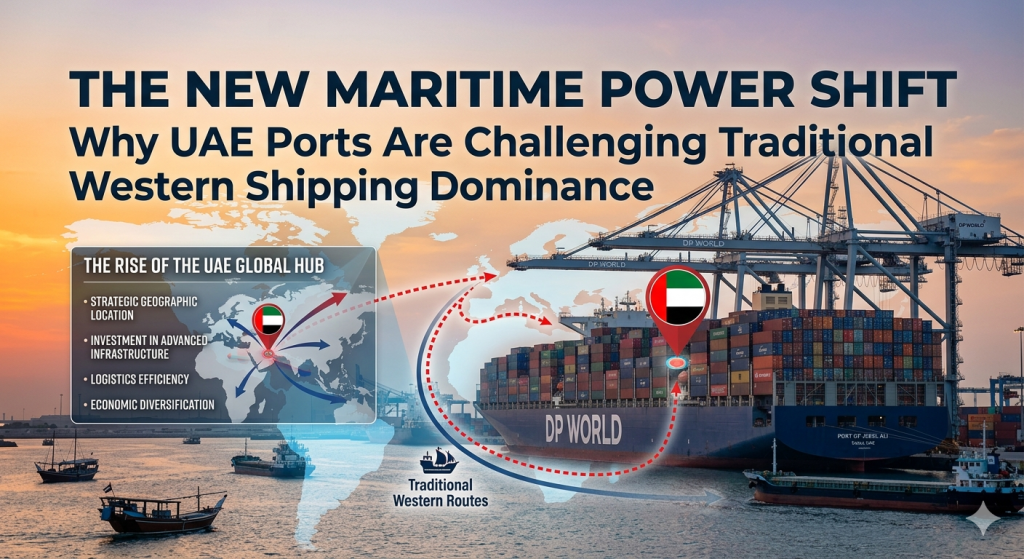
The structural migration of global maritime trade lanes toward United Arab Emirates (UAE) logistical hubs represents a critical risk-reallocation pivot that threatens traditional Western shipping dominance and introduces severe asset vulnerabilities. Institutional investors and corporate balance sheets utilizing legacy European and North American transit corridors face unprecedented exposure to catastrophic capital depreciation, compounding regulatory penalties, and exponentially inflating Parametric Insurance Premiums if they fail to recalibrate their supply-chain geography in 2026.
The Economic Impact: Institutional Balance Sheets under Siege
The contemporary maritime landscape is no longer governed by historical geographic inertia; it is governed by the cold, unforgiving metrics of corporate liquidity and downside asset protection. For institutional investors, sovereign wealth funds, and C-Suite executives across the USA, the UK, Singapore, and the GCC, the shift toward UAE ports—most notably Jebel Ali and the rapidly expanding Khalifa Port—is driven by a fundamental structural mismatch in Western maritime infrastructure and financial policy.
Western logistics networks, burdened by decades of underinvestment, systemic labor disputes, and aggressive regulatory overreach, are suffering a cascading contraction in return on investment (ROI). Conversely, the UAE has deployed immense sovereign capital injections to construct deeply integrated, automation-driven maritime ecosystems. These ports operate with unprecedented berth efficiency and provide an insulated sovereign jurisdiction that minimizes the threat of arbitrary asset freezes.
From a balance sheet perspective, the cost of maritime inertia has reached an existential tipping point. Operating an ocean-going fleet or relying on trans-Pacific and trans-Atlantic lanes now subjects corporate treasuries to extreme volatility in capital expenditures. When a vessel is delayed due to port congestion in northern Europe or labor strikes on the US East Coast, the daily demurrage and detention fees do not merely erode quarterly margins; they threaten the underlying debt covenants of the asset.
[Legacy Western Corridors] —> High Congestion + EU ETS Fines + JWC Surcharges —> Capital Erosion
[UAE Maritime Hubs] —> Automated Infrastructure + Sovereign Arbitration —> Margin Protection
Many modern fleets are leveraged utilizing complex tranches of Senior Secured Debt & Mezzanine Financing. These capital structures require highly predictable, uninterrupted cash flows to service debt obligations. A single prolonged disruption—whether driven by geopolitical flashpoints or infrastructural failures—can trigger technical defaults under loan agreements, enabling lenders to accelerate debt repayment and force restructuring scenarios.
Furthermore, the economic gravity has shifted due to the financialization of carbon emissions. Fleets transiting via Western hubs are hit with compounding operational penalties, whereas the UAE’s strategic investments in green bunkering infrastructure (such as ammonia and liquefied natural gas facilities) allow operators to optimize their fuel spend while mitigating punitive Western taxation.
For global commodity traders and supply chain directors, routed cargo through UAE ports provides an elegant financial hedge: it shortens transit times between the manufacturing centers of the Asia-Pacific region and the consumer markets of the West, thereby accelerating inventory turnover ratios and optimizing working capital efficiency. To ignore this macroeconomic shift is to willingly accept depressed asset yields and heightened vulnerability to unexpected financial shocks.
Navigating the 2026 Regulatory Minefield
Operating a maritime enterprise or financing ocean-going assets in 2026 requires navigating an incredibly complex web of overlapping regulatory frameworks, multinational sanctions regimes, and shifting insurance benchmarks. The legal friction points between Western jurisdictions and the emerging UAE-centric trade architecture are creating a legal minefield for compliance officers.
OFAC and Sanctions Evasion Protocols
First and foremost is the escalating enforcement posture of the US Department of the Treasury’s Office of Foreign Assets Control. OFAC Sanctions Compliance is no longer a matter of periodic screening; it requires real-time, forensic scrutiny of multi-layered ownership structures, ship-to-ship (STS) cargo transfers, and opaque maritime dark fleets.
Because the UAE maintains a non-aligned, plurilateral foreign policy, its ports naturally interface with a broader spectrum of international trade partners. This multi-alignment creates an inherent friction point with Western regulatory bodies.
If a vessel calls at a UAE port and unknowingly handles cargo connected to a sanctioned entity or an unverified beneficial owner, the entire corporate infrastructure faces catastrophic legal exposure. The financial penalties for non-compliance are severe, often accompanied by the immediate revocation of Western banking access, rendering the maritime enterprise structurally insolvent within hours.
+———————————————————————–+
| 2026 MARITIME REGULATORY MATRIX |
+———————————————————————–+
| Framework / Trigger | Operational & Financial Impact |
+————————–+——————————————–+
| OFAC Sanctions | Strict liability; risk of asset freezing |
+————————–+——————————————–+
| JWLA-032 Surcharges | 400% surge in hull war risk premiums |
+————————–+——————————————–+
| EU ETS Phase-In (Methane)| Punitive taxation on unmitigated slip |
+————————–+——————————————–+
| Red Sea AI Navigation | Uncharted liability for automated mishaps |
+———————————————————————–+
The Insurer’s Calculus: JWLA-032 and the JWC
Simultaneously, the London insurance market has radically adjusted its risk pricing models. The Joint War Committee (JWC) Circulars have undergone a series of urgent revisions in response to shifting geopolitical risk profiles across the Middle East and the Bab-el-Mandeb strait.
Specifically, the implementation of the JWLA-032 circular has fundamentally re-drawn the boundaries of listed war risk areas. The activation of JWLA-032 means that any vessel traversing or calling near these newly designated high-risk zones is subject to immediate, non-negotiable insurance surcharges.
The financial consequence is a stark divergence in operational costs: while legacy routes exposed to these zones face a 300% to 400% spike in Asset Seizure & Hull War Risk premiums, UAE ports have established localized sovereign insurance pools and robust naval security corridors to shield incoming tonnage from these crippling Western market surcharges.
Environmental Disclosures and EU ETS Overreach
On the environmental front, the compliance landscape is dominated by the aggressive expansion of the European Union Emissions Trading System (EU ETS) and the International Maritime Organization’s (IMO) 2026 decarbonization mandates. We are currently witnessing the formal implementation of the EU ETS Phase-In costs for methane slip and nitrous oxide emissions. Historical frameworks only penalized carbon dioxide emissions; however, the 2026 rules target unburned methane emissions from LNG-fueled vessels with punitive financial assessments.
This introduces an acute layer of ESG Disclosure Liability for publicly traded maritime conglomerates and institutional funds. Underwriters are now legally required to audit a fleet’s precise emissions profile, and failure to accurately disclose methane slip can lead to massive regulatory fines, corporate litigation, and a total loss of access to green capital markets.
By contrast, the UAE’s proactive development of next-generation, zero-emission bunkering infrastructure allows forward-thinking operators to significantly lower their carbon intensity indicators, bypassing the punitive financial gravity of the EU ETS.
Methane Slip / N2O Emissions (2026 Rules)
|—> Failure to Audit —> High ESG Disclosure Liability —> Capital Starvation
|—> UAE Green Bunkering -> Low Carbon Intensity Indicator -> Access to Capital
Automated Vulnerabilities: AI-Driven Navigation Liability
Compounding these regulatory headaches is the unquantified risk of AI-driven navigation liability in the Red Sea and surrounding littoral zones. To evade human error and combat asymmetric drone threats, many tier-1 operators have deployed autonomous, AI-guided piloting and threat-detection systems.
However, maritime law—specifically the traditional concepts of “seaworthiness” under the Hague-Visby Rules and standard BIMCO contractual clauses—is profoundly unequipped to handle algorithmic failures. If an AI navigation engine executes an evasive maneuver that results in a collision, grounding, or a breach of territorial waters, the legal system faces uncharted questions of liability.
Is the shipowner liable, or does the fault lie with the software developer? Until this legal ambiguity is resolved through high-stakes jurisprudence, standard P&I clubs are excluding autonomous navigation failures from standard coverage, leaving uninsured operators exposed to devastating third-party liability claims.
Strategic Recommendations: C-Suite Action Plan for 2026
To defend institutional capital against these escalating operational and regulatory headwind risks, Chief Executive Officers, Chief Risk Officers, and Managing Directors must immediately execute a proactive, three-tier maritime risk mitigation strategy.
1. Implement Multi-Jurisdictional Maritime Arbitration Structures
Corporate legal counsels must immediately cease relying exclusively on legacy Western legal venues, such as the High Court in London or New York maritime arbitration panels. Given the shifting center of global logistics gravity, contracts must be systematically redrafted to incorporate the Emirates Maritime Arbitration Centre (EMAC) or the Singapore International Arbitration Centre (SIAC) as the primary venues for dispute resolution.
This structural pivot significantly insulates the enterprise from localized Western judicial overreach, minimizes escalating Arbitration & Litigation Costs, and ensures that contract disputes are adjudicated by specialized maritime legal experts who understand the operational realities of modern Eurasian and GCC trade flows.
[Legacy Strategy] —> Exclusive reliance on London / NY Courts —> High Litigation Friction
[Forward Strategy] —> Structural pivot to EMAC / SIAC Clauses —> Optimized Dispute Resolution
2. Restructure Asset Financing to Decouple Geopolitical Risk
Chief Financial Officers must audit all existing fleet financing arrangements to ensure that debt covenants do not contain restrictive clauses tied to shifting Western insurance definitions. In light of the JWLA-032 circular, traditional bank financing lines may contain technical default triggers if a vessel enters a JWC-listed zone.
To mitigate this, financial teams should diversify their capital stack by blended integration of Western Senior Secured Debt & Mezzanine Financing with UAE-backed sovereign wealth funds and Islamic leasing structures (Ijara). Decoupling your asset financing from exclusive Western banking networks guarantees operational continuity and shields your fleet from arbitrary credit freezes during periods of heightened geopolitical tension.
3. Establish a Predictive Real-Time Sanctions & Emissions Auditing Cell
Compliance infrastructure must be upgraded from static, backward-looking check-the-box exercises to a predictive, real-time data fusion cell. This cell must continuously monitor AIS data, verify the beneficial ownership of all regional feeders, and forensically track methane slip signatures across all operational assets.
By actively managing your fleet’s compliance footprint, you structurally eliminate OFAC Sanctions Compliance vulnerabilities and insulate the corporate balance sheet from catastrophic ESG Disclosure Liability penalties.
The structural reconfiguration of global maritime corridors demands an equally sophisticated evolution in corporate risk management. Navigating the treacherous convergence of the JWLA-032 circular, volatile hull war risk environments, and complex multi-jurisdictional sanctions regimes is impossible utilizing standard commercial frameworks. Forward-thinking institutional investors and maritime operators must actively engage top-tier Professional Advisory Services to execute comprehensive legal audits and preserve supply chain integrity.
Furthermore, safeguarding highly leveraged maritime assets against sudden regulatory penalties or unforeseen navigational disruptions requires securing bespoke, next-generation Specialized Insurance Cover from elite global underwriting syndicates. In an era where maritime dominance has fundamentally shifted, retaining specialized legal, financial, and insurance counsel is the single most critical investment required to insulate your enterprise from catastrophic capital depreciation and ensure long-term balance sheet resilience.
Frequently Asked Questions (FAQ)
Q1: What specific changes did the JWLA-032 circular introduce to marine insurance pricing?
The issuance of the JWLA-032 circular by the Joint War Committee fundamentally expanded the designated “Listed Areas” across critical Middle Eastern transit corridors, specifically targeting the Red Sea, the Gulf of Aden, and adjacent maritime choke points. For hull underwriters, this circular serves as an official risk-escalation trigger.
Consequently, any vessel entering these coordinates must formally notify their insurer and pay a mandatory, highly volatile war risk additional premium (AP). The financial impact is immediate: it converts predictable operational expenditures into highly volatile, fluctuating liabilities, directly affecting the fleet’s net operating income and complicating debt-service capabilities under standard mezzanine financing agreements.
JWLA-032 Circular Activation
|
v
Expansion of “Listed Areas” (Red Sea / Gulf of Aden)
|
v
Mandatory War Risk Additional Premium (AP)
|
v
Net Operating Income Volatility & Debt-Covenant Strain
Q2: How does the 2026 EU ETS expansion alter the financial calculus of LNG-fueled fleets?
While LNG was historically championed as a cleaner transitional fuel to reduce carbon dioxide emissions, the 2026 expansion of the EU ETS introduces a punitive carbon-equivalent tax on methane slip (unburned methane escaping into the atmosphere) and nitrous oxide ().
Because methane possesses a global warming potential significantly higher than , even minimal slip percentages translate into immense carbon-equivalent financial penalties. Fleet operators transiting European waters are now forced to purchase expensive European Allowance (EUA) certificates to cover these emissions, drastically altering the ROI calculations for LNG tonnage and creating severe financial downside for investors who backed LNG-fueled fleet expansions without accounting for these specific regulatory alterations.
Q3: Why are traditional Western maritime arbitration venues losing favor compared to UAE alternatives?
For over a century, London and New York were the undisputed default jurisdictions for maritime contract disputes. However, the weaponization of Western financial systems, combined with ballooning Arbitration & Litigation Costs, has driven a major trust deficit among global maritime operators.
Venues like the Emirates Maritime Arbitration Centre (EMAC) offer several distinct institutional advantages: they provide a neutral, highly specialized, and efficient legal framework that operates under modern UNCITRAL model laws while remaining completely insulated from Western political interference or arbitrary asset seizure regimes. This allows international counter-parties to resolve high-stakes shipping disputes without exposing themselves to Western judicial overreach.
+————————————————————————-+
| ARBITRATION VENUE COMPARISON MATRIX |
+————————————————————————-+
| Feature / Metric | Western Venues (London/NY) | UAE Venues (EMAC) |
+————————+—————————-+——————-+
| Average Lifecycle Cost | Extremely High / Inflated | Optimized / Lean |
+————————+—————————-+——————-+
| Geopolitical Isolation | Vulnerable to Sanctions | Politically Neutral|
+————————+—————————-+——————-+
| Regulatory Agility | Slow / Bureaucratic | Rapid / Modern |
+————————————————————————-+
Q4: What is Parametric Insurance, and why is it becoming vital for UAE-bound cargo?
Traditional marine insurance relies on lengthy, highly litigious damage-assessment processes to prove actual physical loss, which can trap critical corporate capital in bureaucratic limbo for years after a maritime disaster. In contrast, Parametric Insurance Premiums fund a next-generation risk-transfer model.
Parametric policies are structured around objective, pre-agreed triggers—such as a specific duration of port closure, a localized geopolitical kinetic event, or verified wind speeds in a shipping lane. Once the data confirms the metric has been breached, the policy executes an automatic, instantaneous payout to the insured party, entirely bypassing the claims-adjustment phase. For operators utilizing high-throughput UAE hubs, parametric coverage guarantees immediate liquidity, preserving corporate cash flows when regional disruptions occur.
Q5: How do modern “Dark Fleets” complicate OFAC Sanctions Compliance for legitimate operators?
The rapid proliferation of the maritime “dark fleet”—vessels operating with deactivated AIS transponders, fraudulent flag registrations, and complex shell-company ownership networks designed to bypass Western energy price caps—has contaminated the broader maritime supply chain. Legitimate operators calling at major global transshipment hubs like Jebel Ali run an elevated risk of inadvertent contamination.
If a legitimate fleet operator unwittingly engages a bunkering barge, a local feeder service, or a ship-to-ship transfer provider that has back-end financial links to dark fleet capital, that operator can be flagged for a strict-liability violation of Western sanctions. This exposure makes comprehensive, real-time forensic auditing of every regional maritime service provider a non-negotiable operational prerequisite.
Dark Fleet Contamination Path:
[Opaque Shell Company] -> [Local Feeder / Bunkering Barge] -> [Legitimate Fleet Operator] -> [OFAC Violation Trigger]
Q6: What specific financial threats do asset seizure clauses pose to leveraged shipping assets?
Most ocean-going vessels are heavily leveraged, with capital stacks split between traditional commercial banks providing senior debt and institutional funds holding mezzanine debt tranches. These highly complex financial instruments contain strict “Material Adverse Effect” (MAE) and asset impairment clauses.
If a vessel is seized, detained, or blocked by a foreign power due to regional regulatory disputes or a breach of international sanctions, the asset’s value drops to zero on the balance sheet for the duration of the detention. This immediately breaches the loan-to-value (LTV) covenants stipulated in the financing agreements. Lenders retain the absolute legal right to declare an immediate default, seize collateral, foreclose on the remaining fleet, or liquidate the operating company to protect their principal capital.
7. Key Performance Indicators: Structural Vulnerability Assessment
To assist C-Suite executives in rapidly evaluating their current exposure to these shifting global maritime dynamics, the following analytical checklist highlights the critical financial and legal vulnerabilities that must be audited immediately.
[ ] Total Fleet Exposure to JWC Listed Areas (JWLA-032 Boundaries)
[ ] Percentage of Debt Covenants Tied Exclusively to Western Banking Systems
[ ] Real-Time Auditing Capabilities for Methane Slip & Nitrous Oxide Emissions
[ ] Percentage of Maritime Contracts Lacking Dedicated Local Arbitration Clauses (e.g., EMAC)
[ ] Verification and Due Diligence Protocols for Regional Transshipment Partners
By systematically addressing each point in this assessment matrix, institutional investors and maritime executive boards can transition their global supply chains away from legacy structural risks, successfully leveraging the immense capital, infrastructural efficiency, and geographic advantages offered by the emerging UAE maritime ecosystem.
Recent Comments