
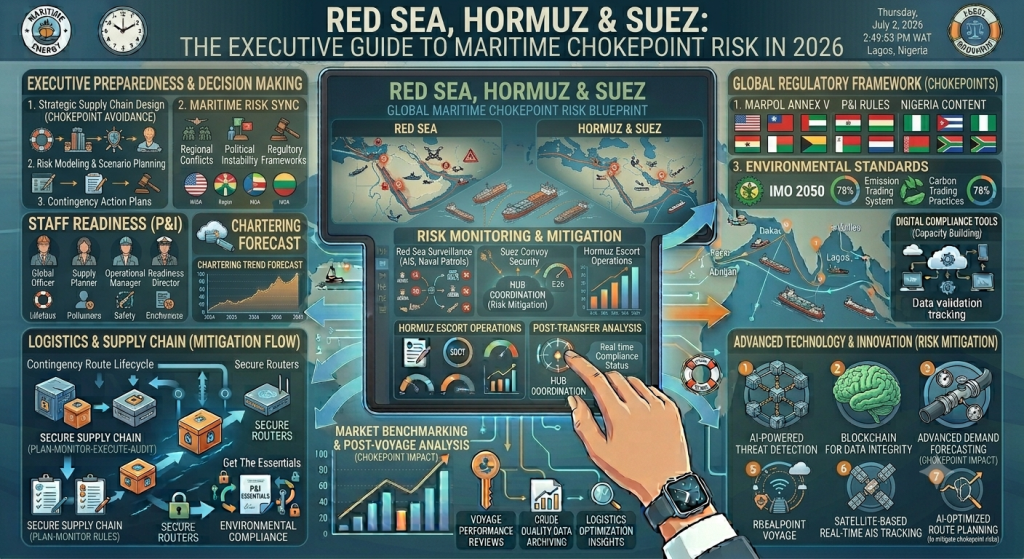
The rapid escalation of geopolitical friction across the Red Sea, Strait of Hormuz, and Suez Canal has fundamentally transformed global maritime bottlenecks from standard operational delays into severe capital threats. For institutional asset managers and corporate boards, navigating these volatile trade corridors in 2026 demands aggressive liability mitigation strategies to protect balance sheets against sudden vessel seizures, punitive regulatory penalties, and escalating risk transfer costs.
Balance Sheet Vulnerabilities and Return on Investment (ROI)
The optimization of global supply chains has historically relied on the unhindered transit of the world’s primary maritime arteries. In 2026, this paradigm is completely dead. For institutional investors holding allocations in shipping tonnage, or corporate entities relying on just-in-time supply chains across the USA, UK, UAE, and Singapore, chokepoint disruption is a direct threat to corporate liquidity.
When a trade lane like the Southern Red Sea or the Strait of Hormuz experiences kinetic hostility or state-backed interdiction, the financial consequences register across the capital stack immediately. Vessels forced to divert around the Cape of Good Hope add 10 to 14 days to a standard Asia-to-Europe voyage, instantly inflating fuel expenditures and operating expenses (OPEX).
[Chokepoint Disruption]
│
├──> Cape of Good Hope Diversion (10-14 Extra Days) ──> Massive OPEX Spike
│
└──> Extended Transit Time ──> Distorts Asset Valuation & Multipliers
This extended transit time drastically reduces the velocity of capital, tying up inventory in prolonged voyages and altering asset valuation models. If a ship finance vehicle relies on steady, predictable cash flows from a fleet of ultra-large container vessels (ULCVs) or very large crude carriers (VLCCs), a sudden rerouting distorts the asset-level debt service capabilities.
Capital Structure Distortions
For entities utilizing layered financing structures, including Senior Secured Debt & Mezzanine Financing, prolonged operational disruptions or sudden route exclusions can trigger technical defaults. If net operating income collapses because of unhedged route deviations or localized asset idleness, debt service coverage ratios (DSCR) easily fall below mandatory lender covenants.
┌──> Senior Secured Debt (Strict DSCR Covenants)
Voyage OPEX Inflates ───┐ │
+ Insurance Premiums ├───┼──> Mezzanine Financing (Subordinated Cash Squeeze)
+ EU ETS Methane Tax │ │
└──> Technical Default Risk Triggered
Mezzanine lenders, occupying a subordinated position in the capital stack, face immediate cash flow squeezes when primary cash flows are cannibalized by unexpected operational costs. Furthermore, prolonged asset idleness caused by mechanical blockades or crew safety standstills reduces the terminal residual value of the vessel, challenging the underlying loan-to-value (LTV) ratios that secure institutional capital.
The Compliance, Legal, and Underwriting Framework
Operating in high-risk corridors requires navigating an intricate web of international regulations, economic sanctions, and strict underwriting guidelines. Failing to monitor these frameworks can expose boards to severe regulatory fines and catastrophic litigation.
Sanctions Compliance and Asset Security
The enforcement landscape for international shipping has never been more aggressive. Boards must maintain absolute OFAC Sanctions Compliance to avoid crippling penalties from the US Department of the Treasury. Modern gray-market networks and state-sponsored maritime interdictions in the Strait of Hormuz frequently utilize complex corporate masking strategies.
If a vessel inadvertently handles cargo tied to blocked entities, or engages in bunkering operations at ports connected to sanctioned regimes, the entire corporate entity risks being shut out from the Western banking system. The legal reality of an Asset Seizure & Hull War Risk scenario means that if a nation-state or hostile faction boards and detains a vessel, the owner’s equity can be wiped out in hours, leaving the corporate shell liable for outstanding cargo commitments.
The Joint War Committee Mandate
The pricing of maritime risk in these choke points is dictated by the structural updates issued by London’s underwriting community. The transition from general risk metrics to specific geographical restrictions is governed explicitly by the latest Joint War Committee (JWC) Circulars.
Critical Risk Advisory: The implementation of the JWLA-032 circular expanded the designated “Listed Areas” for Hull War, Piracy, and Terrorism to explicitly include broader bands of the Indian Ocean, the Gulf of Aden, and the Southern Red Sea south of Latitude 18°N.
Anadolu Sigorta
This update removes standard spatial grace periods for passing ships. Entering these expanded zones without notifying underwriters in advance triggers an immediate breach of standard hull policies. It forces operators onto high daily breach premiums or completely invalidates the hull and machinery (H&M) coverage.
[Vessel Crosses Latitude 18°N]
│
└──> Triggers JWLA-032 Listed Area Mandate
│
├──> Immediate Breach of Standard Hull Policy
└──> Forces Daily Premium Spikes or Total Coverage Invalidation
The 2026 Environmental Liability Landscape
Compounding these geopolitical pressures is the full phase-in of maritime environmental taxes. As of January 1, 2026, the European Union Emissions Trading System (EU ETS) has reached its 100% compliance threshold for cargo and passenger ships over 5,000 GT calling at EU/EEA ports.
Marine Inspection+ 1
Importantly, the scope has expanded beyond carbon dioxide () to include methane (
) and nitrous oxide (
).
Normec Verifavia

For alternative-fueled fleets, particularly those utilizing Liquified Natural Gas (LNG), the EU ETS Phase-In costs for methane slip represent a major balance sheet line item. Methane slip—the escape of unburnt methane through the engine exhaust—carries a global warming potential 28 times higher than carbon dioxide. Under the 2026 mandate, default engine slip factors can account for nearly 25% of a vessel’s total ETS allowance liability unless actual, verified lower slip rates are independently proven.
Normec Verifavia+ 1
[Default Methane Slip Factor Applied] ──> Inflates Reported CO2e by up to 28x ──> +25% Surge in Annual EUA Liability
When chokepoint threats force an LNG-powered vessel to take an extended route around Africa to safely reach an EU port, the combined weight of extra miles and the 2026 methane penalty can quickly turn a profitable voyage into a major financial loss. This reality elevates ESG Disclosure Liability to a board-level concern; misrepresenting actual engine slip profiles or failing to accurately account for the expanded emissions footprint during route deviations leaves public companies vulnerable to greenwashing lawsuits and regulatory enforcement actions.
AI-Driven Navigation and Maritime Law
To bypass traditional human errors in high-stress, contested waterways like the Red Sea, many fleet operators have turned to automated, algorithmic voyage plotting. However, AI-driven navigation liability in the Red Sea has created a fresh wave of maritime disputes.
When autonomous collision-avoidance algorithms or electronic chart systems reroute a vessel directly into high-risk zones, or miscalculate electronic jamming signals deployed near chokepoints, the shipowner cannot simply blame the software vendor. Under long-standing Admiralty law and standard charterparty terms, the shipowner bears an absolute, non-delegable duty to provide a seaworthy vessel with a competent crew.
Algorithmic errors that lead to close-quarters situations, groundings, or entering hostile waters fall squarely on the owner’s balance sheet. This exposes them to immense Arbitration & Litigation Costs when cargo owners, charterers, and hull underwriters dispute who is responsible for the losses.
Strategic Recommendations for the C-Suite
To shield institutional capital from the compounding operational and regulatory pressures of 2026 trade corridors, executive management must pivot from defensive positioning to aggressive, structural risk management.
I. Restructure Debt Covenants and Financing Tranches
C-suite executives must proactively audit all existing Senior Secured Debt & Mezzanine Financing frameworks. Standard financing agreements must be updated to include specific “Geopolitical Force Majeure” and “Regulatory Variance” buffers. Ensure that temporary drops in the debt service coverage ratio caused by mandatory JWC route diversions do not trigger automatic acceleration of debt repayments or transfer equity control to junior lenders.
II. Transition to Verified Slip Tracking and Dynamic Route Pricing
To counteract the financial impact of the 2026 EU ETS methane and nitrous oxide expansions, fleet directors must phase out conservative default emissions assumptions. Implement continuous onboard emissions monitoring systems to document actual, load-dependent tank-to-wake methane slip. By replacing standard regulatory defaults with verified, lower empirical slip numbers, operators can reduce their required EU Allowances (EUAs) by hundreds of thousands of dollars per voyage when navigating long alternative trade routes.
Gasum
III. Deploy Dual-Trigger Risk Transfer Instruments
Incorporate flexible insurance strategies that move away from traditional indemnification processes. By implementing customized insurance structures, organizations can build immediate liquidity backstops that pay out automatically based on objective, third-party data points.
[Geopolitical / Regulatory Trigger Verified] ──> Automatic Claim Payout ──> Injects Immediate Operational Liquidity
Strategic Risk Transfer and Custom Financial Protections
Managing maritime chokepoints requires a shift from passive risk tolerance to structured risk allocation. In an era where a single regulatory mistake or regional conflict can disrupt global supply chains, generic insurance policies are no longer sufficient. Protecting institutional capital requires sophisticated advisory and highly specialized financial instruments tailored to the realities of 2026.
┌────────────────────────────────────────────────────────────────────────┐
│ TOTAL ENTERPRISE RISK PROTECTION │
├───────────────────────────────────┬────────────────────────────────────┤
│ FINANCIAL DE-RISKING │ COMPLIANCE & LEGAL SECURE │
├───────────────────────────────────┼────────────────────────────────────┤
│ • Parametric Insurance Premiums │ • OFAC Sanctions Compliance Audit │
│ • Hull War Risk Underwriting │ • ESG Disclosure Liability Defense │
│ • Capital Stack Covenant Buffers │ • Arbitration Dispute Shield │
└───────────────────────────────────┴────────────────────────────────────┘
Modern risk management benefits significantly from the growth of Parametric Insurance Premiums. Unlike classic indemnity policies that require months of adjusters calculating physical damage or lost business income, parametric contracts trigger automatic payouts based entirely on verifiable data points. For instance, if the Joint War Committee expands a listed area past a specific latitude, or if commercial transit volumes through a key canal drop below a set threshold for consecutive days, the policy pays out automatically.
This injects immediate liquidity into an operator’s accounts, helping to offset the sudden costs of route diversions, premium hikes, or brief asset detentions. Partnering with elite underwriters allows corporate boards to turn unpredictable regional threats into clear, manageable line items, ensuring long-term fiscal stability.
Frequently Asked Questions (FAQ)
How does the JWC JWLA-032 circular specifically change insurance requirements for commercial vessels?
The JWLA-032 circular updates the geographic definitions of high-risk waters, specifically expanding the monitored boundaries in the Indian Ocean, Gulf of Aden, and Southern Red Sea. For shipowners and charterers, this means any transit through these defined waters requires mandatory, timely notification to hull underwriters. Failure to report these transits instantly breaches standard navigation warranties, nullifying standard Hull and Machinery (H&M) cover and leaving the asset owner directly liable for all losses.
What are the immediate balance sheet consequences of a vessel being detained in a chokepoint?
A vessel detention triggers immediate losses across multiple layers of the business. Beyond the physical security of the asset and crew, it halts all voyage revenue while fixed operating costs (OPEX) continue to accumulate.
From a balance sheet perspective, a prolonged detention can lead to a formal declaration of constructive total loss under Asset Seizure & Hull War Risk policies. This can trigger cross-default clauses within senior debt facilities, damage corporate credit ratings, and invite costly cargo non-delivery lawsuits.
How do the 2026 EU ETS updates affect vessels that bypass volatile chokepoints by taking longer alternative routes?
The 2026 expansion of the EU ETS mandates 100% allowance surrenders for greenhouse gas emissions (,
, and
) on voyages touching EU/EEA ports. Bypassing a chokepoint via a longer route significantly increases fuel consumption, which directly drives up the required number of EU Allowances (EUAs) that must be purchased. For fleets utilizing LNG or conventional marine fuels, these extra miles carry heavy penalties for methane slip and nitrous oxide emissions, adding substantial unbudgeted costs to the voyage.
Who bears the legal liability when an AI-driven navigation system steers a ship into an active conflict zone?
Legal liability rests firmly with the registered shipowner. Under long-standing maritime law and standard BIMCO contract templates, the owner holds a non-delegable duty to maintain a seaworthy vessel and ensure safe navigation.
While an automated navigation system provides operational support, any failure by the algorithm to properly identify electronic warfare risks, GPS spoofing, or updated JWC restrictions is legally viewed as a failure of proper oversight. This exposes the owner to significant cargo claims and litigation costs.
Can parametric insurance cover the losses associated with supply chain delays around the Cape of Good Hope?
Yes. Unlike traditional marine policies that require physical hull damage to trigger a claim, parametric coverage pays out based on objective metrics. Corporate entities can structure policies that trigger automatically when a vessel’s transit time between two designated ports exceeds a specific number of days, or when regional transit data confirms a mandatory route deviation. The pre-agreed payout provides rapid liquidity to cover increased fuel costs, crew overtime, and contract penalties.
Speak with a Senior Risk Consultant about securing specialized hull war cover.
Yes…contact oithamarine.com
Recent Comments