
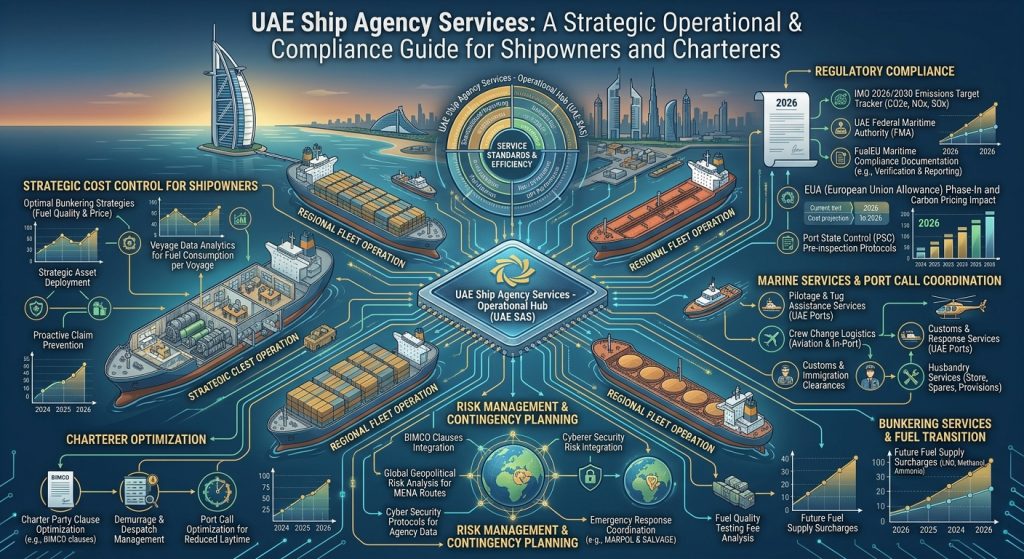
Executing a port call across the United Arab Emirates (UAE) requires navigating complex operational, regulatory, and financial considerations. With major maritime gateways such as Jebel Ali (DP World), the Port of Fujairah, Khalifa Port (AD Ports Group), and Mina Saqr, the UAE serves as the primary trade and bunkering hub in the Middle East.
For shipowners, ship managers, charterers, and operators, selecting a reliable UAE ship agency service is more than an administrative necessity—it is a core risk-management decision. A poorly executed agency assignment can lead to costly port stay delays, unexpected Proforma Disbursement Account (PDA) cost overruns, customs disputes, or non-compliance with strict regulatory frameworks.
This guide provides a commercial and technical breakdown of ship agency operations in the UAE. It covers agency appointment structures, regulatory compliance, port clearance protocols, protective agency management, and disbursement cost optimization.
Executive Summary: Strategic Agency Governance in UAE Ports
- Agency Appointment Mechanics: Port agency functions in the UAE are broadly divided into Full Cargo Agency (appointed by the charterer or party paying port dues) and Owner’s Protective Agency (OPA) / Husbandry Agency (appointed directly by the shipowner to safeguard asset interests, crew changes, and technical supply chains).
- Federal Maritime Regulatory Oversight: All maritime operations, port calls, and agency licensing within the country are governed by the UAE Ministry of Energy and Infrastructure (MOEI) under Federal Decree-Law No. 43 of 2023 on Maritime Law, enforced locally alongside specific port authority bylaws (e.g., DP World, AD Ports Group, Fujairah Port Authority).
- Customs and E-Clearance Automation: Port clearances, crew sign-on/sign-off visas, and cargo manifests are processed digitally via systems like Dubai Trade, Mena Port Community System (AD Ports), and local immigration portals. Inaccurate manifest filings incur strict statutory fines and vessel detention.
- Financial Management & Currency Dynamics: Disbursement accounts are officially calculated in United Arab Emirates Dirhams (AED), pegged to the US Dollar at a fixed rate of 1 USD = 3.6725 AED. Most international agency transactions are settled in USD via advance funding, requiring pre-call auditing of local tariff items.
The Core Functions of a UAE Ship Agent
A ship agent acts as the legal representative of the vessel master, owner, or charterer during a port call or off-port-limits (OPL) operation. The scope of work ranges from pre-arrival notification filings to cargo supervision and final port disbursement accounting.
UAE PORT CALL OPERATIONS
│
┌──────────────────────────┴──────────────────────────┐
▼ ▼
FULL CARGO AGENCY OWNER’S PROTECTIVE AGENCY (OPA)
(Appointed by Charterer) (Appointed by Shipowner)
│ │
├── Cargo Documentation & Manifesting ├── Crew Sign-on / Sign-off & Visas
├── Berth Application & Tonnage Dues ├── Technical Spare Parts Customs Clearance
├── Stevedoring & Terminal Liaison ├── Bunker Coordination & Fuel Sampling
├── Customs Inward / Outward Clearance ├── Cash to Master (CTM) Delivery
└── Terminal Load/Discharge Monitoring └── Class Surveyor & Repair Support
1. Port Health, Immigration, and Customs Clearance
Before entering UAE territorial waters (12 nautical miles), the agent must submit a mandatory Pre-Arrival Notice (PAN) to local port authorities and the Federal Authority for Identity, Citizenship, Customs and Port Security (ICP). Required filings include:
- Certificate of Registry & International Tonnage Certificate (ITC-69)
- International Ship and Port Facility Security (ISPS) Pre-Arrival Information
- Crew List & Passenger List (including passport details, rank, and seaman book numbers)
- Last Port Clearance Certificate
- P&I Club Certificate of Entry & Hull War Risk Coverage
- Cargo Manifest & Bill of Lading Copies
Failure to submit complete documentation at least 48 to 72 hours prior to arrival (depending on port-specific rules) can result in delayed pilotage allocation or anchoring outside port limits at the owner’s expense.
2. Cargo Operations & Terminal Coordination
For liner, bulk, container, and liquid bulk vessels, the agent manages communication between the vessel master and port stevedores, terminal planners, and cargo receivers. This includes monitoring load/discharge rates, processing Statement of Facts (SOF), issuing Mate’s Receipts, and coordinating with cargo surveyors to minimize port stay duration and prevent demurrage disputes.
3. Husbandry & Crew Logistics
For non-cargo calls—such as bunkering at Fujairah anchorage, drydocking in Dubai Maritime City / Drydocks World, or lay-up operations—husbandry services represent the primary operational focus:
- Crew Changes: Processing OK-To-Board approvals, shore passes, transit visas, airport transfers (via Dubai International Airport DXB or Sharjah International Airport SHJ), and seafarer medical care.
- Ship Spares in Transit: Receiving landed airfreight, clearing customs under transit status, and arranging launch boats or berth side delivery.
- Bunker Coordination: Liaising with licensed local marine fuel suppliers, arranging barge berthing, and facilitating independent fuel sampling and quantity verification.
Comparing Port Agency Structures: Full Agency vs. OPA vs. Husbandry
Understanding the commercial distinctions between agency structures is vital when negotiating charter party terms (e.g., Gencon, NBO, or BIMCO standard forms).
| Feature / Scope | Full Cargo Agent | Owner’s Protective Agent (OPA) | Husbandry Agent |
| Appointing Party | Charterer / Cargo Interest | Shipowner / Ship Manager | Shipowner / Vessel Operator |
| Primary Loyalty | Charterer’s Commercial Operation | Shipowner’s Financial & Legal Interests | Technical Fleet Operations & Crew |
| Main Responsibilities | Berthing, cargo manifest, terminal dues, cargo documentation | Auditing cargo agent PDA, safeguarding laytime, monitoring SOF | Crew changes, spares delivery, Cash to Master, provisions |
| Disbursement Account | Pays primary statutory port dues and wharfage | Collects separate owner-expense disbursements | Manages operational Husbandry Disbursement Account (HDA) |
| Conflict Potential | High if charterer & owner dispute SOF/laytime | Zero—acts strictly as owner’s watchdog | Zero—handles non-cargo operational logistics |
The Value of Owner’s Protective Agency (OPA) in the UAE
When a charterer appoints the charterer’s nominated agent under a “Charterer’s Agent” clause in a voyage charter party, that agent’s primary commercial duty lies with the charterer. In complex calls—such as liquid bulk discharges at Jebel Ali or dry bulk handling at Mina Saqr—disagreements frequently arise regarding:
- Exact time of Notice of Readiness (NOR) tendering vs. acceptance
- Calculation of rain delays, equipment breakdowns, or berth congestion in the Statement of Facts
- Overcharging or misallocation of port fees between owner and charterer accounts
Appointing an independent Owner’s Protective Agent (OPA) ensures that an objective third party monitors the main agent, verifies laytime entries, inspects cargo condition, and audits the final Disbursement Account before the shipowner releases payment.
Regulatory and Compliance Framework Governing UAE Maritime Ports
Operating in UAE waters requires strict adherence to international maritime conventions, federal laws, and local port regulations.
UAE MARITIME REGULATORY COMPLIANCE MATRIX
┌─────────────────────────────────────────────────────────┐
│ UAE Ministry of Energy & Infrastructure (MOEI) │
└───────────────────────────┬─────────────────────────────┘
│
┌────────────────┴────────────────┐
▼ ▼
┌──────────────────────┐ ┌──────────────────────┐
│ International IMO │ │ Local Port Authority │
│ Standards │ │ Bylaws │
├──────────────────────┤ ├──────────────────────┤
│ * MARPOL Annex I-VI │ │ * DP World Regulations│
│ * SOLAS & ISPS Code │ │ * AD Ports Rules │
│ * STCW & MLC 2006 │ │ * Fujairah Port Rules│
└──────────┬───────────┘ └──────────┬───────────┘
│ │
└────────────────┬───────────────┘
▼
┌─────────────────────────────────────────────────────────┐
│ Mandatory Agent Verification & Pre-Clearance (PAN) │
└─────────────────────────────────────────────────────────┘
1. Environmental Regulations (MARPOL & Decarbonization)
- Sulfur Cap Compliance: The UAE enforces the global IMO 0.50% sulfur cap for marine fuels. Ships using open-loop scrubbers face local port restrictions in certain jurisdictions (e.g., Fujairah permits scrubber washwater discharge under specific environmental conditions, whereas other UAE terminals mandate closed-loop operation or low-sulfur fuel oil).
- Ballast Water Management (BWM): Vessels arriving in UAE ports must comply with the IMO Ballast Water Management Convention (D-2 standard). Unmanaged ballast water exchange inside Gulf waters is strictly prohibited.
- Waste Disposal & Reception Facilities: Sludge, oily bilge water, and garbage landing must be coordinated via licensed port waste collection contractors, with official disposal certificates issued prior to outward clearance.
2. Sanctions Compliance & Vessel Tracking
Given the geopolitical position of the Arabian Gulf, UAE port authorities and agency companies enforce strict OFAC, EU, and UN sanctions compliance checks. Port agents are legally required to verify:
- Vessel AIS transmission history (flagging unexplained AIS dark periods)
- Ultimate Beneficial Ownership (UBO) against global sanctions databases
- Price-cap compliance documentation for crude oil and petroleum product cargoes
An agency will decline representation or refuse to process port clearance for vessels exhibiting suspicious ship-to-ship (STS) transfer histories or unverified insurance coverage.
Port Disbursement Account (PDA) Management and Cost Breakdown
Managing port costs requires analyzing the Proforma Disbursement Account (PDA) provided by the agent prior to the call, followed by a thorough audit of the Final Disbursement Account (FDA) after departure.
Typical Components of a UAE Port Call Cost Structure
- Navigational Dues: Light dues, port dues, buoyage, and environmental levies assessed on Gross Tonnage (GT).
- Marine Services: Compulsory pilotage, tugboat assistance (billed per hour/horsepower), line-handling, and launch services.
- Berthage and Quay Dues: Charged per meter of Vessel Overall Length (LOA) per hour or fraction thereof alongside the berth.
- Cargo Handling Costs: Stevedoring, crane hire, hatch cover handling, and wharfage (if payable by the vessel under the charter terms).
- Regulatory & Administrative Fees: Customs clearance, port health inspection, ISPS security charges, and immigration processing.
- Agency Fee: The agent’s professional remuneration, charged as a flat fee or scaled according to call length and operational complexity.
Illustrative PDA Model: Tanker Call at Jebel Ali vs. Bunkering at Fujairah OPL
The following breakdown illustrates general cost allocation across two distinct operational scenarios in the UAE.
TYPICAL PDA COST DISTRIBUTION (ESTIMATED ALLOCATION)
==========================================================================
BERTHED CARGO CALL (e.g., Jebel Ali)
[Marine & Berthage Dues: ~55%] [Cargo/Wharfage: ~25%] [Agency & Admin: ~20%]
OFF-PORT-LIMITS CALL (e.g., Fujairah OPL)
[Port Dues & Anchorage: ~45%] [Launch & Logistics: ~35%] [Agency & Husbandry: ~20%]
==========================================================================
| Cost Category | Berthed Liquid Bulk Call (approx. 50,000 GT) | OPL Bunkering & Husbandry Call (approx. 50,000 GT) |
| Port / Tonnage Dues | High (based on GT and berth hours) | Moderate (based on OPL anchorage scale) |
| Pilotage & Towage | High (compulsory multi-tug operations) | Zero (no pilotage/tug required outside port) |
| Berthage / Quay Fees | High (hourly rate per meter LOA) | Zero |
| Launch Hire Charges | Low / Optional | High (crew/stores boat transfer to anchorage) |
| Immigration & Visas | Standard per seafarer rate | Standard per seafarer rate |
| Agency Professional Fee | Higher (reflects cargo supervision) | Lower (reflects husbandry focus) |
Disclaimer: Operational costs vary widely based on individual vessel GT, actual hours alongside, port authority tariff revisions, tug utilization, and specific cargo handling scope. Official tariffs are published independently by DP World, AD Ports Group, and Fujairah Port Authority.
How Shipowners Can Optimize Agency Costs and Prevent Port Delays
- Conduct Pre-Arrival PDA Audits
Compare Against Published Port Tariffs
Require your port agent to submit an itemized Proforma Disbursement Account (PDA) referencing official port authority tariff line items. Audit marine dues, tug hour estimates, and pilotage surcharges before transferring advance funds.
- Appoint Independent OPA Representation
Safeguard Laytime and SOF Accuracy
On charterer-agent calls, appoint a dedicated Owner’s Protective Agent (OPA) to independently track Notice of Readiness (NOR) acceptance, weather delays, and cargo loading rates in the Statement of Facts (SOF).
- Consolidate Husbandry Requirements
Bundle Crew and Supply Transfers
Combine crew sign-on/sign-off, spare parts delivery, fresh water bunkering, and hull inspections into a single operational window to minimize launch hire fees and anchorage day rates.
Oitha Marine Support Services
Navigating UAE port agency operations, charter party execution, and marine logistics requires an experienced partner who understands both local port dynamics and international shipping standards.
Oitha Marine provides comprehensive marine and chartering support services across global trade routes, including:
- Ship Agency & Husbandry Coordination: Expert oversight of port agency appointments, independent PDA auditing, and vessel husbandry management.
- Ship Chartering & Brokerage: Professional brokerage services connecting charterers and shipowners across dry cargo, liquid bulk, and specialized tonnage segments.
- Marine Logistics & Supply Chain Support: Coordination of technical spares in transit, offshore supply boat chartering, and crew transfer logistics.
- Bunker Management & Operational Consulting: Practical guidance on fuel procurement schedules, OPL operations, and port compliance strategies.
Contact Oitha Marine today to discuss your vessel requirements, request port agency guidance, or explore chartering solutions for your fleet.
Frequently Asked Questions
What is the role of a ship agent in UAE ports?
A ship agent acts as the legal and operational representative of the shipowner, charterer, or vessel master during a port call. The agent handles statutory port clearances, liaises with port authorities and customs, arranges pilotage and tugs, coordinates crew logistics and husbandry, and manages the collection and payment of port disbursements.
What is the difference between a Full Cargo Agent and an Owner’s Protective Agent (OPA)?
A Full Cargo Agent is usually nominated by the charterer to manage cargo operations, berthing, and terminal documentation. An Owner’s Protective Agent (OPA) is appointed directly by the shipowner to supervise the call, safeguard the owner’s legal and financial interests, monitor laytime recording, and audit the primary agent’s disbursement account.
How are port agency fees structured in the UAE?
Agency fees are charged as a professional service fee per port call or per day, based on the vessel type, Gross Tonnage (GT), and scope of work (cargo operation vs. husbandry/OPL call). These fees are separate from statutory port dues, pilotage, and terminal tariffs billed by port authorities.
What documents are required for vessel clearance in UAE ports?
Key documents include the Certificate of Registry, International Tonnage Certificate (ITC-69), Pre-Arrival Notice (PAN), Crew and Passenger Lists, Last Port Clearance, Cargo Manifest, Bill of Lading, ISPS Information, and valid P&I / War Risk Cover certificates.
How long does crew change clearance take at UAE anchorage locations like Fujairah?
Crew changes at anchorage generally require 24 to 48 hours of advance notice to process transit visas, seafarer shore passes, and port health approvals. Once OK-To-Board letters are issued, crew transfers via launch boat typically take a few hours depending on weather and anchorage distance.
Who pays port charges under a voyage charter versus a time charter?
Under a Voyage Charter, the shipowner generally pays all standard port charges, pilotage, and towage unless specific charter party clauses (e.g., Free In/Out) shift certain cargo-handling dues to the charterer. Under a Time Charter, the charterer pays for port dues, pilotage, tugs, berthage, and fuel, while the owner pays for vessel crew expenses and husbandry.
Are open-loop scrubbers permitted in all UAE ports?
Scrubber regulations vary by local port authority in the UAE. While some ports allow open-loop scrubber washwater discharge subject to strict monitoring standards, others mandate that vessels switch to closed-loop mode or burn compliant low-sulfur fuel oil (VLSFO / MGO) while within port limits.
What currency is used to settle Port Disbursement Accounts in the UAE?
Official port tariffs are denominated in United Arab Emirates Dirhams (AED). However, because the AED is pegged to the US Dollar (1 USD = 3.6725 AED), most international shipowners settle PDAs directly in US Dollars via international bank transfers.
Recent Comments