
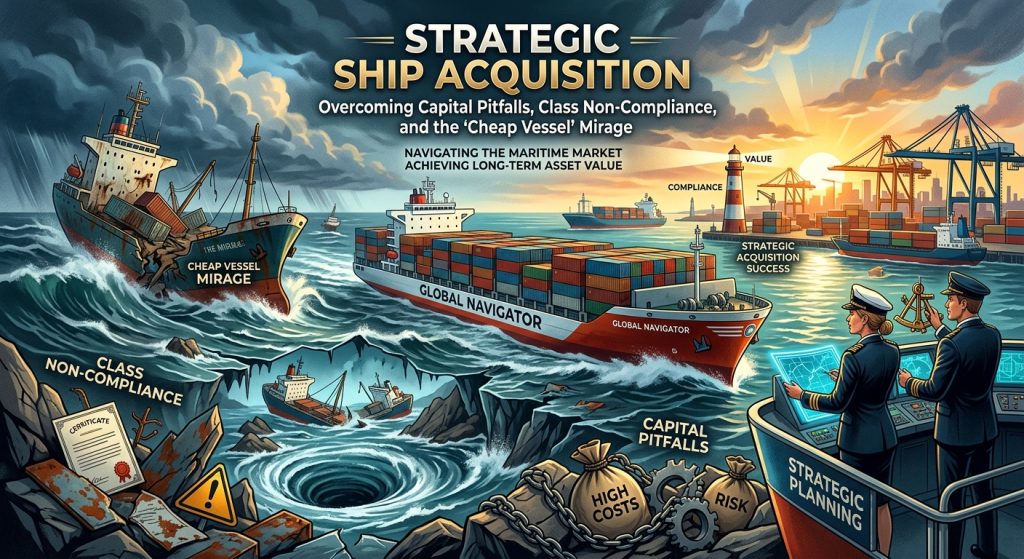
Vessel acquisition is one of the most capital-intensive choices an executive, shipowner, or maritime consortium will ever make. Whether buying an Anchor Handling Tug Supply (AHTS) vessel, a product tanker, or a offshore support vessel (OSV), the capital outlay represents only the entry point into a matrix of maritime finance, class compliance, and operational economics.
Across global maritime markets—and particularly within regional offshore sectors such as West Africa—buyer performance is undermined by a repeating error: purchasing a vessel based on low initial acquisition cost rather than Total Cost of Ownership (TCO) and operational compliance.
When capital expenditure (CapEx) decisions prioritize cheap hull prices over class status, drydock history, and engine condition, shipowners frequently encounter massive cost overruns. A “discount” $2.5 million vessel can rapidly accumulate $4 million in reactivation, steel replacement, and Class survey fees before ever earning its first day-rate.
Understanding these structural mechanics helps identify why the initial purchase price is often deceptive, how financing mechanisms like Nigeria’s Cabotage Vessel Financing Fund (CVFF) are impacted by poor selection, and how Oitha Marine provides end-to-end advisory services to safeguard maritime investments.
Federal Ministry of Information and National Orientation
1. The “Cheap Vessel” Illusion: Why Low CapEx Equals Astronomical OpEx
In ship sales and purchase (S&P), distress-priced or long-cold-stacked vessels often appear as lucrative investment opportunities. However, steel ships submerged in saltwater decay continuously, and a vessel sitting idle without active cathodic protection, engine rotation, or climate control suffers compound degradation.
[ THE “CHEAP VESSEL” TRAP ]
│
┌────────────────────────────────────┴────────────────────────────────────┐
▼ ▼
[ INITIAL ASSET PURCHASE ] [ REAL WORLD CAPITAL OUTLAY ]
• Advertised Bargain: $2.5M • Hull Purchase: $2.5M
• Aged Asset / Cold-Stacked • Steel & Hull Work: $1.2M
• Minimal Pre-Purchase Audit • Machinery Overhaul: $1.5M
• Class Recertification: $800K
• Drydocking & Retrofits: $600K
—————————–
TOTAL ACTUAL EXPENDITURE: $6.6M
The Unseen Capital Sinks of Discount Vessels
- Cold-Stacking Degradation: When a vessel is cold-stacked for over 12 months, its auxiliary systems, seals, heat exchangers, and main engines seize or corrode. Rebuilding a main medium-speed diesel engine (e.g., Wärtsilä, Caterpillar, or Mak) can easily exceed hundreds of thousands of dollars per unit, eliminating any upfront purchase savings.
- Special Survey and Class Recertification Overruns: Major classification societies—such as DNV, ABS, Lloyd’s Register, and Bureau Veritas—mandate rigorous 5-year Special Surveys. A cheap vessel sold “as is, where is” without up-to-date Class certificates often requires extensive non-destructive testing (NDT), ultrasonic thickness measurements (UTM), and thousands of kilograms of steel plate renewal before being deemed seaworthy.
- Regulatory Non-Compliance Retrofits: Older or poorly maintained assets frequently lack modern environmental and safety compliance standard equipment, such as Ballast Water Management Systems (BWMS), IMO Tier II/III NOx compliant engines, or updated SOLAS fire-fighting infrastructure. Retrofitting these systems onto an aged hull creates complex engineering integration costs.
- Dynamic Positioning (DP) System Obsolescence: For offshore support vessels operating around oil platforms, a Class 2 Dynamic Positioning system (DP2) is a basic requirement for chartering. Upgrading an obsolete DP1 or failed DP2 control system with outdated sensors and thruster interfaces can cost well over $500,000, rendering the vessel uncharterable until resolved.
2. Technical Evaluation Matrix: Acquisition Risk vs. Compliance Reality
To avoid catastrophic cash burn, asset buyers must evaluate ships using a multi-variable operational framework rather than looking exclusively at asking price.
| Asset Metric | Low-Cost / Distress Asset (“Bargain”) | Class-Compliant / Pre-Audited Asset | Impact on Operational ROI |
| Initial Purchase Price (CapEx) | Low (30% to 50% below market average) | Market Value (Reflects current condition) | Deceptive; low CapEx masks massive reactivation liabilities. |
| Classification Status | Class Suspended / Lapsed | Class Maintained / In-Cycle | Lapsed Class requires immediate, expensive special surveys prior to deployment. |
| Drydocking Requirement | Immediate mandatory drydocking needed | Minimal or near-term planned drydock | Unscheduled drydocking locks up cash and delays charter earnings. |
| Steel Thickness (UTM) | Significant wastage; heavy steel renewal | Measured within Class tolerances | Steel replacement requires hot-work permits, extended yard stays, and high labor costs. |
| Charter Readiness | 6 to 12 months reactivation delay | Immediate deployment (0–30 days) | Extended yard stays burn standing crew costs while generating zero charter revenue. |
3. Local Context: The Cabotage Vessel Financing Fund (CVFF) and Misallocated Capital
A prime example of the buy-side technical trap occurs within regional maritime empowerment initiatives, most notably Nigeria’s Cabotage Vessel Financing Fund (CVFF).
Federal Ministry of Information and National Orientation
Established under the Coastal and Inland Shipping (Cabotage) Act of 2003, the CVFF was designed to offer single-digit interest loans (6.5%) and long-term financing—up to $25 million per qualifying applicant—to help indigenous shipping companies acquire vessels and build local fleet capacity. Under the guidelines administered by the Nigerian Maritime Administration and Safety Agency (NIMASA) and designated Primary Lending Institutions (PLIs), applicants must cover a 15% equity contribution, while the facility funds up to 70%.
Federal Ministry of Information and National Orientation+ 1
[ CVFF APPLICATION & PROCUREMENT LIFECYCLE ]
│
[1] Primary Lending Bank (PLI) Risk Audit & Feasibility Review
└─► [2] NIMASA & Ministerial Authorization for Capital Allocation
└─► [3] Technical Asset S&P Selection (CRITICAL FAILURE POINT)
└─► [4] Flag State Registration & Cabotage Operating Authorization
The CVFF Acquisition Dilemma
Many indigenous operators positioning themselves for CVFF funding make a critical mistake during asset selection: they identify older, cheap vessels under the assumption that lower purchase costs will maximize loan margins or minimize equity requirements.
Without technical consulting, this approach leads to major operational failures:
- Bankable Feasibility Rejections: Primary Lending Institutions (PLIs) and NIMASA enforce strict risk and technical criteria. Submitting an application tied to an aged, high-risk, or non-compliant vessel often results in credit rejection, as the asset offers insufficient collateral value for a revolving loan structure.
- Post-Acquisition Insolvency: Operators who purchase a low-cost vessel using loan capital frequently discover that the remaining funds cannot cover the actual cost of reactivation, drydocking, and flag registration. The vessel sits idle at an anchorage, accruing berthage fees while loan interest continues to accumulate.
- Cabotage Waiver and Flagging Delays: To operate in domestic cabotage trade, acquired vessels must meet strict flag registry and structural standards administered by the Nigerian Ship Registry. A poorly selected foreign-flagged vessel that fails flag-state inspections cannot secure cabotage clearance, blocking access to lucrative long-term international oil company (IOC) charters.
4. Why Oitha Marine is the Strategic Partner for Ship Acquisitions
Navigating the global Sales and Purchase (S&P) market requires clear technical oversight, regulatory expertise, and commercial planning. Oitha Marine bridges the gap between capital deployment and operational execution, guiding shipowners away from high-risk assets toward profitable fleet investments.
[ OITHA MARINE CONSULTING VALUE STACK ]
│
┌──────────────────────────────────┼──────────────────────────────────┐
▼ ▼ ▼
[ Technical Pre-Purchase ] [ Financial & CVFF Due ] [ Post-Acquisition & ]
[ Condition Audits ] [ Diligence ] [ Charter Onboarding]
• NDT & Hull Thickness • Bankable Feasibility • Flag State Registration
• Machinery Health Checks • Life-Cycle Costing • Drydock Project Mgmt
• Class Record Audits • CAPEX vs OPEX Modeling • IOC Charter Compliance
Independent Pre-Purchase Condition Audits
Oitha Marine deploys marine engineers, naval architects, and master mariners to perform comprehensive physical and documentary inspections before any sale agreements are finalized. We evaluate:
- Ultrasonic Thickness Measurement (UTM) reports to calculate actual steel renewal costs.
- Main engine, generator, and gearbox operating histories, oil analysis logs, and maintenance records.
- Classification society survey status to identify hidden, pending recommendations or class memorandum items.
Financial Modeling and Total Cost of Ownership (TCO) Analysis
We replace guesswork with rigorous life-cycle cost analysis. Oitha Marine calculates the True Acquisition Cost (TAC)—combining the purchase price, drydock costs, reactivation expenses, Class recertification, and flag state compliance into a single financial forecast. This gives shipowners and lending banks a realistic picture of the capital required to bring the vessel to revenue-generating status.
End-to-End CVFF and Cabotage Advisory
For Nigerian shipowners navigating the CVFF application process, Oitha Marine provides technical guidance to ensure chosen assets meet the criteria set by NIMASA and Primary Lending Institutions. We assist in sourcing high-spec, modern vessels that align with Cabotage Act requirements, helping operators secure approvals and long-term charter contracts with major energy companies.
5. Free Pre-Acquisition Advisory Services
To help shipowners avoid costly asset selection errors, Oitha Marine offers zero-cost preliminary vessel evaluation sessions.
During this initial advisory session, our marine technical team reviews candidate vessel specifications, Class status reports, and intended charter profiles to evaluate asset viability before you sign a Memorandum of Agreement (MoA) or commit capital.
Why Settle for a Bargain Hull That Drains Your Balance Sheet?
Consult with Oitha Marine’s technical experts to ensure every dollar invested delivers a safe, fully compliant, and charter-ready vessel.
Frequently Asked Questions (FAQ)
Q1: Why is buying a vessel below market value often a financial risk?
Cheap vessels usually carry hidden technical liabilities, such as lapsed Class certifications, severe hull corrosion, or deferred machinery maintenance. The cost to repair, drydock, and recertify these assets often exceeds the price of purchasing a modern, well-maintained vessel that can enter service immediately.
Q2: What is the Cabotage Vessel Financing Fund (CVFF), and who can access it?
The CVFF is a revolving loan facility created under Nigeria’s Coastal and Inland Shipping (Cabotage) Act of 2003 to support indigenous ship acquisition. Administered by NIMASA through designated Primary Lending Institutions (PLIs), it provides single-digit interest loans (6.5%) covering up to 70% of a vessel’s cost for qualifying, 100% Nigerian-owned shipping companies.
Federal Ministry of Information and National Orientation+ 1
Q3: What happens if a vessel’s Classification status lapses before purchase?
When a ship’s Class lapses, it loses its operational authorization and insurance coverage. Restoring Class requires a mandatory Special Survey, extensive drydocking, hull non-destructive testing (NDT), and complete machinery overhauls—a process that can cost millions of dollars and cause monthslong deployment delays.
Q4: How does Oitha Marine assist indigenous shipowners seeking CVFF loans?
Oitha Marine helps shipowners select bankable, high-spec vessels that meet the strict requirements of NIMASA, PLIs, and international oil companies. We provide technical due diligence, TCO financial modeling, and pre-purchase audits to ensure loan funds are invested in reliable, charter-ready assets rather than high-risk projects.
Federal Ministry of Information and National Orientation
Q5: Can Oitha Marine manage the vessel reactivation process after acquisition?
Yes. Oitha Marine provides complete project management for drydocking, reactivation, class recertification, flag state registration, and charter onboarding, keeping retrofits on schedule and within budget.
Secure Your Next Ship Acquisition with Technical Precision
Avoid costly vessel purchases. Partner with Oitha Marine to protect your capital, satisfy regulatory standards, and deploy a charter-ready fleet.
To schedule a free pre-acquisition advisory session with Oitha Marine, you can submit your vessel candidates and technical documentation directly to our marine technical desk.
How to Initiate Your Free Advisory Review
You can send your inquiry directly via email or reach out through our technical communications channel:
- Direct Technical Email: oithamarine.com
- Direct Telephone / WhatsApp: +234 702 517 8785
- Corporate Website: oithamarine.com
- Operational Base: Lagos, Nigeria (Serving West Africa and International Waters)
Recommended Information to Include in Your Submission
To ensure our naval architects, master mariners, and technical consultants provide an immediate, high-value evaluation, please attach or mention as many of the following details as possible in your initial message:
- Vessel Target Candidates:
- Candidate ship details (Vessel Type, Age, IMO Number, General Arrangement Plan).
- Current Operational Status (e.g., Active trading, Warm-stacked, or Cold-stacked duration).
- Asking Price & Sellers’ Memorandum of Agreement (MoA) terms, if available.
- Technical & Class Documentation:
- Executive summary of Classification Society records (Class status report, pending recommendations/memoranda).
- Latest Ultrasonic Thickness Measurement (UTM) or drydock reports (if accessible).
- Main Engine, Generator, and Dynamic Positioning (DP) spec sheets.
- Intended Commercial Scope:
- Targeted chartering environment (e.g., Cabotage trade in Nigeria, IOC platform support, regional transshipment, or long-term time charter).
- Financing structure considerations (e.g., CVFF applicant, bank leverage, or private equity allocation).
What Happens During Your Free Advisory Session?
- Preliminary Desktop Audit: Our engineering team cross-references the candidate vessel’s Class history and technical specs against regional regulatory standards (IMO, SOLAS, MARPOL, NIMASA/Cabotage Act).
- True Cost of Ownership (TCO) Assessment: We provide a high-level review highlighting potential hidden liabilities, such as estimated drydocking expenses, reactivation costs, or pending steel renewal.
- Strategic Path Forward: We provide clear guidance on whether to proceed with a full physical Pre-Purchase Inspection, renegotiate terms based on technical risks, or pivot to alternative, bankable vessel candidates.
Oitha Marine bridges the gap between commercial maritime operations and statutory project finance. Under the Cabotage Vessel Financing Fund (CVFF) Guidelines, any application submitted to the Nigerian Maritime Administration and Safety Agency (NIMASA) and designated Primary Lending Institutions (PLIs) must include a bankable feasibility report.
PLIs (such as Zenith Bank, United Bank for Africa, First Bank, and Union Bank) assess loan risks using commercial banking standards. NIMASA enforces strict statutory compliance under the Cabotage Act. Oitha Marine structures technical feasibility reports to satisfy both technical and financial requirements.
Key Components of an Oitha Marine Technical Feasibility Report
[ CVFF BANKABLE FEASIBILITY STRUCTURE ]
│
┌────────────────────────────────┼────────────────────────────────┐
▼ ▼ ▼
[ 1. Asset Technical Audit ] [ 2. Lifecycle TCO Analysis ] [ 3. Commercial Alignment ]
• Pre-Purchase Condition • CAPEX Purchase vs. OPEX • Long-Term Offtake/Charter
• Class Recertification • Reactivation & Drydocking • Flagging & Cabotage Waiver
• Ultrasonic Thickness (UTM) • Total Cost of Ownership • Estimated Day-Rate Projections
1. Independent Asset Condition & Class Audit
PLIs will not finance an asset that carries hidden technical liabilities or unquantified drydocking burdens. Oitha Marine includes a detailed technical audit of the target vessel within the report:
- Class Record Verification: Documenting survey histories, open class recommendations, and memorandum items across classification societies (e.g., DNV, ABS, Lloyd’s Register).
- Hull Steel Integrity (UTM Analysis): Integrating Ultrasonic Thickness Measurements to verify structural wastage tolerances and calculate required hot-work steel renewals.
- Machinery & Systems Diagnostic: Auditing main propulsion engines, auxiliary generators, and specialized equipment (e.g., Dynamic Positioning DP2 controls, fire-fighting systems, anchor-handling winches).
2. Total Cost of Ownership (TCO) & Reactivation Modeling
A primary reason PLIs reject vessel applications is an understated project cost. Oitha Marine structures a realistic True Acquisition Cost (TAC) financial model, combining:
FOI Counsel
- Initial S&P vessel purchase price (matching the required 15% applicant equity contribution).
- Yard fees for drydocking, hull blasting, anti-fouling coating, and class recertification.
- Required safety and regulatory retrofits (e.g., Ballast Water Management Systems, SOLAS appliances, IMO Tier compliance).
- Projected operational expenditure (OpEx) covering crew manning, scheduled maintenance, lubrication, and P&I/H&M insurance coverage.
3. Statutory Cabotage Compliance & NIMASA Flagging Roadmap
For NIMASA to issue an eligibility certificate, the report must prove that the vessel can legally operate within domestic waters. Oitha Marine details the regulatory roadmap:
- Nigerian Ship Registry Clearance: Steps for re-flagging foreign-acquired assets under the Nigerian Flag post-acquisition.
- Cabotage Waiver Strategy: Guidance on crewing, building, and ownership compliance, including required waivers or joint-venture structures where applicable.
- Local Content & Manning Plans: Training frameworks and Nigerian manning schedules to satisfy NIMASA Cabotage requirements.
4. Commercial Offtake & Cash Flow Bankability
PLIs require clear proof of debt-service capacity before committing up to 35% bank financing alongside NIMASA’s 50% CVFF contribution. Oitha Marine incorporates commercial mechanics into the report:
- Market analysis matching vessel technical specs with active international oil company (IOC) charter tenders (e.g., NNPCL, Shell, TotalEnergies, Chevron).
- Sensitivity models projecting debt-service coverage ratios (DSCR) across varying charter day-rates, utilization percentages, and idle periods.
- Proof-of-concept for bareboat or time-charter agreements to guarantee recurring revenue streams for loan repayment.
How Oitha Marine Streamlines the Approval Pipeline
[ NIMASA & PLI REVIEW PROCESS ]
│
[1] Oitha Marine Technical Feasibility Report Submission
└─► [2] Primary Lending Institution (PLI) Risk & Credit Approval
└─► [3] NIMASA Technical Verification & Eligibility Certification
└─► [4] Ministerial Approval & Loan Disbursement
- Risk Alignment: By presenting a transparent, conservative technical report, Oitha Marine eliminates red flags during PLI credit committee reviews.
- Defensible Estimates: We ground all drydocking, reactivation, and maintenance figures in current shipyard cost data, avoiding cost overruns that jeopardize loan repayment.
- End-to-End Coordination: We assist applicants from initial vessel selection through technical desktop audits, report generation, and presentations before PLI risk committees.
Recent Comments