
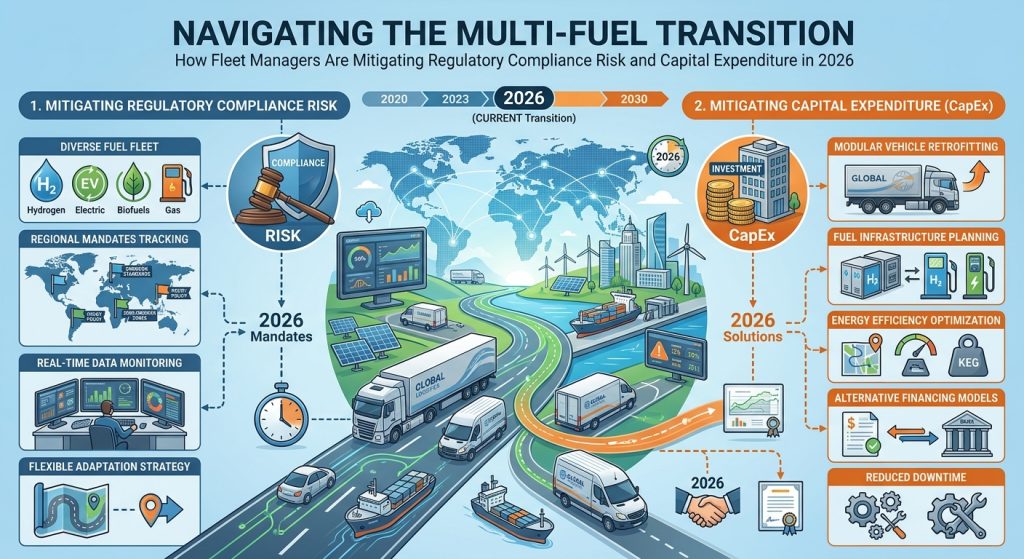
The commercial maritime industry has entered an era defined by fuel ambiguity, stringent regulatory oversight, and complex capital allocation. As enforcement mechanisms for global decarbonization frameworks mature in 2026, fleet operators, technical directors, and naval architects face a critical crossroads. The mandate is clear: reduce lifecycle greenhouse gas (GHG) emissions without locking in stranded assets or overextending capital expenditures (CapEx).
Developing a resilient maritime multi-fuel transition strategy is no longer a speculative sustainability project—it is a core requirement for corporate solvency and commercial competitiveness. This comprehensive guide examines how technical decision-makers are evaluating dual-fuel retrofits, methanol and ammonia readiness, and fuel-flexible engine architectures to balance regulatory compliance against operational risk.
1. The Regulatory Landscape: Navigating Compliance Risk
The commercial case for maritime decarbonization is driven by overlapping global, regional, and national regulatory pressures. Fleet managers must account for three main regulatory hurdles:
International Maritime Organization (IMO) GHG Strategy
The IMO’s revised GHG intensity targets require commercial shipping to achieve net-zero emissions by or around 2050, with checkpoints demanding a 20–30% reduction in absolute emissions by 2030 (compared to 2008 baselines).
- Carbon Intensity Indicator (CII): Operational efficiency ratings (A through E) directly impact a vessel’s charterability. Low-performing vessels face operational restrictions, mandatory corrective action plans, or steep commercial discounts.
- Energy Efficiency Existing Ship Index (EEXI): Serves as the baseline technical design standard for existing vessels, forcing operators to install Engine Power Limitation (EPL) systems or invest in energy-saving devices (ESDs).
Regional Frameworks: EU ETS and FuelEU Maritime
Regional policies have introduced direct financial penalties for carbon-intensive fuels:
- EU Emissions Trading System (EU ETS): Commercial vessels operating within, into, or out of EU ports must purchase and surrender carbon allowances for their covered emissions, creating a direct link between fuel selection and operating costs.
- FuelEU Maritime: Imposes well-to-wake GHG intensity limits on energy used on board. The regulation penalizes non-compliant vessels with escalating financial fines while rewarding early adopters of Renewable Fuels of Non-Biological Origin (RFNBOs).
[Well-to-Wake Lifecycle Analysis] ├── Well-to-Tank (Upstream Production & Feedstock) └── Tank-to-Wake (Onboard Combustion Efficiency)Managing maritime greenhouse gas regulation risk requires addressing both well-to-tank (upstream production) and tank-to-wake (onboard combustion) footprint. A fuel that appears carbon-neutral on board may carry significant upstream carbon liabilities if derived from fossil feedstocks without carbon capture.
2. Comparing Alternative Fuel Pathways: LNG, Methanol, Ammonia, and Hydrogen
Selecting the optimal fuel architecture requires balancing energy density, bunkering infrastructure availability, engine maturity, and long-term fuel cost volatility.
| Fuel Type | Energy Density (Volumetric vs. VLSFO) | Storage Requirement | Technological Maturity | Infrastructure Availability | Key Operational Risks |
| Liquefied Natural Gas (LNG) | ~60% | Cryogenic (-162°C) | High (Proven) | Widespread | Methane slip, slip-related GHG penalties |
| E-Methanol / Bio-Methanol | ~45% | Ambient Temperature | High | Growing Rapidly | High green premium, supply constraints |
| Green Ammonia (NH3) | ~30% | Refrigerated (-33°C) or Pressurized | Medium (Pilot Stage) | Limited | Extreme toxicity, NOx emissions, pilot fuel needs |
| Hydrogen (H2) | ~15-25% | Deep Cryogenic (-253°C) | Low (Feeder/Short-Sea) | Sparse | Low energy density, high storage footprint |
LNG and Bio-LNG: The Bridge Option
LNG remains a widely adopted alternative fuel due to established supply chains and engine reliability. Dual-fuel high-pressure gas engines substantially reduce SOx, NOx, and particulate matter. However, unburned fuel loss—methane slip—presents a major compliance risk under well-to-wake regulations. Incorporating Bio-LNG or Synthetic LNG (e-LNG) offers a pathway to compliance, provided drop-in volumes remain cost-effective.
E-Methanol: The Current Commercial Favorite
Methanol has emerged as a primary choice for container lines, bulk carriers, and tankers. Because it remains liquid at ambient temperatures, methanol simplifies bunkering, fuel handling, and storage systems compared to cryogenic alternatives.
- Pros: Standard atmospheric storage tanks, lower retrofit complexity, zero sulfur emissions.
- Cons: Lower energy density requires approximately 2.2 times the volume of Heavy Fuel Oil (HFO), reducing cargo space or requiring more frequent bunkering stops.
Green Ammonia: The Zero-Carbon Contender
Ammonia provides a zero-carbon molecular structure (NH3), avoiding direct CO2 tailpipe emissions. However, technical barriers remain significant.
- Toxicity and Handling: Requires double-walled piping, advanced leak detection systems, nitrogen purging, and safe venting procedures to ensure crew safety.
- Combustion Dynamics: Slow flame speed and high auto-ignition temperatures require conventional pilot fuel assistance and selective catalytic reduction (SCR) systems to control nitrous oxide (N2O) formation.
3. Financial Engineering: Mitigating Dual-Fuel Vessel Retrofitting Costs and CapEx
Upgrading an existing fleet or placing newbuilding orders requires balancing immediate capital expenditures against future operational expenditures (OpEx).
Total Cost of Ownership (TCO) Framework ├── Capital Expenditure (CapEx) │ ├── Engine Conversion & Fuel Handling Systems │ ├── Storage Tank Integration & Loss of Cargo Space │ └── Safety Systems & Structural Modification └── Operational Expenditure (OpEx) ├── Fuel Premium & Well-to-Wake Carbon Taxes ├── Crew Training & Safety Protocols └── Maintenance & Lifecycle Equipment ServicingDeconstructing the Dual-Fuel Vessel Retrofitting Cost
A complete fuel system conversion involves more than replacing engine components. It requires structural, electrical, and naval architecture modifications:
- Engine Modifications: Converting a standard 2-stroke main engine to dual-fuel capability (e.g., MAN B&W ME-LGIM for methanol or ME-GA/GI for LNG) requires new cylinder heads, fuel injection valves, high-pressure fuel pumps, and upgraded control units.
- Fuel Storage and Delivery Systems: Installing C-type containment tanks or integrated structural tanks. Methanol systems require chemical-resistant coatings and double-walled supply lines. Cryogenic LNG systems require vacuum-insulated tanks and Fuel Gas Supply Systems (FGSS).
- Safety and Auxiliary Integration: Inert gas generators, fire suppression upgrades, gas detection networks, and explosion-proof electrical fittings add significant costs.
Representative Retrofit Cost Breakdown (5,000-8,000 TEU Container Vessel)
[CapEx Allocation for Methanol Retrofit]■ Engine Conversion & Fuel Supply: 40-45%■ Containment Tanks & Structural Work: 30-35%■ Safety, Piping & Automation: 15-20%■ Yard Logistics & Lost Revenue: 5-10%- Methanol Dual-Fuel Retrofit: Approximately $12 million – $18 million per vessel, depending on structural layout and tank placement.
- LNG Dual-Fuel Retrofit: Approximately $25 million – $35 million per vessel, driven by cryogenic storage requirements and complex FGSS installations.
Strategies for CapEx Optimization
1. “Ready” Notation Classifications
When placing newbuilding orders, technical directors frequently select class notations such as Methanol-Ready or Ammonia-Ready. By completing structural reinforcement, space allocation, and piping layout designs during initial construction, future conversion costs can be reduced by 50–60%.
2. Modular and Deck-Mounted Fuel Containment
To protect cargo-carrying capacity, naval architects are increasingly designing deck-mounted, modular C-type fuel tanks. This approach preserves lower-hold cargo volume and accelerates yard installation time.
3. Energy Saving Devices (ESDs) as CapEx Offsetters
To lower overall fuel consumption—and reduce the volume of expensive green fuels required—operators install mechanical ESDs prior to or alongside engine retrofits:
- Wind-Assisted Propulsion Systems (WAPS): Rotor sails and rigid wings reduce main engine load by 5–15% on suitable trade routes.
- Air Lubrication Systems (ALS): Generates a layer of micro-bubbles along the hull bottom, reducing frictional resistance by 4–8%.
- Optimized Propeller Nozzles and Boss Cap Fins: Improves hydrodynamics, offering immediate fuel burn reductions of 2–5%.
4. Technical Implementation & Naval Architecture Considerations
Integrating multi-fuel systems requires addressing key design challenges across vessel stability, crew safety, and system integration.
┌─────────────────────────────────────────┐ │ Dual-Fuel Main Engine │ └────────────────────┬────────────────────┘ │ ┌──────────────────────────┴──────────────────────────┐ ▼ ▼┌──────────────────────┐ ┌──────────────────────┐│ Atmospheric Storage │ │ Cryogenic / High-P ││ (Methanol / Biofuel) │ │ (LNG / Ammonia) │└───────────┬──────────┘ └───────────┬──────────┘ │ │ ▼ ▼┌──────────────────────┐ ┌──────────────────────┐│ Low-Pressure FGSS │ │ High-Pressure FGSS ││ & Nitrogen Purging │ │ & Gas Detection │└──────────────────────┘ └──────────────────────┘Fuel Density and Space Allocation
Because alternative fuels possess lower volumetric energy densities than conventional HFO, storage tanks must expand to maintain the same sailing range.
Required Storage Volume=Fuel Energy Density (MJ/L)Energy Demand (MJ)
Naval architects must balance tank placement against vessel stability, transverse metacentric height (GM), trim, and structural bending moments. Allocating space inside cargo holds directly impacts revenue generation, making deck-mounted options an attractive alternative where visibility rules permit.
System Integration and Automation
Modern dual-fuel engine rooms rely on automated Fuel Supply Control Systems (FSCS). These systems manage:
- Automatic Fuel Switching: Seamlessly transitioning between conventional pilot fuel and alternative gas/liquid modes without loss of propulsion power.
- Purging and Inerting Sequences: Automatically purging lines with nitrogen gas before and after fuel transfer to eliminate explosive or toxic mixtures.
- Redundant Safety Loops: Integrating gas detection sensors, temperature alarms, and emergency shut-off valves (ESDV) into the vessel’s main Integrated Automation System (IAS).
5. Strategic Playbook for Fleet Managers in 2026
To manage regulatory expectations and capital allocation effectively, technical leadership should consider a structured, phased implementation roadmap:
[Phase 1: Operational Optimization] ──► [Phase 2: Drop-in Biofuels] ──► [Phase 3: Targeted Retrofits] (ESDs & AI Route Analytics) (Immediate CII Uplift) (Dual-Fuel Conversion)Phase 1: Maximize Hydrodynamic and Operational Efficiency
- Install high-efficiency hull coatings, air lubrication systems, and wind-assisted propulsion.
- Deploy real-time voyage optimization software to balance speed, weather conditions, and port arrivals.
Phase 2: Utilize Drop-In Biofuels for Immediate Compliance
- Use certified Sustainable Aviation Fuel (SAF) byproducts or Used Cooking Oil Methyl Ester (UCOME) bio-blends (B20, B30, or B100).
- Drop-in fuels require minimal to no engine modifications, serving as a flexible buffer against CII performance drops.
Phase 3: Execute Targeted Dual-Fuel Conversions on Long-Life Assets
- Focus retrofit CapEx on younger vessels (5 to 8 years old) with sufficient operational lifespan to amortize investment costs.
- Prioritize high-volume trade lanes where green fuel bunkering corridors are actively supported by regional port authorities.
Frequently Asked Questions (FAQ)
What is a realistic payback period for a dual-fuel methanol retrofit?
Payback periods vary based on the price spread between conventional Very Low Sulfur Fuel Oil (VLSFO) and green methanol, as well as prevailing carbon taxes under the EU ETS and FuelEU Maritime penalties. Assuming carbon costs continue to rise, typical return-on-investment (ROI) models range between 5 to 8 years when factoring in saved compliance fines and premium charter rates for low-emission vessels.
How does methane slip impact the long-term viability of LNG-fueled fleets?
Methane slip refers to unburned methane escaping through the engine exhaust stack. Because methane carries a global warming potential (GWP) 28 times greater than CO2 over a 100-year timeframe, regulatory bodies are actively incorporating well-to-wake methane accounting into compliance metrics. Operators using LNG dual-fuel engines must adopt high-pressure injection architectures (such as ME-GI engines) or install exhaust oxidation catalysts to minimize methane emissions.
Can existing diesel main engines be converted to run on ammonia?
While engine manufacturers are developing ammonia retrofit kits, conversions are technically complex. Ammonia requires higher ignition energy, specialized high-pressure fuel injection systems, advanced materials to prevent stress corrosion cracking, and dedicated toxicity management systems. Initial retrofits focus on “Ammonia-Ready” vessels built with structural and safety provisions already integrated.
How are vessel owners managing fuel availability and price volatility risks?
Fleet managers mitigate operational risk by securing long-term Offtake Agreements with green fuel producers and utilizing dual-fuel flexibility. A dual-fuel vessel can operate on conventional fuels if green fuel supply is unavailable or cost-prohibitive, providing an operational safety net while maintaining regulatory compliance options when entering controlled emission areas.
Related Content & Resources
- IMO Data Collection System (DCS) Overview – Official guidelines on ship fuel oil consumption data reporting and carbon intensity calculations.
- EMSA Decarbonization Portal – Regulatory documentation on EU ETS implementation and FuelEU Maritime compliance mechanisms.
- ClassNK Technical Publications on Alternative Fuels – Detailed naval engineering guidelines for methanol, LNG, and ammonia vessel integration.
Recent Comments