
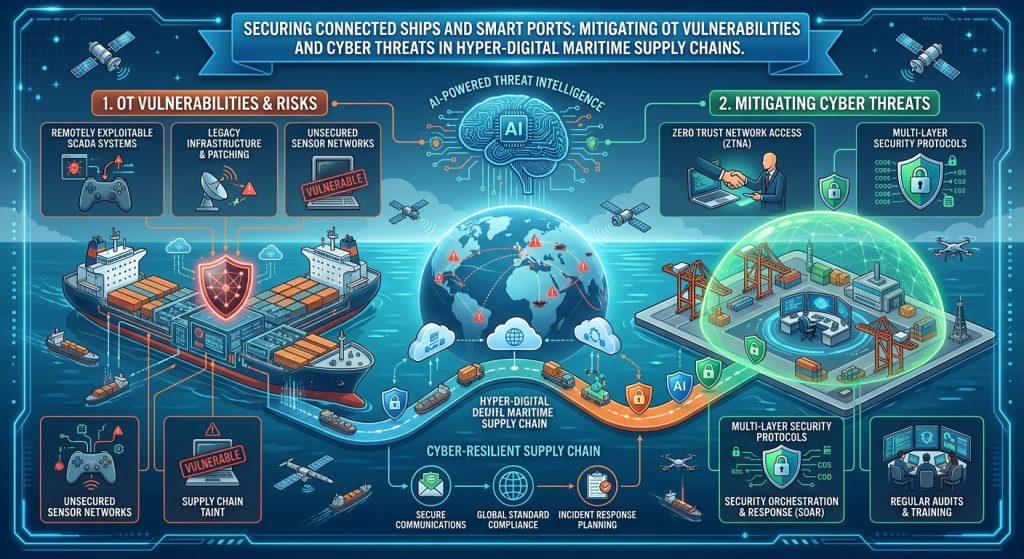
As global trade transitions toward hyper-digitized supply chains, the convergence of Information Technology (IT) and Operational Technology (OT) has fundamentally reshaped the maritime landscape. Automated container terminals, remote diagnostics, satellite-enabled vessel telemetry, and cloud-integrated logistics platforms offer unprecedented efficiency gains. However, this hyper-connectivity expands the cyber-attack surface of critical maritime infrastructure.
For maritime IT directors, port authority managers, and logistics technology vendors, cybersecurity is no longer an ancillary IT ticket—it is a core operational requirement. A cyber breach on an OT system does not merely endanger data privacy; it can paralyze port cranes, compromise vessel propulsion systems, cause physical collisions, and freeze global supply chains.
This guide provides a technical roadmap for mitigating maritime operational technology cybersecurity risks, securing ship-to-shore communications, and complying with international maritime security mandates.
1. The Threat Landscape: IT vs. OT Vulnerabilities in Modern Shipping
Understanding the distinction between IT and OT security is fundamental to designing resilient maritime defense architectures:
- Information Technology (IT): Focuses on data confidentiality, integrity, and availability within enterprise networks (e.g., email servers, booking systems, freight invoicing).
- Operational Technology (OT): Focuses on physical safety, continuous availability, and real-time control of physical machinery (e.g., engine control systems, steering gear, bridge navigation, gantry cranes).
[Maritime Cyber Attack Surface] ┌─────────────────────────────────────────────────────────────┐ │ Enterprise IT Infrastructure │ │ Logistics Platforms • Invoicing • Port Community Systems │ └──────────────────────────────┬──────────────────────────────┘ │ [Attack Vector: Phishing, API Exploits] ▼ ┌─────────────────────────────────────────────────────────────┐ │ Ship-to-Shore Communication Bridge │ │ VSAT / Starlink LEO • Cellular Gateways • Edge Routers │ └──────────────────────────────┬──────────────────────────────┘ │ [Attack Vector: Man-in-the-Middle, OT Pivot] ▼ ┌─────────────────────────────────────────────────────────────┐ │ Onboard / Terminal OT Control │ │ ECDIS / GPS • Main Engine PLCs • Automated Terminal Cranes │ └─────────────────────────────────────────────────────────────┘Primary Threat Vectors in Hyper-Digital Maritime Ecosystems
- Ransomware Attacks on Port Community Systems (PCS): Attackers target logistics coordination platforms, locking container gate systems and disabling terminal operating systems (TOS). This creates massive vessel congestion and paralyzes inland trucking networks.
- GPS / GNSS Spoofing and Jamming: Adversaries manipulate satellite signals to feed false positional data into a vessel’s Electronic Chart Display and Information System (ECDIS), forcing manual intervention or risking groundings and collisions.
- Pivoting from IT to Onboard OT Networks: Unsecured satellite routers or remote-maintenance portals allow cyber criminals to breach shipboard IT networks and pivot into critical industrial control systems (ICS) and Programmable Logic Controllers (PLCs).
- Supply Chain Software Compromise: Malicious code embedded into third-party software updates (e.g., engine diagnostic tools or port automated gate software) gives threat actors deep access to restricted maritime networks.
2. Regulatory Frameworks & Compliance Benchmarks
Regulatory bodies have shifted from voluntary guidelines to strict, enforceable cybersecurity mandates.
Key Compliance Frameworks ├── IMO Resolution MSC.428(98): Mandates cyber risk management in ISM Safety Management Systems. ├── IACS Unified Requirements E26 & E27: Standardizes cyber resilience for ships and equipment. └── EU NIS 2 Directive: Enforces strict incident reporting & supply chain security for ports.IMO Resolution MSC.428(98)
The International Maritime Organization (IMO) requires ship operators to integrate cyber risk management directly into their approved Safety Management Systems (SMS). Non-compliant vessels face detention during Port State Control (PSC) inspections.
IACS Unified Requirements UR E26 and UR E27
Developed by the International Association of Classification Societies (IACS), these requirements apply to ships contracted for construction:
- UR E26 (System Integrity): Regulates ship design, construction, and integration to safeguard onboard OT networks against cyber incidents.
- UR E27 (Equipment Integrity): Specifies cybersecurity testing and certification requirements for third-party systems and machinery controllers.
European Union NIS 2 Directive
The Network and Information Security (NIS 2) Directive classifies port authorities and maritime transport operators as “essential entities.” It mandates strict risk management protocols, supply chain security assessments, and rapid incident notification windows (24-hour early warning).
3. Technical Architecture: Zero Trust & Network Segmentation
Implementing vessel network ransomware protection and securing smart ports requires abandoning traditional perimeter security in favor of a Zero Trust Architecture (ZTA).
[Purdue Model Architecture for Maritime OT] Level 4 / 5: Enterprise Network (ERP, Email, Cloud APIs) ────────────────────────────────────────────── [Firewall / DMZ] Level 3: Port / Vessel Management (TOS, PMS Data Hub) ────────────────────────────────────────────── [Unidirectional Data Diode] Level 2: Supervisory Control (SCADA, HMI, ECR Monitoring) ────────────────────────────────────────────── [OT Firewall / Deep Packet Inspection] Level 0 / 1: Physical Process Control (Engine PLCs, Steering, ECDIS)1. Enforcing Micro-Segmentation via the Purdue Model
Critical onboard systems must be segmented into segregated security zones based on the Purdue Model for Industrial Control Systems:
- Navigation & Safety Zone (Air-Gapped / Isolated): ECDIS, Radar, Gyrocompass, AIS, and Dynamic Positioning (DP).
- Propulsion & Machinery Control Zone: Main engine PLCs, ballast water controls, power management systems (PMS).
- Operational IT Zone: Cargo management tools, crew administrative networks, engine room diagnostic reporting.
- Passenger / Crew Entertainment Zone: Isolated Wi-Fi networks connected directly to satellite gateways without internal routing to bridge or machinery networks.
2. Unidirectional Data Diodes
To stream telemetry data from onboard machinery to shore-side analytics engines without exposing control networks, operators install hardware data diodes. Data diodes enforce physically one-way data transfer, ensuring external traffic can never reach critical PLCs.
3. Secure Ship-to-Shore Satellite Communications
With the rapid adoption of LEO satellite constellations (e.g., Starlink, OneWeb) alongside legacy VSAT networks, multi-WAN communication gateways must implement:
- Mutual TLS (mTLS) & Encrypted VPN Tunnels: Encrypting all data in transit between shipboard edge nodes and shore cloud platforms.
- Identity and Access Management (IAM): Multi-Factor Authentication (MFA) enforcement for shore-based engineers accessing vessel diagnostic portals.
- Endpoint Detection and Response (EDR): Light-footprint agents running on shipboard computers to block malicious execution offline or during satellite dropouts.
4. Smart Port IT Framework Security: Protecting Terminal Operations
Port automation brings operational velocity, but connected equipment—such as Automated Stacking Cranes (ASCs), Automated Guided Vehicles (AGVs), and Internet of Things (IoT) sensors—presents significant smart port IT framework security challenges.
┌─────────────────────────────────────────┐ │ Terminal Operating System (TOS) │ └────────────────────┬────────────────────┘ │ ┌──────────────────────────┴──────────────────────────┐ ▼ ▼┌──────────────────────┐ ┌──────────────────────┐│ Automated Gate & OCR │ │ Wireless IoT Network ││ (Truck Access Control) (Asset Tracking & Sensors)└───────────┬──────────┘ └───────────┬──────────┘ │ │ ▼ ▼┌──────────────────────┐ ┌──────────────────────┐│ Identity Management │ │ Private 5G Network ││ & Biometric Auth │ │ Segmented & Encrypted└──────────────────────┘ └──────────────────────┘Key Strategies for Port Security Managers
- Private 5G / LTE Infrastructure: Replacing public Wi-Fi networks across port terminals with dedicated Private 5G networks. Private 5G offers granular network slicing, strict SIM-based device authentication, and superior encryption for AGVs and wireless PLCs.
- Third-Party Vendor Risk Management: Supply chain partners, logistics vendors, and equipment suppliers must undergo continuous vulnerability scans and comply with strict API security standards before accessing Port Community Systems (PCS).
- Continuous OT Security Operations Center (OT-SOC): Operating specialized SOC monitoring tools equipped with Deep Packet Inspection (DPI) tailored for industrial protocols (e.g., Modbus, PROFIBUS, NMEA 0183/2000).
5. Incident Response Playbook: Mitigating Cyber Supply Chain Risk
When a cyber incident occurs, a structured, pre-tested response plan minimizes operational downtime and legal exposure:
[Phase 1: Detection & DPI Analysis] ──► [Phase 2: Isolation & Air-Gapping] ──► [Phase 3: Failover to Manual Mode] ──► [Phase 4: Forensics & Recovery]- Phase 1: Immediate Detection & Threat Isolation Automatically isolate compromised IT or OT network segments using automated firewalls or physical disconnect switches. Prevent lateral movement to navigation systems or port gate controls.
- Phase 2: Transition to Fail-Safe Manual Protocols Enforce clear operational continuity plans. Ship crews must be trained to seamlessly transition to manual steering, manual engine control, and paper chart navigation if bridge systems become unreliable.
- Phase 3: Forensic Remediation & Secure Recovery Utilize clean, offline backup images to restore terminal operating platforms and shipboard control units. Validate software integrity prior to reconnecting networks to shore links.
- Phase 4: Regulatory Reporting and Information Sharing Comply with mandatory incident notification windows (e.g., EU NIS 2, US Coast Guard Cyber Incident Reporting) and share threat intelligence via maritime Information Sharing and Analysis Centers (ISACs).
Frequently Asked Questions (FAQ)
How can maritime operators secure legacy OT equipment that cannot support modern security agents?
Legacy PLCs and bridge systems often run outdated operating systems that cannot support local antivirus or EDR software. These systems are secured through network encapsulation. Operators deploy industrial firewalls in front of legacy devices, strictly filtering incoming traffic via protocol-aware Deep Packet Inspection (DPI) and isolating them within strict VLAN micro-segments.
What is the risk of using LEO satellite internet (like Starlink) on commercial vessels?
High-speed LEO internet significantly improves crew welfare and operational data transmission, but it increases the attack surface if improperly integrated. Without robust network segmentation, direct cloud access increases exposure to drive-by malware downloads, phishing, and unauthorized remote access. LEO connections must always terminate into an enterprise edge firewall with strict traffic segregation.
What role does human error play in maritime cyber incidents, and how can it be mitigated?
Human error—primarily through social engineering, phishing, or plugging unauthorized USB drives into engine control consoles—remains a major attack vector. Mitigation requires continuous, maritime-specific security awareness training, strict physical port restrictions on ECR/bridge consoles, and software policies that disable USB mass storage ports on operational workstations.
Related Content & Resources
- BIMCO Guidelines on Cybersecurity Onboard Ships – Practical industry guidelines for managing cyber risks across shipboard IT and OT environments.
- USCG Maritime Cyber Readiness Center (MCRC) – Threat intelligence, incident reporting guidelines, and cyber advisories for maritime stakeholders.
- Maritime Information Sharing and Analysis Center (M-ISAC) – Global threat sharing network dedicated to safeguarding maritime critical infrastructure.
Recent Comments