
As of early 2026, the shipping industry has seen a 300% increase in “Signal-to-System” attacks, where hackers exploit the high-bandwidth satellite terminal to gain lateral access to the ship’s Operational Technology (OT). To combat this, the industry is pivoting toward Managed Detection and Response (MDR)—a proactive, AI-driven security model that hunts threats before they lock the bridge.
1. The High Cost of the “Wait and See” Approach (Downtime Analysis)
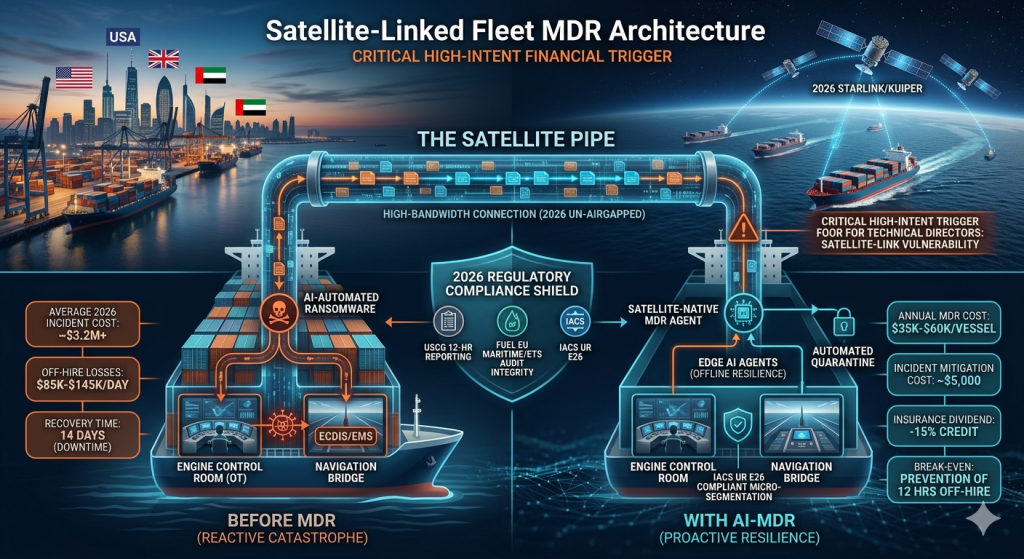
In 2026, a ransomware attack on a satellite-linked vessel is not a “computer glitch”; it is a Kinetic Financial Event. If your navigation (ECDIS) or propulsion control (EMS) is encrypted, the ship is dead in the water.
The Financial Anatomy of Ransomware Downtime:
- Off-Hire Losses: For a 2026-spec LNG carrier or Large Container Ship, off-hire costs range from $85,000 to $145,000 per day.
- Ransom Demands: Current 2026 averages for maritime targets have climbed to $1.8M per incident, often demanded in privacy-focused cryptocurrencies.
- Reputation & Vetting Penalties: A single successful attack can lead to a “Blacklist” status from major oil majors and charterers for up to 24 months.
The “Expensive Reality”: The average recovery time for a vessel without a proactive MDR service is 14 days. Total cost: ~$3.2M (excluding the ransom itself).
2. The MDR Solution: AI-Driven Threat Hunting
MDR is a service that combines Advanced Analytics (AI) with human Security Operations Center (SOC) experts who monitor your fleet’s satellite traffic 24/7/365.
How 2026 MDR Protects Satellite Fleets:
- Behavioral Basclining: AI learns the “normal” data patterns of your Starlink terminal. If an unknown IP in a foreign jurisdiction suddenly begins “East-West” lateral movement toward the Engine Control Room, the MDR system triggers an automatic Micro-Segmentation.
- Agentic AI Response: In 2026, MDR agents can autonomously “quarantine” a compromised workstation on the ship without human intervention, preventing the ransomware from spreading to the steering gear.
- Satellite-Optimized Logs: Modern MDR providers use Data Compression Algorithms to ensure that security telemetry doesn’t “hog” the bandwidth needed for ship operations.
3. Cost Comparison: Proactive MDR vs. Reactive Recovery (2026)
| Expense Category | Reactive (No MDR) | Proactive (AI-MDR) |
| Annual Subscription/Ops | $0 | $35,000 – $60,000 (per vessel) |
| Average Incident Cost | $3.2M+ (Downtime + Recovery) | $5,000 (Investigation/Clean-up) |
| Insurance Impact | +20% Premium Surcharge | -15% “Cyber-Secure” Credit |
| Regulatory Risk | High (PSC Detention Risk) | Low (IACS E26 Compliant) |
Export to Sheets
The ROI Logic:
For a fleet owner in the UAE or USA, the Break-Even Point for a top-tier MDR solution is reached the moment it prevents just 12 hours of off-hire. In 2026, the statistical probability of a cyber-attack on a satellite-connected ship is roughly 1 in 4 annually. The “Insurance Dividend” alone often covers 40% of the MDR subscription cost.
4. Best 2026 MDR Providers for Maritime Sat-Links
When selecting a provider in 2026, founders must look for “Satellite-Native” capabilities. Standard “Office” MDR often fails due to the latency and intermittent connectivity of maritime life.
- CrowdStrike Falcon (Maritime Edition): Exceptional at low-bandwidth telemetry.
- SentinelOne (Vessel Shield): High use of on-vessel AI agents that work even if the satellite link is temporarily lost.
- Marlink/CyberGuard: Specifically designed for the integration between the sat-com hardware and the ship’s network.
Frequently Asked Questions (FAQ)
1. Does Starlink’s built-in security replace the need for MDR?
No. Starlink (and other LEO providers) secures the pipe (the connection), but they do not secure the endpoints (the computers and engines at the end of the pipe). Hackers don’t need to “break” Starlink; they just need to send a malicious file through it. MDR monitors what is inside the pipe.
2. Can MDR work if the ship loses satellite connectivity?
In 2026, the best MDR solutions use Edge AI Agents. These are small pieces of software installed on the ship’s servers that can detect and block a ransomware attack locally, even if the ship is in a “dead zone” or the satellite link is cut.
3. How does MDR affect my P&I Insurance in 2026?
Most 2026 maritime insurers now require “Evidence of Active Monitoring” to honor cyber-related claims. Without an MDR or SOC service, many P&I clubs will classify an attack as “Gross Negligence,” potentially voiding your coverage.
4. Is MDR difficult to implement on an existing fleet (Legacy Vessels)?
Not anymore. 2026 technology allows for “Plug-and-Play” OT Sensors that can be installed in the engine room in under 4 hours. These sensors feed data back to the MDR provider without requiring a complete rewiring of the ship.
5. What is “Methane-Slip Cybersecurity” in 2026?
This is a new 2026 risk. Hackers can manipulate the engine sensors to report incorrect emissions data. If your ship “fakes” its carbon reporting, you face massive EU ETS fines. MDR is now being used to audit the integrity of environmental data to prevent “Regulatory Hacking.”
Final Strategist’s Conclusion: Moving from “Defense” to “Resilience”
In the high-speed trade corridors of 2026, Connectivity = Vulnerability. For business owners in the USA, UAE, UK, and Canada, an MDR subscription is no longer a “luxury software”; it is a Financial Hedge against the absolute certainty of an attempted breach.
By investing in AI-driven threat hunting, you aren’t just buying software—you are buying the operational uptime that defines a Tier-1 shipping company.
Recent Comments