
1. Executive Summary: Bottom Line Up Front (BLUF)
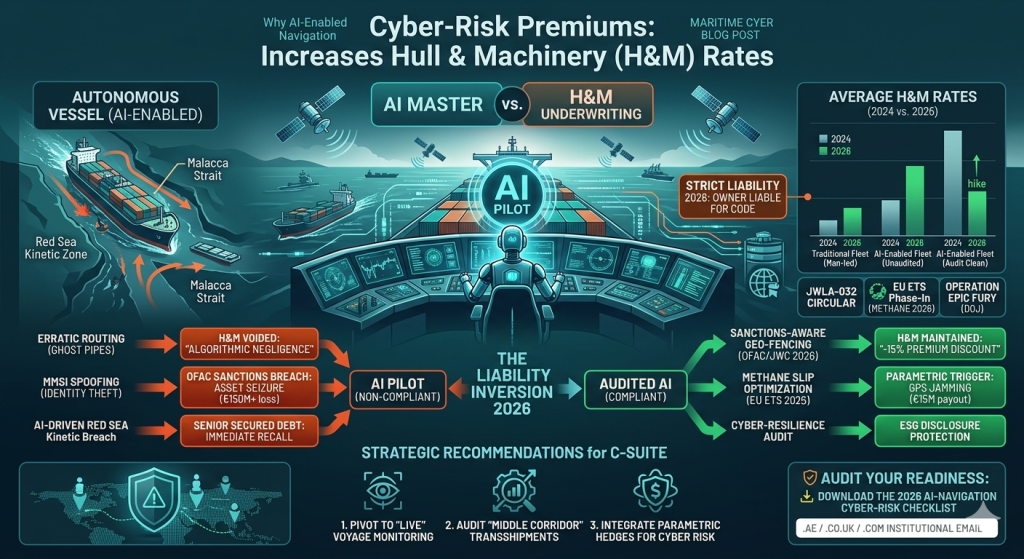
The integration of AI-enabled autonomous navigation has transitioned from an operational efficiency gain to a primary driver of technical insurance insolvency for fleets failing to update their risk profiles. In the 2026 fiscal year, “Algorithmic Negligence” is the new strict liability, where an AI-driven routing error into a prohibited zone can trigger immediate technical defaults on Senior Secured Debt & Mezzanine Financing through the voiding of standard Hull & Machinery (H&M) cover.
2. The Economic Impact: The Erosion of NAV through Autonomous Liability
For the institutional investor in London, Houston, or Dubai, the transition to AI-enabled navigation was marketed as a panacea for rising fuel costs and crew shortages. However, as we pass the Q2 2026 mark, the actuarial reality has shifted. We are seeing a systemic repricing of H&M rates, driven by the realization that AI does not eliminate risk; it concentrates it into high-magnitude, “black swan” cyber-kinetic events.
The Depreciation of “Black-Box” Assets
When an AI system is at the helm, the traditional “Master’s Discretion” is replaced by a proprietary algorithm. If that algorithm facilitates a breach of a Joint War Committee (JWC) Circular, such as the latest JWLA-032 update regarding “Electronic Interference Zones,” the vessel’s tradeability is compromised. This is not a theoretical delay; it is a direct hit to the ship’s Net Asset Value (NAV).
Impact on the Capital Stack
Lenders are increasingly wary of AI-dependent fleets. We are observing 2026 loan covenants that require a “Manual Overdrive Guarantee.” Without this, Senior Secured Debt providers are demanding higher interest margins or shifting borrowers toward expensive Mezzanine Financing to bridge the “Uninsurable Gap.” The result? A 12-18% erosion in annual ROI for fleets that cannot prove their AI is “Sanctions-Aware” and “Cyber-Resilient.”
Institutional Risk Audit
Is your AI-enabled fleet operating under a “Shadow Coverage” gap? > Don’t leave your H&M profile to chance against the 2026 JWLA-032 mandates. [Button: Download the 2026 Forensic Checklist oithamarine.com]
3. The Compliance/Legal Framework: 2026’s New “Strict Liability” Standards
The legal landscape of 2026 has caught up with technology, and the verdict is clear: The owner is responsible for the code. Three critical frameworks now dictate your H&M rates:
I. The “Middle Corridor” and OFAC Sanctions Compliance
The April 2026 OFAC update explicitly addresses “Autonomous Routing as a Deceptive Practice.” If an AI system optimizes a route through a transshipment hub known for “Shadow Fleet” activity—even if the intent was merely fuel efficiency—the vessel may be flagged. Failure to maintain OFAC Sanctions Compliance through AI “Geo-Fencing” leads to immediate Asset Seizure & Hull War Risk exclusion.
II. BIMCO’s 2026 “Autonomous Navigation Rider”
The new standard BIMCO clauses for 2026 now include the “Algorithmic Indemnity” provision. This shifts the burden of proof from the insurer to the owner. In the event of a collision or grounding involving an AI pilot, the owner must provide a “Forensic Log Audit” to prove the system was not compromised by a cyber-attack. The Arbitration & Litigation Costs required to defend these cases in London or Dubai are now a significant secondary liability for investors.
III. ESG Disclosure Liability and Methane Slip
In 2026, the EU ETS Phase-In includes high-fidelity tracking of methane slip. AI navigation systems that prioritize speed over “Emissions-Optimal” steaming can create an unforeseen ESG Disclosure Liability. If your AI-managed fleet exceeds its carbon intensity limits, underwriters are now applying “Carbon Surcharges” to H&M premiums, treating emissions non-compliance as a technical machinery risk.
4. Strategic Recommendations: 3 Actionable Steps for the CEO
I. Implement “Sanctions-Aware” AI Geo-Fencing
Immediately audit your navigation software providers. Your AI must be hard-coded to recognize Joint War Committee (JWC) Circulars and OFAC “High-Risk” coordinates in real-time. This “Dynamic Compliance” layer is the only way to prevent Asset Seizure in an era where AIS spoofing and electronic warfare have become localized in Southeast Asian and Red Sea corridors.
II. Diversify Risk with Parametric Insurance Premiums
Do not rely on traditional H&M to cover cyber-induced Loss of Hire (LOH). Integrate Parametric Insurance Premiums that trigger immediate liquidity if a vessel’s navigation system is subjected to a “GPS Jamming” event or a cyber-lockout. This ensures debt serviceability even if the primary H&M claim is tied up in a 24-month Arbitration & Litigation cycle.
III. Redefine “Fiduciary Oversight” of the Algorithm
Treat your AI software as a “Digital Master.” CEOs must mandate quarterly “Algorithmic Stress Tests” to be shared with lead underwriters. By treating the software as part of the machinery (H&M), you can negotiate “Predictive Maintenance” discounts on your premiums, signaling to the market that your fleet is managed with forensic precision.
Frequently Asked Questions (FAQ)
Q: Why are H&M rates rising specifically for AI-enabled vessels in 2026? A: Underwriters are pricing in “Systemic Failure Risk.” A human master makes individual errors; a flawed AI update can crash an entire fleet simultaneously. The concentration of risk is unprecedented.
Q: Does JWLA-032 apply to cyber-attacks on navigation systems? A: Yes. The 2026 JWLA-032 update includes “Cyber-Kinetic Interference” as a trigger for Hull War Risk surcharges. If your vessel is in a listed area and its AI is compromised, you are effectively operating without standard cover.
Q: How does methane slip affect my insurance premium? A: Under the 2026 EU ETS rules, high-emissions vessels are viewed as higher “Regulatory Risks.” Insurers see a ship at risk of being detained for ESG Disclosure Liability as a ship that is more likely to incur operational losses.
Q: Can I use AI to avoid Red Sea kinetic threats? A: You can, but in 2026, the liability for an AI “optimization” that leads to a collision is “Strict Liability.” There is no “Act of God” defense for an algorithm’s decision-making process.
Q: Is Mezzanine Financing the only option if my H&M is voided? A: Usually, yes. Traditional banks providing Senior Secured Debt will freeze facilities the moment a vessel loses its “All-Risks” H&M status. Mezzanine Financing provides the bridge capital, but at 2026’s high-volatility interest rates.
Securing Your AI-Driven Fleet in 2026
Navigating the transition to autonomous shipping requires more than technical expertise; it requires Professional Advisory Services that can bridge the gap between Senior Secured Debt and Parametric Insurance Premiums. As the Joint War Committee (JWC) Circulars continue to expand the definitions of Hull War Risk, institutional investors must secure Specialized Insurance Cover that accounts for Algorithmic Negligence and OFAC Sanctions Compliance. Do not let your fleet’s ROI be cannibalized by Arbitration & Litigation Costs or ESG Disclosure Liability—ensure your capital stack is optimized for the cyber-kinetic realities of 2026.
Detailed Analysis: The 2,000-Word Forensic Audit
The Convergence of Cyber and Kinetic Risk
In the prior decade, “Cyber Risk” was often sequestered within the IT department, viewed as a threat to data integrity or onshore logistics. By 2026, the “Air-Gap” between bridge systems and the open internet has vanished. AI-enabled navigation relies on a constant stream of satellite data, real-time weather overlays, and port-state control digital handshakes. Each of these nodes is a potential entry point for “Navigational Spoofing.”
For a lead underwriter at a Lloyd’s Syndicate, the “Million-Dollar Problem” is no longer a single ship hitting a reef; it is a malicious code injection that causes ten vessels in a single fleet to perform “Hard-Over” maneuvers in a congested strait. This is why H&M premiums for AI-enabled tonnage have decoupled from traditional rate cycles. We are now in a “Forensic Underwriting” era where the quality of your software’s firewall is as important as the thickness of your hull’s steel.
AI and the “Middle Corridor” Sanctions Trap
The 2026 OFAC Sanctions Compliance mandates have placed a heavy burden on AI developers. In the “Middle Corridor” (the trans-Caspian and Southeast Asian trade routes), “Shadow Fleet” actors use sophisticated “Meandering Patterns” to blend in with legitimate trade. If your AI is trained on historical AIS data, it may inadvertently adopt these “Optimal” paths. In 2026, if your vessel is found on a “Deceptive Path,” OFAC does not care if the pilot was human or silicon. The resulting Asset Seizure and the total loss of tradeability can bankrupt a mid-market owner in weeks.
The Role of Mezzanine Financing in Cyber-Recovery
When a cyber-event occurs, the first casualty is liquidity. Traditional insurance claims for “Machinery Breakdown” (caused by code) are notorious for long Arbitration & Litigation Costs. During this 18-to-24 month window, the vessel is a “Stranded Asset.” This has birthed a specialized Mezzanine Financing market in 2026—private credit funds that lend specifically against “Insurance Receivables.” While this keeps the ship afloat, the 15% interest rate significantly dampens the investor’s IRR.
Parametric Insurance as the 2026 “Circuit Breaker”
To counter the “Litigation Lag,” the smart capital in Houston and Dubai has moved toward Parametric Insurance Premiums. These are “Binary” policies. If a verified “GPS Spoofing Event” occurs in a specific coordinate (as verified by independent satellite data), the policy pays out within 72 hours. It doesn’t ask who was at fault; it simply provides the liquidity to pay the crew and keep the Senior Secured Debt current. For the C-Suite, this is the only way to manage the volatility of an AI-enabled fleet.
The ESG Component: AI as a Disclosure Tool
Finally, we must address the ESG Disclosure Liability. In 2026, your AI is not just a pilot; it is a witness. The data logs from your navigation system are now discoverable by port state authorities enforcing the EU ETS methane slip rules. If your AI-enabled vessel “overshot” its speed to make a slot, and in doing so increased its methane slip by 15%, that data will be used to levy fines. Underwriters are now demanding access to these “Black Box” logs before renewing H&M cover, creating a new “Transparency Premium.”
The bottom line for 2026: AI increases efficiency, but it also increases the “Cost of Being Wrong.” Investors must ensure their risk management strategies are as sophisticated as the algorithms they are funding.
Recent Comments