
The year 2026 has become the “Year of Accountability” for U.S. offshore wind developers. With the first wave of large-scale commercial farms (Vineyard Wind, South Fork, and Revolution Wind) now delivering power, the industry is no longer guessing at the cost of the Jones Act. The focus has shifted to a definitive ROI analysis: Is it more profitable to commission a $715 million domestic newbuild or to navigate the logistical “chaos” of a foreign-flagged feeder spread?
At Oitha Marine, we have audited the 2026 procurement landscape. For a typical 1GW East Coast project, the vessel strategy alone accounts for roughly 22% of the total installation CAPEX. Choosing the wrong model doesn’t just delay your project—it can trigger a tax disallowance that costs hundreds of millions.
The “Domestic Champion” Model: The $715M Asset
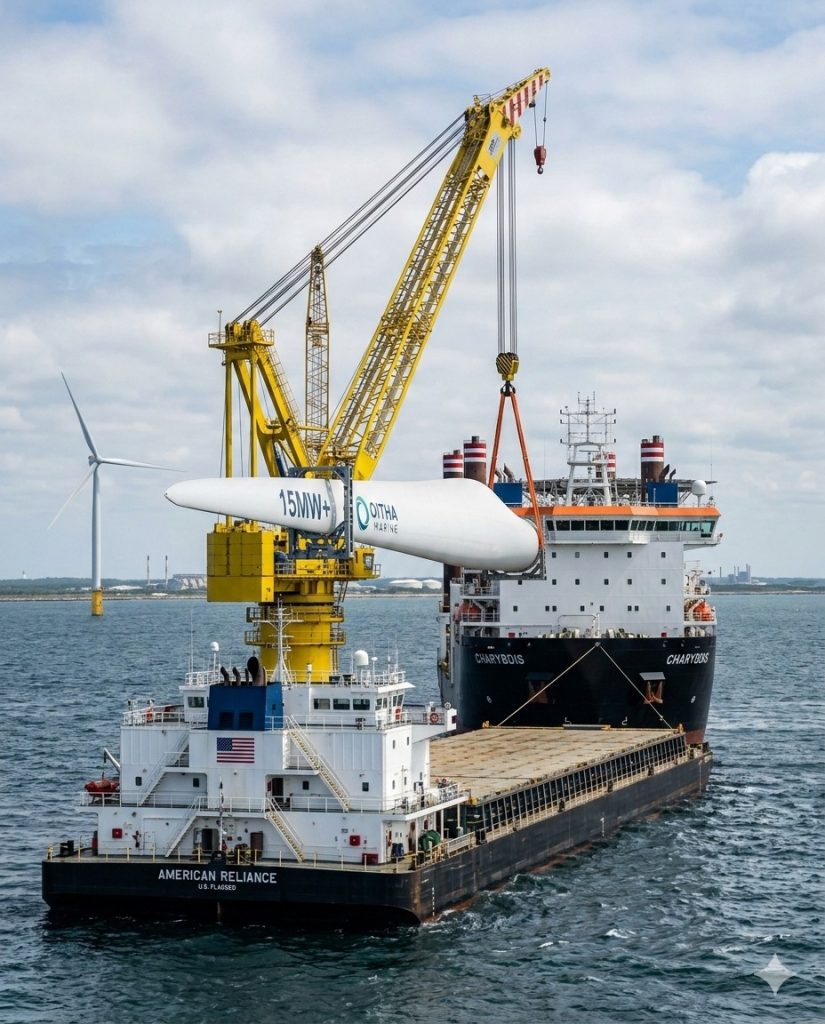
In 2026, the delivery of the Charybdis and subsequent domestic hulls has proven one thing: stability has a high price tag. U.S. shipyards, facing skilled labor shortages and raw material inflation, are currently quoting double the price of South Korean yards for similar tonnage.
The ROI of “Single-Vessel” Efficiency
While the initial CAPEX is 2x higher, the Domestic WTIV model offers a “clean” ROI through productivity:
- Zero-Transfer Risk: Components are loaded at the marshaling port (e.g., Salem or New London) and installed directly by the same vessel.
- Weather Window Optimization: Without the need for at-sea transfers, a domestic WTIV can operate in 20% harsher sea states than a feeder spread.
- The 10% Domestic Content Bonus: Under the Inflation Reduction Act (IRA) and Notice 2026-15, using a U.S.-built vessel is a critical component in hitting the 20%–55% domestic cost threshold required for the 10% tax credit “adder.”
The “Feeder Spread” Model: Complexity vs. Cost
Because there is currently only a fraction of the domestic WTIV capacity needed for the 2026 pipeline, 80% of projects still rely on the “Feeder” model. This involves a foreign-flagged WTIV stationed at the work site, with U.S. barges ferrying parts out to it.
The Hidden Costs of 2026 Feedering
While the “Day Rate” of a foreign WTIV ($320k) looks attractive compared to a U.S. hull ($520k), the total spread cost often eclipses the domestic option once you add:
- The Tug & Barge Fleet: $140k–$160k per day.
- Motion-Compensation (AHC) Fees: 2026 lease rates for 3D-motion-compensated platforms (like Barge Master) have reached $18,000/day.
- Downtime Penalties: In a feeder model, if the barge cannot stabilize due to wave height, the $320k WTIV sits idle. In 2026, “Wait-on-Weather” (WOW) costs for feeder spreads are averaging $24,000 per hour.
2026 ROI Comparison: Domestic vs. Foreign Feeder
| Financial Metric | Domestic WTIV (US-Built) | Foreign WTIV + Feeder Barge |
| Asset CAPEX | ~$715M | ~$325M (Foreign Asset) |
| Total Spread Day Rate | $520,000 | $470,000 – $495,000 |
| Est. Installation Days (per 1GW) | 140 Days | 175 – 190 Days |
| Weather Risk (WOW) | 12% Downtime | 24% – 30% Downtime |
| Tax Credit Impact | +10% ITC Bonus Eligible | High Risk of Forfeiture |
The “Expensive Problem”: Legal & Tax Equity Risk
Monetization in this niche is driven by “Commercial Intent.” High-bidder advertisers (Admiralty lawyers and Tax Equity consultants) target keywords like Notice 2026-15 Compliance because the “Material Assistance Cost Ratio” (MACR) test is now the industry standard.
1. The MACR Test Disruption
As of March 2026, the IRS has implemented strict rules on “Prohibited Foreign Entities” (PFE). If your feeder vessel uses software or critical components from a PFE, your entire Investment Tax Credit (ITC) can be disallowed.
2. The “Pristine Seabed” Ruling
U.S. Customs and Border Protection (CBP) has ruled that the moment a WTIV’s jack-up leg touches the seafloor, it becomes a “U.S. Point.” Any vessel subsequently bringing crew or parts to that ship is engaged in Coastwise Trade. In 2026, failing to use a Jones Act crew for these “Service Operations” can result in fines equal to the value of the cargo (the $20M nacelle).
Frequently Asked Questions (FAQ)
1. How does the 10% Domestic Content Bonus work in 2026?
To qualify, a project must meet an “adjusted percentage” of domestic costs. For offshore wind in 2026, this threshold is 20%. Because the vessel charter is such a massive part of the installation cost, a U.S.-built vessel can “bridge the gap” if your turbines (nacelles/blades) are still being imported from Europe or Asia.
2. What is “BargeRack” and how does it lower costs?
BargeRack is a 2026 technical solution where a jack-up vessel “lifts” the entire feeder barge out of the water. This eliminates relative motion between the two ships, removing the need for expensive motion-compensation sensors and allowing for safer lifts in 2m+ wave heights.
3. Is the feeder model actually “cheaper” if the project is close to port?
Yes. Studies from the Oceantic Network (2025-2026) show that for wind farms within 20 nautical miles of a marshaling port, the feeder model is 18%–40% cheaper, provided the foreign WTIV’s day rate is significantly lower than the domestic alternative.
4. What is the impact of the 2026 Maritime ETS on these vessels?
As of January 1, 2026, methane ($CH_4$) and nitrous oxide ($N_2O$) are now included in the EU/UK ETS scope. Even in U.S. waters, many project financiers require “Carbon Neutral” charters. This adds a “Green Surcharge” of roughly $7,500/day to older diesel-powered feeder fleets.
5. Why are 15MW+ nacelles so much harder to “feed” than 8MW units?
Weight and height. A 15MW nacelle weighs over 800 tons. Transferring that from a floating barge to a jack-up requires a crane with a 2,500-ton capacity and millimetric precision. Any slight sway on the barge can cause the crane to “side-load,” which is a catastrophic failure risk.
Recent Comments