
Executive Summary :
The U.S. Office of Foreign Assets Control (OFAC) has signaled a paradigm shift in its April 2026 maritime advisory, moving from static watchlists to dynamic, behavioral interdiction strategies targeting transshipment hubs in Southeast Asia. For institutional investors and C-suite executives, failure to implement “Know Your Vessel” (KYV) protocols now constitutes a material breach of fiduciary duty, exposing portfolios to immediate Asset Seizure & Hull War Risk.
1. The Economic Impact: The High Cost of “Blind” Expansion
In the first half of 2026, the maritime industry has seen a convergence of regulatory “cliffs.” The April OFAC update specifically targets the “Middle Corridor” and Southeast Asian transshipment hubs—notably Malaysia, Indonesia, and the emerging “gray-zone” ports in Vietnam. For a Private Equity fund or an institutional lender, a single vessel flagged for a deceptive Ship-to-Ship (STS) transfer can trigger a catastrophic loss of liquidity.
The Balance Sheet Erosion
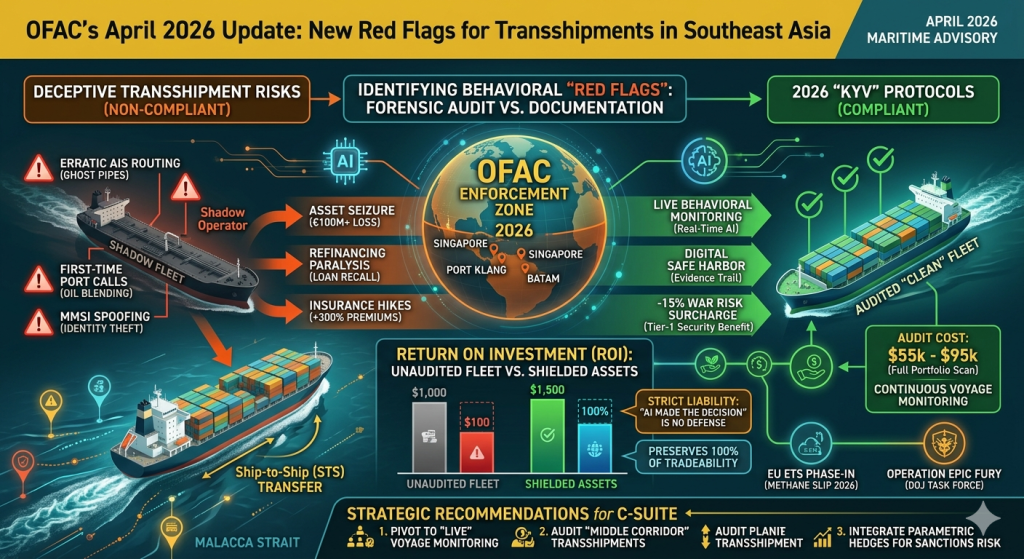
When a vessel is designated or “blocked” under the new 2026 criteria, its market value effectively drops to zero overnight. Unlike previous years, where a “pay and walk away” fine was the norm, 2026 enforcement under Operation Epic Fury focuses on the permanent freezing of assets. This results in:
- Asset Seizure: Total loss of the hull’s tradeability and residual value.
- Refinancing Paralysis: Traditional lenders will immediately pull Senior Secured Debt facilities, forcing owners into high-cost Mezzanine Financing just to cover operating expenses during the Arbitration & Litigation Costs phase.
- Insurance Hikes: The Joint War Committee (JWC) Circulars, particularly the recent JWLA-032, have already expanded “Listed Areas.” A sanctions-related incident in Southeast Asia can lead to a 300% spike in Parametric Insurance Premiums across your entire fleet.
2. The Compliance/Legal Framework: 2026’s “Strict Liability” Era
The April 2026 update is not just another list of names; it is a mandate for forensic behavioral analysis. The legal framework now integrates three critical 2026 shifts:
I. Behavioral Red Flags over Documentation
OFAC now explicitly rejects legal opinions based solely on paperwork. The April update lists “Behavioral Anomalies” as primary evidence for OFAC Sanctions Compliance breaches. These include:
- Erratic AIS Routing: Deviations from standard commercial lanes without mechanical justification.
- First-Time Port Calls: New patterns of calls to Southeast Asian hubs known for “Oil Blending.”
- MMSI Spoofing: Frequent changes to a vessel’s Maritime Mobile Service Identity to break historical trails.
II. The EU ETS & Methane Slip Trigger
As of Q2 2026, the EU ETS Phase-In has reached 100% compliance for $CO_2$ and, crucially, began including methane ($CH_4$) and nitrous oxide ($N_2O$). Why does this matter for sanctions? Transshipment hubs often use older, “Shadow Fleet” tonnage with high methane slip. If your vessel interacts with these entities, your ESG Disclosure Liability becomes a financial trap, as you may be held responsible for the “dirty” carbon footprint of your transshipment partners.
III. AI-Driven Navigation & Kinetic Risk
In the Red Sea and Southeast Asian corridors, AI-driven navigation liability has become a central legal debate. If an AI system “optimizes” a route through a JWC-listed area to save on fuel, and that route involves an unauthorized STS transfer, the owner is held under “Strict Liability.” The 2026 update makes it clear: the “AI made the decision” is no longer a valid defense in U.S. courts.
3. Strategic Recommendations: 3 Actionable Steps for the C-Suite
I. Pivot from “Screening” to “Live Monitoring”
Cease reliance on monthly static watchlist updates. Implement real-time, behavioral intelligence platforms that track AIS manipulation and “Dark Activity” in Southeast Asian waters. This provides a “Digital Safe Harbor” evidence trail in the event of Arbitration & Litigation Costs.
II. Audit Your “Middle Corridor” Transshipments
Perform an immediate forensic audit of all transshipment activities in Malaysia and Indonesia. Ensure your contracts include “Sanctions Exit” clauses that allow for immediate termination without penalty if a counterparty exhibits behavioral red flags identified in the April 2026 advisory.
III. Integrate Parametric Hedges for Sanctions Risk
Work with your Lloyd’s syndicate to secure Parametric Insurance Premiums that trigger liquidity payouts upon vessel detention. In the 2026 landscape, cash-on-hand is your only defense against a bank-led loan recall following a sanctions flag.
Frequently Asked Questions (FAQ)
1. What makes the April 2026 OFAC update different from previous advisories?
Previously, OFAC focused on who you were trading with. The April 2026 update focuses on how the vessel behaves. It identifies “Complex Transshipment Hubs” in Southeast Asia where “Shadow Fleet” activity is blended with legitimate trade. If your vessel exhibits “Dark Activity” patterns, it is flagged regardless of the cargo’s stated origin.
2. How does the JWLA-032 circular interact with Southeast Asian trade?
While JWLA-032 primarily focused on Guyana and the Black Sea, its 2026 revision includes “Expanded Surveillance Zones” in Southeast Asia. This means your Hull War Risk insurance now requires specific notifications for calls to certain Indonesian and Malaysian transshipment hubs, significantly raising your operational overhead.
3. Can I use AI-driven navigation to avoid these Red Flag zones?
Yes, but with caution. In 2026, underwriters require that AI-driven route optimizations be “Sanctions-Aware.” If your AI prioritizes fuel savings over OFAC Sanctions Compliance, you may find your insurance voided. Ensure your navigation software is integrated with live JWC and OFAC data feeds.
4. What is the impact of “Methane Slip” on my sanctions risk?
If you are using LNG-dual fuel vessels, the EU ETS phase-in requires precise reporting. “Shadow Fleet” tankers used in transshipment often have unverified methane slip profiles. In 2026, port authorities are using these emissions “signatures” to identify and detain suspect vessels, leading to Asset Seizure.
5. Why is “Mezzanine Financing” becoming a standard in 2026 maritime debt?
Because traditional banks are retreating from high-risk zones due to Basel IV “Output Floors.” Mezzanine Financing provides the flexible, albeit more expensive, capital needed to weather a 6-12 month Arbitration & Litigation period if a vessel is detained under the new April 2026 red flags.
Securing Your 2026 Strategic Advantage
Navigating the complexities of OFAC Sanctions Compliance and the shifting Joint War Committee (JWC) Circulars requires more than just due diligence; it requires Professional Advisory Services capable of forensic behavioral monitoring. As Parametric Insurance Premiums continue to rise and Asset Seizure & Hull War Risk becomes a daily reality for Southeast Asian transshipments, securing Specialized Insurance Cover is the only way to protect your Senior Secured Debt & Mezzanine Financing structures. Do not let ESG Disclosure Liability or Arbitration & Litigation Costs erode your portfolio’s yield—invest in the forensic infrastructure required for the 2026 maritime era.
Recent Comments