
As of January 2026, the global shipping community is under the full enforcement of the IACS Unified Requirements (UR) E26 and E27. These rules mandate that every newbuild and majorly retrofitted vessel must have a “Cyber Resilient” design that protects its navigation, propulsion, and steering systems.
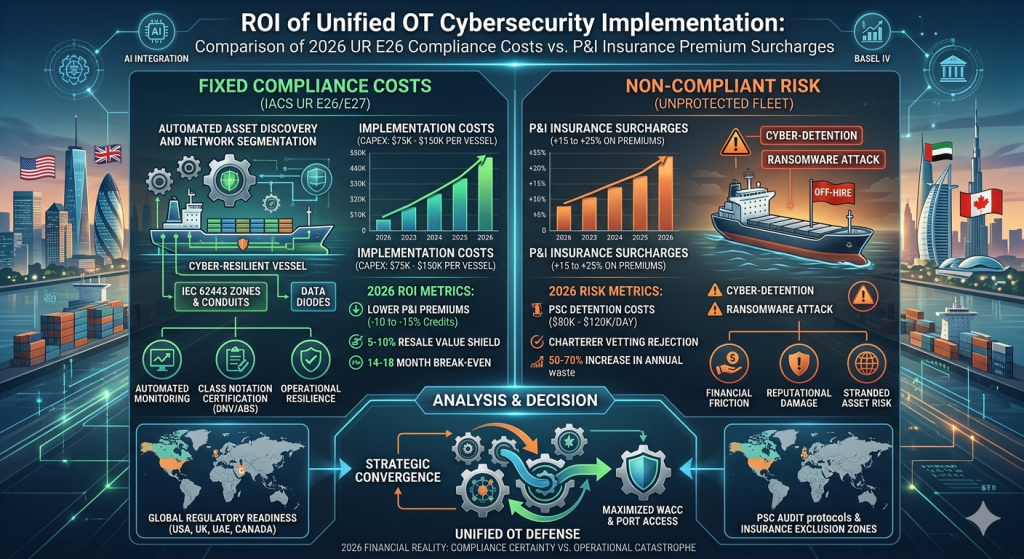
1. The Cost of Compliance: Implementing IACS UR E26/E27
Compliance in 2026 requires more than a firewall. It requires a fundamental re-engineering of the vessel’s digital architecture.
The Implementation Financials:
- Asset Discovery & Inventory: $15,000 – $30,000 per vessel. You cannot protect what you cannot see. Automated OT asset discovery tools are now required to map every PLC (Programmable Logic Controller) on the bridge and in the engine room.
- Network Segmentation: $40,000 – $85,000. Creating “Zones and Conduits” (as per IEC 62443) to ensure a malware infection on the crew Wi-Fi cannot jump to the Main Engine Control.
- Continuous Monitoring (MDR): $2,500 – $5,000 per month. 2026 regulations favor “Detect and Respond” over simple “Protect.”
The ROI Logic: While the upfront cost for a 10-vessel fleet might reach $750,000, this implementation acts as a valuation shield. A “Cyber-Classed” vessel in 2026 commands a 5–10% higher resale value and is significantly easier to charter to major energy companies (Shell, BP, ADNOC) who now mandate E26-level security in their vetting protocols.
2. The P&I Insurance Reality: “Cyber-Exclusion” is the Default
In 2026, the “Insurance Gap” is the most dangerous financial trap for shipowners. Most Protection & Indemnity (P&I) clubs and Hull & Machinery (H&M) underwriters have strictly enforced Cyber Exclusion Clauses (e.g., Clause 380 or LMA5403).
The Surcharge vs. Discount Math:
- The “Unprotected” Surcharge: If your fleet cannot demonstrate UR E26/E27 alignment, expect a 15–25% surcharge on your premiums, or worse, a complete exclusion for “Cyber-Attributed Losses.”
- The “Cyber-Secure” Discount: Owners with certified OT security systems are securing Premium Credits of 10–15%.
- The ROI Logic: For a Capesize bulker with an annual insurance bill of $200,000, a 15% surcharge is $30,000/year in pure waste. Over a 5-year period, your cybersecurity implementation pays for itself through insurance savings alone.
The “Silent Killer”: Port State Control (PSC) Detentions
By mid-2026, Port State Control authorities in the US (USCG), UK (MCA), and UAE have integrated Cyber-Audit Protocols into their standard inspections.
The Financial Impact of a “Cyber Detention”:
- Daily Off-Hire Cost: $35,000 – $120,000 (depending on vessel type).
- Emergency Consultant Fees: $15,000 – $25,000 to “clear” the deficiency and satisfy the surveyor.
- Reputational Damage: A detention record on Equasis can lead to the loss of future high-value charters.
The ROI Logic: A single 3-day detention in the Port of Houston or Jebel Ali can cost an operator $250,000. This is nearly the entire cost of a top-tier cybersecurity rollout for that vessel. Proactive compliance isn’t an expense; it is Operation Loss Prevention.
2026 Strategy: The “Unified Defense” Model
The most profitable 2026 maritime startups are moving away from “Siloed Security” (treating IT and OT separately) and adopting a Unified Threat Management (UTM) approach.
- Phase 1 (Audit): Perform a Gap Analysis against IACS UR E26.
- Phase 2 (Hardening): Implement hardware-based “Data Diodes” to protect the most critical propulsion systems.
- Phase 3 (Assurance): Secure a Cyber Class Notation (e.g., DNV “Cyber Secure” or ABS “Cyber Resilience”) to lock in insurance discounts.
Frequently Asked Questions (FAQ)
1. Does IACS UR E26 apply to my existing ships (legacy fleet)?
Technically, it applies to vessels contracted for construction after July 1, 2024. However, in 2026, many charterers and insurers are using E26 as the “Gold Standard” for all ships. If your 2015-built vessel isn’t retrofitted to these standards, you will likely face the insurance surcharges mentioned above.
2. What is the difference between IT and OT cybersecurity in 2026?
- IT (Information Tech): Protects your emails and manifest data.
- OT (Operational Tech): Protects the physical systems—the engine, the GPS, the ballast water pumps. In 2026, OT is the priority because an OT failure results in a physical casualty (grounding or collision).
3. Can I use standard “Office” antivirus for my ship’s bridge?
No. Standard antivirus can actually crash critical bridge software by blocking legitimate navigation updates. 2026 compliance requires Maritime-Grade EDR (Endpoint Detection and Response) that is “Class Approved” and tested for zero-interference with OT systems.
4. How long does a 2026 Cyber-Class Audit take?
A full fleet audit usually takes 4–8 weeks. This includes a remote assessment and a physical “Onboard Verification” by a surveyor while the vessel is in port or drydock.
5. Is Starlink/Kuiper making my ship more vulnerable?
Yes. The 2026 “Always-On” connectivity has permanently removed the “Air Gap” that used to protect ships. Every Starlink terminal is a potential entry point for a ransomware attack, making Unified OT Security non-negotiable for high-speed satellite users.
Final Strategist’s Conclusion: The “Cyber-Seaworthiness” Dividend
In 2026, “Seaworthiness” has been redefined. If your digital defenses are down, your ship is effectively a “Dead Ship” in the eyes of the law and the market. The ROI of OT cybersecurity is found in the avoidance of catastrophic friction—from insurance hikes to port detentions.
Recent Comments