
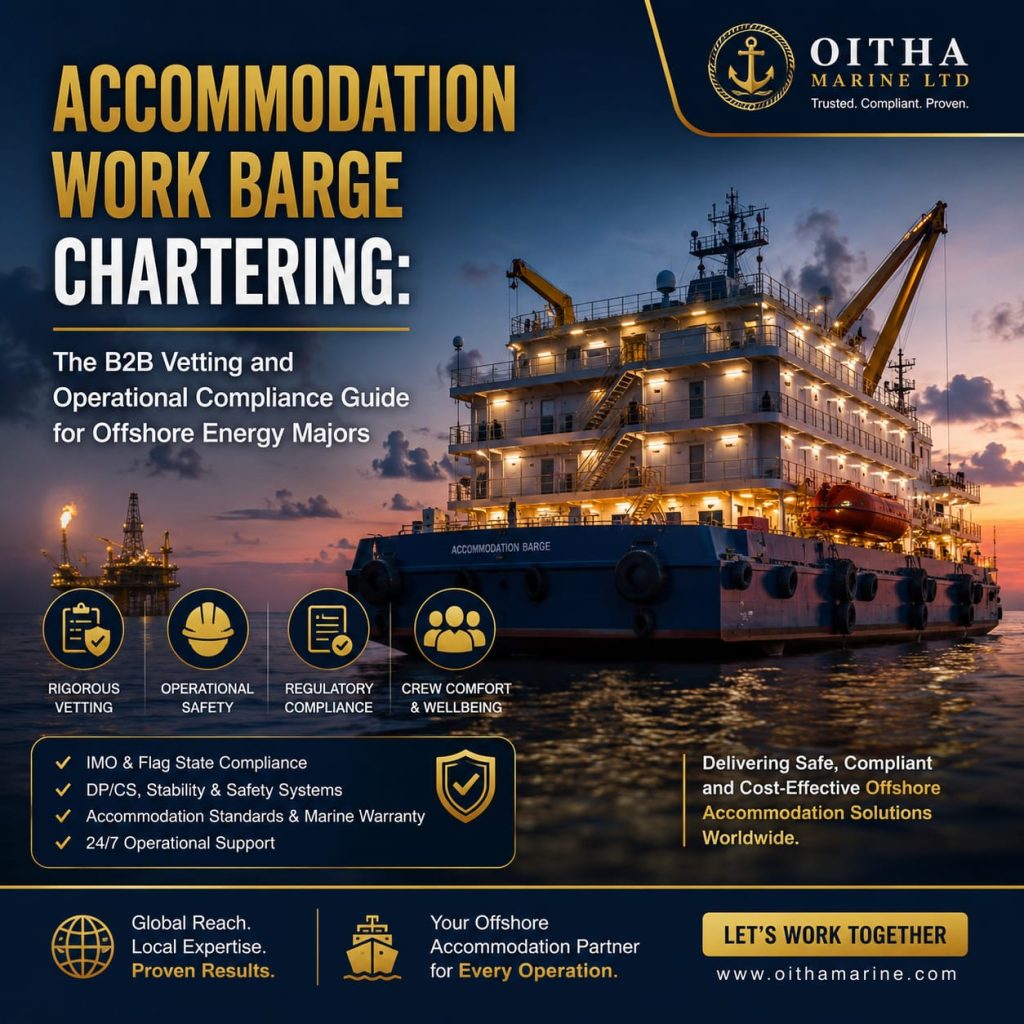
For offshore field managers, engineering procurement and construction (EPC) contractors, and marine logistics directors, chartering an offshore Accommodation Work Barge (AWB) is a capital-intensive decision governed by strict operational, safety, and regulatory benchmarks. Whether supporting hook-up and commissioning (HUC), platform maintenance, offshore decommissioning, or deepwater pipeline installation, selecting the right support barge requires evaluating how a vessel’s technical specifications translate into project uptime and safety.
In modern offshore operations across West Africa and international marine basins, oil and gas majors enforce strict International Marine Contractors Association (IMCA) and Oil Companies International Marine Forum (OCIMF) vetting standards.
This comprehensive guide breaks down the core technical, logistical, and safety criteria required when evaluating a high-capacity 290-Pax, 225-Tonne Crane Accommodation Work Barge for offshore campaigns.
1. Technical Evaluation Matrix: Key Vessel Specifications
When auditing an accommodation barge for offshore deployment, project planners must align vessel capacities with field requirements. The following specs represent the operational baseline for a heavy-capacity 90-meter class AWB:
| Operational Area | Technical Parameter | Specification Baseline | Strategic Field Value |
| Principal Dimensions | LOA × Breadth × Depth | Provides a stable, high-displacement platform for shallow and deepwater moorings. | |
| Draft & Deck Space | Max Draft / Deck Area | Allows high deck-load staging for fabrication spools, diving gear, and project equipment. | |
| Deck Strength | Uniform Loading Cap | Capable of supporting heavy offshore equipment, ROV spreads, and structural skids. | |
| Cargo Carrying Cap | Deadweight / Deck Cargo | Reduces transit frequency for supply vessels by storing substantial project cargo offshore. | |
| Accommodation | Total Persons Onboard (POB) | 290 Pax ( | Supports large multi-disciplinary engineering, commissioning, and marine teams. |
| Main Heavy Lift | Pedestal Crane Capacity | Executes heavy platform lifts, jacket maintenance, and structural module placement. | |
| Auxiliary Lift | Deck Service Crane | SWL | Handles continuous deck logistics, container transfers, and tool staging independently. |
| Position Keeping | Mooring Architecture | 8-Point Winch System ( | Maintains stationary station-keeping around fixed offshore assets and jacket legs. |
2. Station-Keeping Engineering: Evaluating 8-Point Mooring Infrastructure
For non-propelled or auxiliary-propelled accommodation work barges, station-keeping integrity around offshore platforms is a critical safety consideration. An unverified mooring configuration can lead to catastrophic platform contact or subsea pipeline damage.
[ 8-Point Mooring System Layout ]
│
┌────────────────────────────────┴────────────────────────────────┐
▼ ▼
[ Anchor Winch Capacity ] [ Anchoring Hardware ]
• 8-Point Mooring System • 12 x 7 t Delta Flipper Anchors
• Pull: 70 t @ 7 m/min | 35 t @ 14 m/min • High holding power in soft mud / clay
• Static Brake Hold: 150 t • Wire: 1,500 m x 46 mm diameter
• 4 x 10 t @ 15 m/min Tugger Winches • Wide operational footprint for deep water
A. High Holding Power (HHP) Anchor Deployment
An 8-point mooring system utilizing Delta Flipper anchors provides high holding power in soft mud, silt, and clay bottoms commonly encountered in deltaic regions. Combined with main winch drums spooled with
of
high-tensile steel wire, this setup offers a wide anchoring radius, allowing the barge to maintain precise positioning near platform jackets across changing tidal currents and severe weather conditions.
B. Tension Management and Brake Holding Load
With a static brake holding capacity of and line pulls of
at
, the mooring winches can absorb dynamic swell forces while keeping the barge stable during heavy lifting operations or gangway connections. Auxiliary
tugger winches further streamline deck handling and anchor wire management.
3. Off-Loading & Installation Capabilities: Dual Heavy-Lift Cranage
A primary factor in selecting an accommodation work barge is its ability to serve as a floating construction support hub. Relying solely on separate heavy-lift vessels increases charter costs and introduces scheduling conflicts.
[ Heavy Lift & Deck Cranage ]
│
┌─────────────────────────────────┴─────────────────────────────────┐
▼ ▼
[ Main Heavy-Lift Pedestal Crane ] [ Auxiliary Service Crane ]
• Capacity: 225 t @ 9 m radius • Capacity: SWL 37 t @ 9 m radius
• Outreach: 37 t @ 38 m max radius • Outreach: SWL 24 t @ 19 m radius
• Purpose: Heavy module placement, jacket repair, • Purpose: Continuous deck loading, tool basket
and structural decommissioning support transfers, and supply vessel offloading
- Heavy Lift Operations: A main pedestal crane rated at
(and capable of reaching
) enables the barge to execute module installations, conductor pipe replacements, and subsea manifold handling without bringing in secondary crane ships.
- Continuous Deck Logistics: Operating a dedicated
auxiliary deck crane ensures that routine supply boat offloading, container movements, and tool staging continue uninterrupted while the main crane is configured for major platform lifts.
4. Personnel Access, Helideck Operations, and POB Welfare
Offshore workforce productivity depends on reliable platform access, safe personnel transport, and suitable living conditions on board.
[ Offshore Access & Personnel Infrastructure ]
│
┌──────────────────────────────────┼──────────────────────────────────┐
▼ ▼ ▼
[ Telescopic Gangway ] [ Certified Helideck ] [ Hotel & Welfare Amenities ]
• Length: 36.5 m ± 6 m • Size: 15.24 m x 15.24 m • 290-Pax capacity (8×1-man, 70×4-man)
• SWL Rating: 10 t • Aircraft Class: S-61N & S-92 • Dedicated Medic & Hospital cabins
• Continuous walk-to-work access • Dedicated foam monitors • Offices, conference, gym, prayer room,
for 290-person workforce ($2 \times 68\text{ m}^3\text{/hr}$) and separate officer/crew recreation rooms
A. Walk-to-Work Gangway Safety
To maintain continuous workforce transfer between the barge and the offshore structure, the vessel utilizes a telescopic aluminum gangway rated for a
Safe Working Load (SWL) with a
compensation stroke. This system enables safe, continuous “walk-to-work” access, minimizing reliance on basket transfers during high sea states.
B. Helideck Compliance
The integrated helideck is rated to support heavy offshore transport helicopters, including the Sikorsky S-61N and S-92 classes. Outfitted with dedicated
main helideck fire pumps and dual
foam monitors, the helideck provides direct, compliant crew changes and emergency medical evacuations.
C. Offshore Personnel Welfare
Capable of housing 290 persons onboard (POB) across 8 single-man officer cabins, 70 four-man technician cabins, a dedicated medic room, and a fully equipped hospital cabin, the barge functions as a self-contained offshore hotel. Amenities include:
- Conference rooms, charterer offices, and client workspaces.
- Dedicated officer and crew mess rooms and separate recreation lounges.
- An onboard gymnasium and prayer room.
- Integrated charterer and vessel workshops to support field repairs.
5. Marine Power, Autonomy, and Safety Systems
To support continuous offshore campaigns without frequent port calls, an accommodation work barge requires substantial utility storage, robust power generation, and comprehensive safety systems.
[ Vessel Utilities & Autonomy Framework ]
│
┌─────────────────────────────────────┼─────────────────────────────────────┐
▼ ▼ ▼
[ Electrical Power Plant ] [ Fresh Water Autonomy ] [ Marine Fuel & Fluid Storage ]
• 4 x 500 kW Main Generators • Watermakers: 3 x 30 t/day RO Units • Fuel Oil: 1,858.4 m³
(415 V, 50 Hz, 3-Phase) • Potable Water Storage: 2,344.4 m³ • Drill Water / SWB: 4,842.0 m³
• 1 x 200 kW Emergency Gen • Sewage Plant: 300-person capacity • Industrial Water: 349.7 m³
A. Power Generation & Redundancy
Primary power is delivered by four main generator sets (
), providing load-sharing capability and redundancy during heavy lifting and gangway operations. Emergency systems are backed by an independent
emergency generator.
B. Offshore Fresh Water Generation
With a potable water tank capacity of backed by three
Reverse Osmosis (RO) watermakers (generating
of fresh water daily), the barge can maintain extended offshore campaigns without requiring constant fresh water supply boat transfers.
C. Safety and Life-Saving Appliances (LSA)
The safety configuration exceeds SOLAS requirements for 290 POB:
- Liferaft Capacity: 36 x 25-person SOLAS-compliant liferafts distributed across both sides of the superstructure.
- Fast Rescue Craft (FRC):
Fast Rescue Boat supported by a dedicated
SWL davit.
- Firefighting Capabilities: Features a
helideck fire pump, two
general service fire pumps, a
emergency fire pump, and four
water monitors for off-ship firefighting support.
Technical B2B FAQ: Accommodation Barge Chartering
Q1: What class notations are essential for an accommodation work barge operating in offshore fields?
A fully compliant barge should carry class notations from an International Association of Classification Societies (IACS) member, such as Bureau Veritas (BV). Key notations include X100A1 Accommodation Barge, Helicopter Landing Area, Deck Strengthened for Uniform Distribution Loading, XIWS (In-Water Survey capability), and XLMC (Machinery Control).
Q2: How is the deck loading capacity calculated for heavy project equipment?
Deck loading relies on both total weight capacity and point load strength. A barge with a deck cargo capacity and a uniform deck strength of
can support concentrated loads from heavy structural skids, diving spreads, and subsea reels without structural deformation. Engineering teams must calculate point loads and use load-spreading mats when dynamic stresses exceed
.
Q3: Why is an 8-point mooring system preferred over a 4-point system for offshore work barges?
An 8-point mooring system provides redundant directional control, higher total holding force, and greater stability against cross-currents and wind loads. If a single anchor slips or requires resetting during operations, the remaining seven points maintain station-keeping, preventing emergency disconnects of the telescopic gangway or crane loads.
Q4: How does the presence of onboard reverse osmosis (RO) watermakers impact charter economics?
Offshore accommodation barges house up to 290 personnel, consuming substantial fresh water daily. Onboard RO watermakers producing of fresh water per day eliminate the need for frequent supply boat deliveries. This reduces charterer operational expenditure (OPEX) and fuel consumption associated with water-hauling supply vessel runs.
Q5: Can the helideck handle offshore night operations and emergency evacuations?
Yes. A helideck compliant with CAP 437 standards—measuring with dedicated perimeter lighting, wind indicators,
fire pumps, and dual foam monitors—is rated for round-the-clock passenger transport, medical evacuations, and logistics support for heavy aircraft classes like the S-92.
Operational Vetting Summary for Charterers
When conducting pre-charter audits for a 290-Pax Accommodation Work Barge, marine engineering teams should evaluate four primary technical areas:
- Station-Keeping Reliability: Verify anchor wire length (
per winch), brake holding capacity (
), and anchor holding power for local sea-bottom conditions.
- Lifting Flexibility: Ensure the primary heavy-lift crane (
) and auxiliary deck crane (
) match the reach and weight requirements of planned platform construction or repair tasks.
- Personnel Logistics: Confirm that the gangway stroke (
) and helideck rating (S-92 compliant) provide continuous, safe access for offshore personnel.
- Hotel & Utility Autonomy: Verify fresh water generation capabilities (
RO capacity) and total fuel oil storage (
) to ensure long-term, uninterrupted field autonomy.
Secure Compliant Offshore Support with Oitha Marine
Sourcing verified accommodation work barges, heavy-lift support assets, and offshore logistics support requires deep marine engineering and regulatory expertise. At Oitha Marine, we support oil majors, EPC contractors, and offshore field operators across West Africa and international marine corridors with vessel sourcing, technical compliance auditing, and marine logistics management.
Ensure your offshore campaign is supported by compliant, high-performing marine assets. Contact our technical chartering desk today at oithamarine.com or visit Oitha Marine Technical Insights to request a vessel availability assessment.
Recent Comments