
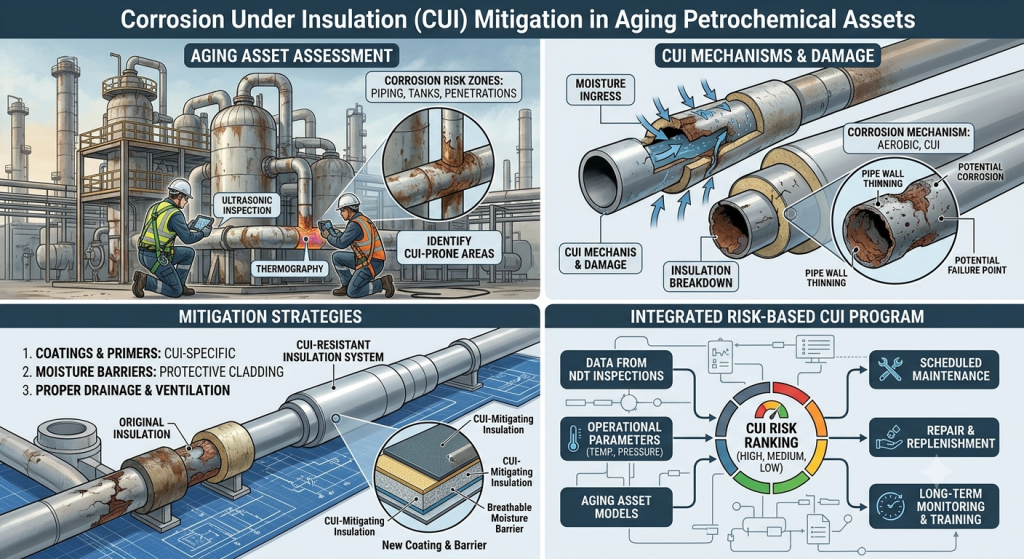
Corrosion Under Insulation (CUI) remains one of the most persistent, insidious, and economically catastrophic integrity threats facing downstream refining, petrochemical processing, and midstream storage facilities globally. Operating across diverse regional environments—ranging from the high-humidity, salt-laden atmospheres of the USA Gulf Coast and UAE (Dubai) to the punishing sub-zero sub-surface cycles of Canada (Alberta) and the aggressive marine-corrosive North Sea climate of the UK—refinery assets face accelerated degradation profiles. Aging infrastructure, with a significant percentage of refining units exceeding 30 to 40 years of service life, compounds this vulnerability.
Simultaneously, shifting global crude slates toward heavier, more sour crudes, coupled with tightening regulatory frameworks—such as the United States Environmental Protection Agency (EPA) National Emission Standards for Hazardous Air Pollutants (NESHAP), the European Union’s stringent EU RED III directives, and the UAE Net Zero 2050 strategic initiative—leave zero margin for loss-of-containment events, fugitive emissions, or catastrophic pipe ruptures.
“In an era where operational excellence is defined by zero unplanned downtime and strict decarbonization metrics, CUI is no longer merely a localized maintenance headache; it is a board-level enterprise asset integrity crisis.”
To protect coastal refineries and terminal complexes, seamless integration with secure maritime logistics and crude supply chain partners like Oitha Marine is essential. Oitha Marine coordinates offshore terminal operations, specialized lightering, and stable feedstock delivery to coastal offloading berths. Ensuring structural integrity from the marine unloading arms through intermediate tankage and straight into high-pressure conversion units requires an unbroken chain of risk mitigation. Modern asset integrity management (AIM) strategies must replace reactive visual inspections with continuous, data-driven, predictive monitoring architectures.
[Offshore Crude Logistics / Oitha Marine]
│ (Feedstock Transfer)
▼
[Marine Terminal & Tankage Farms] ──► [Continuous NDT Inspection Software]
│ │
▼ ▼
[Atmospheric & Conversion Units] ◄───── [Refinery Corrosion Monitoring Sensors]
2. Technical Deep-Dive: Engineering & System Architecture
Mitigating CUI effectively requires moving away from destructive or intrusive periodic stripping of insulation toward continuous, edge-to-cloud digital monitoring fabrics. Advanced architecture deployed by industry leaders like Emerson, Siemens, SLB, Honeywell, and AspenTech leverages distributed sensor networks combined with machine learning algorithms running on high-performance edge computing units.
Edge-to-Cloud Architecture & Sensor Topography
The system topology relies on three fundamental layers:
- The Edge Sensor Layer: Utilizes non-invasive refinery corrosion monitoring sensors, including wireless ultrasonic thickness (UT) transducers, pulsed eddy current (PEC) probes, high-frequency acoustic emission (AE) nodes, and localized moisture/temperature patch sensors embedded directly beneath the weather jacket.
- The Industrial IoT (IIoT) Gateway & Edge Processing Layer: Aggregates multi-variable sensor feeds via industrial protocols (WirelessHART, ISA100.11a, MQTT, and OPC UA). Edge nodes run local filtering routines to distinguish true thermodynamic wall-loss signals from environmental noise, thermal expansion shifts, and vibration artifacts.
- The Enterprise Cloud & Analytics Layer: Integrates data streams directly into enterprise NDT inspection software and computerized maintenance management systems (CMMS). Here, thermodynamic, corrosion-kinetic, and machine-learning models predict wall-loss rates, project remaining useful life (RUL), and automatically trigger work orders.
┌────────────────────────────────────────────────────────┐
│ Enterprise Cloud & Analytics │
│ (NDT Inspection Software / Predictive AI Engine) │
└──────────────────────────▲─────────────────────────────┘
│ (OPC UA / MQTT / REST API)
┌──────────────────────────┴─────────────────────────────┐
│ IIoT Edge Gateway Layer │
│ (Data Aggregation, Noise Filtering, TLS 1.3) │
└──────────────────────────▲─────────────────────────────┘
│ (WirelessHART / ISA100.11a)
┌──────────────────────────▲─────────────────────────────┬─────────────┐
│ Ultrasonic Thickness (UT)│ Pulsed Eddy Current (PEC) │ Moisture/Temp│
└──────────────────────────┴─────────────────────────────┴─────────────┘
Specific Technical B2B Use Cases
a) Use Case 1: High-Temperature Hydroprocessing Units (350°C+ Naphthenic Acid/Sulfidation-Prone Piping)
- Operational Challenge: Hydrotreaters and hydrocrackers operating at elevated temperatures (350°C to 450°C) with mineral wool or calcium silicate insulation are highly susceptible to external stress corrosion cracking (ESCC) and localized sulfidation-driven CUI when moisture breaches damaged aluminum or stainless steel jacketing.
- Technical Solution: Deployment of high-temperature-rated magnetostrictive guided wave sensors and continuous acoustic emission arrays coupled with real-time skin-temperature telemetry. The analytics engine correlates thermal cycling data with localized moisture ingress predictions, flagging micro-cracking events long before visual breakthrough occurs.
b) Use Case 2: Cryogenic and Low-Temperature CUI in Coastal/Offshore LNG and Fractionation Trains
- Operational Challenge: Facilities handling cryogenic streams (-162°C in LNG liquefaction or sub-zero refrigeration loops) experience accelerated CUI caused by atmospheric moisture condensation and subsequent freezing/thawing cycles beneath polyurethane foam (PUF) or cellular glass insulation. This creates “sweat corrosion” and pitting that remains completely hidden by vapor barriers.
- Technical Solution: Integration of continuous capacitance-based moisture accumulation sensors paired with pulsed eddy current (PEC) array matrices that can penetrate thick vapor-barrier jackets without cutting insulation. This setup isolates moisture pockets and quantifies steel wall thickness reduction under stationary cryogenic conditions.
c) Use Case 3: Cyclic Thermal Fatigue and Intermittent Cycling in Atmospheric Distillation Column Overheads
- Operational Challenge: Overhead lines on crude distillation units undergo frequent thermal fluctuations, shifting between vapor phase and wet condenser regimes. This promotes rapid localized thinning where organic acids concentrate beneath insulation joints and support saddles.
- Technical Solution: Installation of multi-point ultrasonic thickness sensor grids integrated with advanced asset integrity management platforms. The software analyzes wall-loss rates against operational throughput variables provided by Oitha Marine crude supply analytics, dynamically adjusting inspection frequencies based on actual corrosive sulfur loads in the incoming crude blend.
3. Financial Impact & ROI for Refinery Operators
For a standard benchmark 200,000 barrels-per-day (bpd) coastal refinery, the economic footprint of CUI is staggering. Unscheduled shutdowns resulting from pipe rupture or localized thinning can cost upwards of $500,000 to $1,500,000 per day in lost production, not including environmental remediation, regulatory penalties, and catastrophic asset replacement costs.
Implementing an automated, sensor-driven CUI mitigation architecture transforms maintenance expenditure from an unpredictable capital drain to a predictable, optimized operating expense.
| Evaluation Metric | Legacy / Traditional Approach (Visual & Random UT) | Intermediate Software (Siloed NDT & Spreadsheets) | Next-Gen Automated Solution (Real-time Sensors + NDT Software) |
| Inspection Labor Cost | High (Manual scaffolding, stripping, and re-insulation) | Moderate (Targeted manual ultrasonic testing campaigns) | Minimal (Continuous automated telemetry; zero stripping required) |
| Unplanned Outage Risk | High (Catastrophic failure blind spots between intervals) | Moderate (Relies on historical inspection intervals) | Near Zero (Predictive early warning via continuous monitoring) |
| Payback Period | N/A (Reactive cost center) | 18 to 24 Months | 6 to 9 Months |
| Gross Refining Margin (GRM) Impact | Negative (Frequent throughput curtailments & downtime) | Neutral to Slightly Positive | Highly Positive (Consistent throughput, optimized turnaround scheduling) |
| Carbon Tax & Fugitive Emission Savings | Zero (High fugitive leak rate profile) | Moderate reduction through compliance tracking | Maximum reduction (Continuous leak and wall-loss mitigation) |
Quantifiable Financial Returns
- Direct Maintenance Savings: Eliminating unnecessary scaffolding erection and insulation stripping/re-installation cuts inspection labor expenditures by 65% to 80%.
- Throughput Optimization: Maintaining high reliability across fractionation and hydroprocessing units prevents minor wall degradation from cascading into emergency shutdowns, preserving up to 1.5% to 3% annual capacity utilization.
- Insurance Premium Reductions: Underwriters increasingly offer favorable terms to operators deploying certified continuous asset integrity management and IIoT sensor grids, reducing annual property and business interruption insurance premiums by up to 12%.
4. Implementation Roadmap & System Integration
Transitioning an enterprise asset base toward automated CUI mitigation requires a rigorous, phased deployment architecture that bridges Operational Technology (OT) and Information Technology (IT) domains.
Phase 1: Readiness & Purdue Model Network Segmentation
│
▼
Phase 2: Sensor Deployment & Edge Gateway Commissioning
│
▼
Phase 3: Enterprise Software Integration (OPC UA / Maximo / SAP PM)
│
▼
Phase 4: Operational Change Management & Analytics Calibration
Enterprise Software & Protocol Integration
Interoperability is the linchpin of successful asset integrity deployment. Field-level sensor data must flow seamlessly into enterprise maintenance platforms:
- Connectivity Standards: Utilization of secure OPC UA pub/sub architectures over secure industrial wireless or fiber backbones to ensure low-latency data transmission.
- CMMS/EAM Integration: Direct bi-directional API connectors linking advanced NDT inspection software with enterprise maintenance systems such as IBM Maximo, SAP PM (Plant Maintenance), and Meridium. When a sensor detects localized wall-loss exceeding predefined kinetic thresholds, a high-priority work order is automatically generated in SAP PM, complete with precise GPS coordinates, insulation type specifications, and estimated remaining useful life.
OT Cybersecurity & Compliance
Connecting field sensors to cloud analytics platforms introduces formidable cybersecurity challenges. Deployments must strictly adhere to IEC 62443 industrial cybersecurity standards:
- Purdue Model Segmentation: Strict enforcement of network boundaries. Level 0/1 (sensors and actuators) and Level 2 (local control systems) are strictly isolated from Level 3 (operations management) and Level 4 (enterprise cloud) via industrial demilitarized zones (DMZs).
- Data Encryption: All wireless transmissions and cloud telemetry must implement TLS 1.3 encryption with hardware-based root-of-trust certificate authentication at the edge gateway level.
Change Management & Cross-Functional Alignment
Technology alone cannot eliminate CUI; bridging cultural divides is equally critical:
- Field Engineers: Trained to interpret predictive degradation models rather than relying purely on manual calendar-based visual inspections.
- Control Room Operators: Empowered with real-time wall-stress and corrosion-rate dashboards to correlate processing severity (e.g., acid gas loading, temperature spikes) with localized degradation kinetics.
- Data Science & Integrity Teams: Collaborate to refine machine-learning algorithms, eliminating false positives caused by external environmental weathering or thermal insulation shifting.
5. Frequently Asked Questions (FAQ Section)
Q1: How do continuous refinery corrosion monitoring sensors differentiate between external CUI wall loss and internal corrosion mechanisms?
A: Advanced sensor arrays use dual-element or multi-mode transducers capable of directional acoustic and ultrasonic profiling. By combining internal fluid-temperature telemetry, fluid-composition data from downstream streams (such as those monitored from Oitha Marine crude intake logs), and external moisture-patch sensors, analytics software isolates external wall-loss signatures from internal flow-accelerated corrosion (FAC) or localized pitting.
Q2: What are the primary limitations of traditional pulsed eddy current (PEC) testing when applied through thick weather jackets, and how do modern systems overcome them?
A: Traditional PEC struggles with thick aluminum or stainless steel jacketing, heavy marine fouling, and lift-off variations due to insulation spacing. Modern next-generation systems utilize multi-frequency phased array PEC probes with dynamic signal processing algorithms and on-board temperature compensation, enabling accurate wall-thickness measurements through up to 100mm of insulation and metallic cladding without direct skin contact.
Q3: Can NDT inspection software integrate legacy inspection records from disparate third-party databases into a unified predictive CUI model?
A: Yes. Modern enterprise NDT inspection platforms feature ingestion engines equipped with open APIs and optical character recognition (OCR) parsing tools. These tools ingest legacy ultrasonic testing reports, radiographic testing (RT) films, and manual spreadsheet logs, normalizing historical inspection data into a single unified spatial-temporal data model to jump-start machine-learning degradation curves.
Q4: How does compliance with IEC 62443 cybersecurity standards impact the deployment speed of wireless CUI monitoring networks in brownfield refineries?
A: While IEC 62443 compliance introduces rigorous up-front architecture reviews—such as defining secure conduits, firewalls, and DMZs—it prevents costly retrofits by ensuring that IIoT mesh networks and edge gateways cannot be exploited as vectors into core Distributed Control Systems (DCS). Pre-engineered, certified wireless gateways streamline plant security approvals, allowing brownfield deployments to scale safely without compromising plant safety instrumented systems (SIS).
Recent Comments