
As fleet founders in the USA, UK, and UAE scale their 2026 acquisitions, the choice between Fixed (Land-to-Ship) and Mobile (Ship-to-Ship/Truck-to-Ship) bunkering infrastructure is the single most significant driver of long-term OpEx.
1. Fixed LNG Bunkering Infrastructure: The CAPEX Fortress
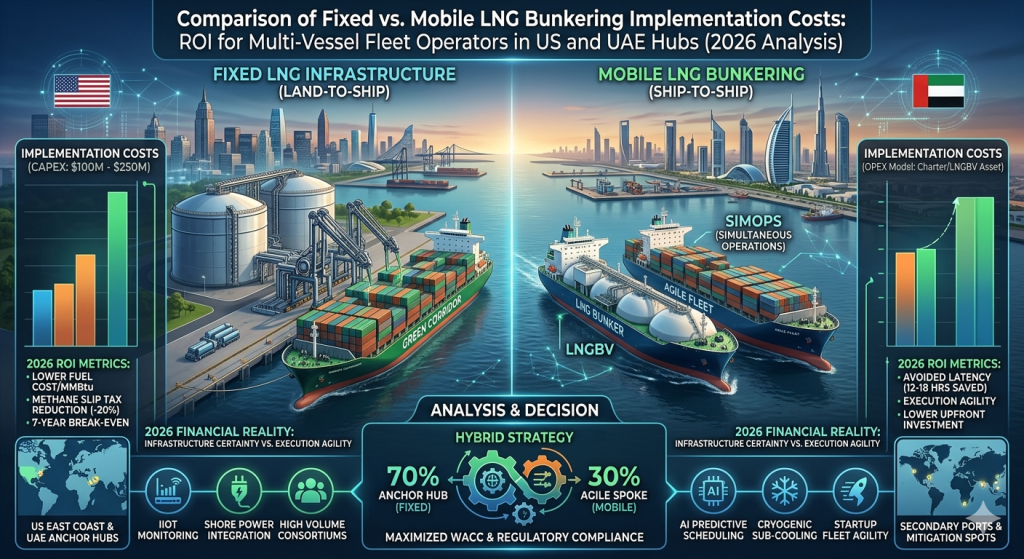
Fixed infrastructure involves dedicated LNG jetties and cryogenic pipelines connected to land-based storage tanks. In 2026, these are increasingly seen in “Mega-Hubs” like the Port of Virginia (USA) and Port Khalifa (UAE).
The Financials:
- Implementation Cost: $80M – $250M (Scale dependent).
- 2026 Tech Integration: Requires Industrial IoT (IIoT) mesh networks for real-time methane slip monitoring and automated cryogenic loading arms.
- The “Moat”: Provides the lowest cost-per-MMBtu of fuel due to direct pipeline or bulk-import access.
The ROI Logic:
For a fleet operator with more than 10 dual-fuel vessels calling at a single hub consistently, fixed infrastructure offers a 7-year break-even point. The ROI is driven by Volume Discounts and the total elimination of “Barge Charter Fees,” which in 2026 have spiked due to limited supply of Jones Act-compliant LNG bunker vessels in the USA.
2. Mobile LNG Bunkering (STS): The Agile OPEX Play
Mobile bunkering utilizes specialized LNG Bunker Vessels (LNGBVs) to refuel ships at anchor or during cargo operations (SIMOPS).
The Financials:
- Implementation Cost: $0 (Charter model) or $60M – $90M (Asset purchase of an LNGBV).
- 2026 Tech Integration: Requires AI-Driven Predictive Scheduling to coordinate the LNGBV’s movements with the fleet’s arrival, minimizing “idle steam” time.
- The “Flexibility”: Allows for bunkering at any berth, preventing the need to move the vessel to a specialized terminal.
The ROI Logic:
For startups and mid-sized fleets (3–7 vessels), Mobile STS is the winner. The ROI is found in Avoided Opportunity Costs. By performing bunkering simultaneously with cargo operations (SIMOPS), an operator saves 12 to 18 hours per port call. At 2026 charter rates, this is a $300,000+ annual saving per vessel.
2026 Cost Comparison Matrix: US East Coast vs. UAE Hubs
| Metric | US East Coast (Port of Savannah/Virginia) | UAE (Jebel Ali/Fujairah) |
| Fixed Infrastructure Permitting | 24–36 Months (Complex EPA/FERC) | 12–18 Months (Streamlined MOEI) |
| Mobile LNGBV Charter (Daily) | $35,000 – $55,000 (Jones Act Premium) | $25,000 – $40,000 |
| Methane Slip Tax (2026) | $90 / Tonne (Estimated) | Linked to EU ETS (Export focus) |
| Labor/Tech Implementation | High (Specialized Engineering) | Moderate (Expat Technical Teams) |
3. The “Methane Slip” Liability: A 2026 Financial Pivot
In 2026, “Methane Slip”—the release of unburned methane during the bunkering process—is no longer just an environmental issue; it is a Balance Sheet Liability.
- Fixed Systems: Generally feature higher-efficiency vapor recovery systems (VRUs), reducing methane tax liability by 15%–20% compared to older mobile setups.
- Mobile Systems: 2026-gen LNGBVs now use Cryogenic AI sub-cooling to maintain zero-boil-off, but the “Transfer Friction” still carries a higher regulatory risk score in UK and Canadian waters.
Operational Strategy: The “Hybrid” Implementation
The most successful 2026 founders in the UAE and USA are moving toward a Hybrid Bunkering Strategy:
- Anchor Hub (Fixed): Secure a long-term “Take-or-Pay” contract with a fixed terminal in their primary hub (e.g., Jebel Ali) for 70% of fuel needs.
- Agile Spoke (Mobile): Use spot-market mobile bunkering for “Top-offs” in secondary ports or to mitigate schedule delays.
Frequently Asked Questions (FAQ)
1. Why are implementation costs higher in the USA than the UAE?
In 2026, the USA’s Jones Act and NEPA (National Environmental Policy Act) requirements add layers of domestic labor mandates and environmental impact studies that don’t exist in the same format in the UAE. However, US-based projects often qualify for Green Infrastructure Tax Credits (ITC) under the 2026 expanded Inflation Reduction Act.
2. Can a startup fleet afford Fixed Infrastructure?
Rarely as a solo entity. In 2026, startups are forming “Bunkering Consortiums.” By pooling 3–4 small fleets together, they can secure “Project Finance” from Tier-1 banks to build a shared fixed terminal, dramatically lowering their individual cost of fuel.
3. What is the impact of AI on 2026 Bunkering ROI?
AI is the “Margin Protector.” In 2026, Agentic AI manages the “Bunker Auction.” It scans the prices in Jebel Ali vs. Fujairah vs. Virginia in real-time, accounts for the carbon tax in each jurisdiction, and directs the vessel to the most “Tax-Efficient” bunkering location.
4. Is LNG “Future-Proof” against 2030 Ammonia/Hydrogen mandates?
Most 2026 fixed infrastructure is now built as “Multi-Fuel Capable.” Cryogenic tanks designed for LNG are being engineered with the metallurgy required for Liquid Hydrogen or Ammonia retrofits, protecting the owner’s long-term CAPEX.
5. How does the UK’s 2026 Carbon Budget affect LNG bunkering?
The UK has implemented a strict “Port Emissions Limit.” Mobile bunkering vessels that do not use Zero-Emission Electric Propulsion are increasingly being surcharged, making Fixed Land-to-Ship (which can use shore power) more attractive for UK-based operations.
Final Strategist’s Conclusion: The “Infrastructure Dividend”
In 2026, the maritime energy transition is a game of Infrastructure Certainty. Fixed infrastructure offers the “Compliance Fortress” for established giants, while Mobile STS provides the “Execution Agility” for high-growth startups.
For fleet owners in the USA and UAE, the ROI isn’t just in the fuel price—it’s in the Regulatory Shield provided by high-efficiency, AI-monitored bunkering systems.
Recent Comments