
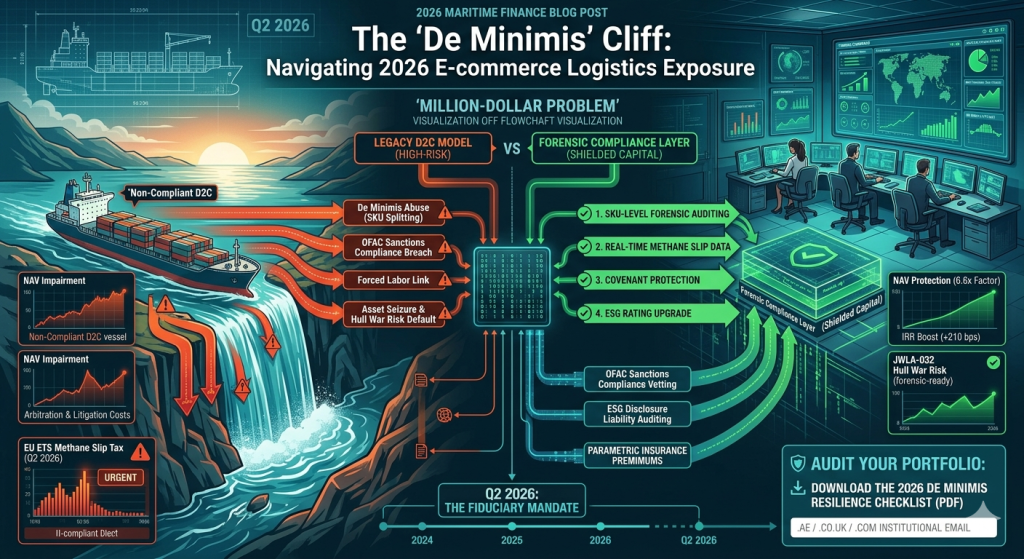
The Q2 2026 contraction of “De Minimis” thresholds across major OECD jurisdictions has transformed high-volume e-commerce from a low-friction logistics play into a high-stakes forensic compliance minefield. For institutional investors and C-Suite executives, failure to mitigate the resulting customs scrutiny triggers an immediate contagion of Asset Seizure & Hull War Risk defaults, potentially impairing the Senior Secured Debt underpinning global supply chain platforms.
The Economic Impact: Capital Devaluation and Margin Compression
The “Million-Dollar Problem” for 2026 is the sudden “thickening” of borders. For years, the $800 threshold (Section 321 in the U.S.) acted as a fiduciary safe harbor; its removal or aggressive narrowing has stripped the scalability from “direct-to-consumer” (DTC) models.
Balance Sheet Impairment
- Inventory Stagnation: Increased customs inspections lead to port congestion. In 2026, a 48-hour delay in clearing high-value e-commerce parcels can trigger a 15% drop in quarterly EBITDA for just-in-time retailers.
- Liquidity Freezes: When customs authorities identify systematic De Minimis abuse, they move beyond fines to Asset Seizure. For a Private Equity fund, the seizure of a charter vessel’s cargo isn’t just a loss of goods—it is a technical default on Senior Secured Debt & Mezzanine Financing agreements that require “unencumbered movement of collateral.”
- Insurance Hardening: The 2026 Joint War Committee (JWC) Circulars, specifically updates following JWLA-032, now factor “Trade Compliance Velocity” into war risk ratings. A fleet flagged for customs irregularities faces a 200-basis-point surge in Parametric Insurance Premiums, as insurers price in the risk of state-sponsored detention.
The Compliance/Legal Framework: The 2026 Enforcement Grid
The 2026 regulatory environment is a convergence of fiscal protectionism and national security.
OFAC Sanctions Compliance and Forced Labor
The new De Minimis rules require granular SKU-level data. This transparency is now the primary vehicle for enforcing OFAC Sanctions Compliance. In 2026, “I didn’t know the subcontractor’s subcontractor was sanctioned” is no longer a valid legal defense. Regulators are utilizing AI to trace upstream components back to prohibited regions, and the resulting Arbitration & Litigation Costs for misdeclared e-commerce shipments are becoming unrecoverable for mid-tier operators.
EU ETS and Methane Slip: The Hidden Logistics Tax
Simultaneously, the EU ETS Phase-In costs for methane slip have hit their 2026 peak. E-commerce carriers utilizing LNG-fueled vessels are finding that the “Green Premium” is being cannibalized by these phase-in costs. This creates an ESG Disclosure Liability; if your firm claims “Carbon Neutral Delivery” while ignoring the forensic methane slip data at the vessel level, you are exposed to significant “Greenwashing” litigation.
AI-Driven Navigation and Liability in the Red Sea
Furthermore, the shift in e-commerce routes to avoid Red Sea kinetic threats has introduced AI-driven navigation liability. When automated systems reroute high-priority e-commerce vessels to meet delivery windows, any collision or breach of territorial waters during “Dark Mode” navigation places the liability squarely on the C-Suite’s algorithmic oversight.
Strategic Recommendations: 3 Actionable Steps for the CEO
I. Institutionalize Forensic Cargo Auditing
Cease reliance on third-party customs brokers’ generic attestations. Implement an internal “Forensic Compliance Layer” that validates SKU-level data against OFAC Sanctions Compliance lists and Forced Labor databases before the vessel is fixed. This proactive stance is the only way to insulate Senior Secured Debt from regulatory-induced acceleration.
II. Restructure Insurance for “Regulatory Sudden-Stop”
Standard P&I and Hull cover are insufficient for the 2026 “De Minimis” cliff. CEOs should negotiate Parametric Insurance Premiums that trigger immediate liquidity injections upon “Administrative Detention” by customs authorities. This offsets the operational burn rate during Arbitration & Litigation Costs and prevents the need for emergency, high-interest Mezzanine Financing.
III. Deep-Tier ESG Reporting
Address your ESG Disclosure Liability by integrating real-time methane slip data from your shipping partners. Ensure your 2026 ESG audits reflect the actual EU ETS Phase-In costs, moving beyond “Carbon Offsets” to hard forensic data. This protects the firm’s valuation during institutional due diligence.
Professional Advisory for the 2026 Trade Era
The collapse of De Minimis thresholds has turned the “Global Village” into a series of “Forensic Checkpoints.” Navigating this shift requires more than a logistics manager; it requires a Senior Risk Consultant with an underwriter’s forensic eye. Whether you are battling rising Parametric Insurance Premiums or mitigating the threat of Asset Seizure & Hull War Risk in congested lanes, you need Professional Advisory Services. Oitha Marine specializes in providing the Specialized Insurance Cover and legal frameworks—governed by the latest Joint War Committee (JWC) Circulars—to ensure your capital remains senior and your supply chain remains unencumbered.
FAQ: 2026 E-commerce Logistics Risk
Q: How does the JWLA-032 circular impact my e-commerce shipping? A: While JWLA-032 focuses on war risk “Listed Areas,” in 2026, these areas have been expanded to include ports where “Trade War Contagion” is high. If your e-commerce cargo is on a vessel entering these zones without specific “Sanctions-Safe” certification, your insurance may be voided ab initio.
Q: What is the “Methane Hammer” in 2026 logistics? A: It refers to the EU ETS Phase-In costs for methane slip. If your carrier uses LNG, you are now paying for the methane that leaks during combustion. This must be factored into your landed cost models or your ESG Disclosure Liability will skyrocket.
Q: Can Mezzanine Financing help if my cargo is seized? A: Mezzanine Financing is often the only liquidity source when Senior Secured Debt is frozen due to an Asset Seizure. However, the “Sanctions Premium” in 2026 means this capital is prohibitively expensive. Prevention through compliance is the only viable ROI strategy.
Q: How do I handle AI-driven navigation liability in the Red Sea? A: You must ensure your charterparties include “Algorithmic Indemnity” clauses. If the AI reroutes the ship into a sanctioned port to avoid a drone strike, the legal responsibility for the OFAC Sanctions Compliance breach must be pre-allocated.
The Death of “Good Faith” in Customs Attestation
In the previous decade, shipowners could claim a “Passive Carrier” defense. In 2026, the law has moved to “Forensic Liability.” The Joint War Committee (JWC) Circulars now explicitly state that if a carrier knowingly facilitates the systematic circumvention of De Minimis thresholds (e.g., through “split shipments” intended to stay under new $50 limits), the vessel is classified as an “Enforcement Target.”
This classification triggers an immediate hike in Parametric Insurance Premiums. Investors must understand that “Trade Velocity” is now a risk metric. When a vessel is detained in Gibraltar or Singapore for forensic SKU auditing, the daily OPEX burn—exacerbated by EU ETS Phase-In costs—can exceed the value of the cargo itself.
The Capital Stack Waterfall: Senior Debt vs. Regulatory Seizure
For the CFO, the most terrifying phrase in 2026 is “Government Lien.” If a vessel is seized due to an OFAC Sanctions Compliance violation buried deep within 10,000 e-commerce parcels, the government’s claim on that hull often ranks ahead of the Senior Secured Debt.
Lenders are responding by demanding “Sanctions-Safe” warranties. If those warranties are breached, the bank can accelerate the debt, forcing the company into a fire-sale or a desperate scramble for Mezzanine Financing. This is the “Million-Dollar Problem” in its purest form: the destruction of institutional equity via a $50 parcel.
The Red Sea Paradox: AI, Conflict, and Liability
The Red Sea remains the world’s most volatile e-commerce artery. In 2026, the threat isn’t just kinetic—it’s legal. AI-driven navigation liability arises when automated rerouting algorithms optimize for fuel and time but fail to account for the shifting boundaries of Asset Seizure & Hull War Risk zones.
If your cargo is on a vessel that is seized because an AI agent decided to save three hours by skirting a “Listed Area” without a JWC-approved “War Risk Waiver,” the Arbitration & Litigation Costs will be astronomical. C-Suite executives must ensure that “Human-in-the-Loop” overrides are mandatory for any navigation change involving a JWC-monitored zone.
ESG: The New Frontier of Litigation
Finally, the ESG Disclosure Liability of 2026 cannot be overstated. With the EU ETS Phase-In costs for methane slip fully integrated into maritime law, every e-commerce shipment has a forensic “Methane Signature.” Institutional investors are now auditing these signatures. A firm that ignores this data is essentially carrying “Toxic Carbon Assets” on its balance sheet.
Protecting your ROI means moving beyond the logistics of how you ship to the forensics of what you are shipping and who is moving it. The 2026 De Minimis cliff is not just a tax—it is a filter that will remove non-forensic players from the global market.
[Consult with Oitha Marine today to secure your 2026 Fiduciary Shield.]
Recent Comments