
The “Expensive Problem” for 2026 maritime investors is Asset Immobilization. As of March 2026, OFAC has designated over 875 vessels, entities, and individuals linked to shadow networks. For a PE fund, a single “blocked” vessel in your portfolio doesn’t just represent a loss of that asset—it can trigger cross-default clauses in your entire financing structure and result in the loss of correspondent banking relationships.
1. The “Strict Liability” Trap: Why General Due Diligence Fails
In 2026, “I didn’t know” is no longer a legal defense. U.S. sanctions are a strict liability offense, meaning OFAC can impose civil penalties regardless of whether the investor intended to violate the law.
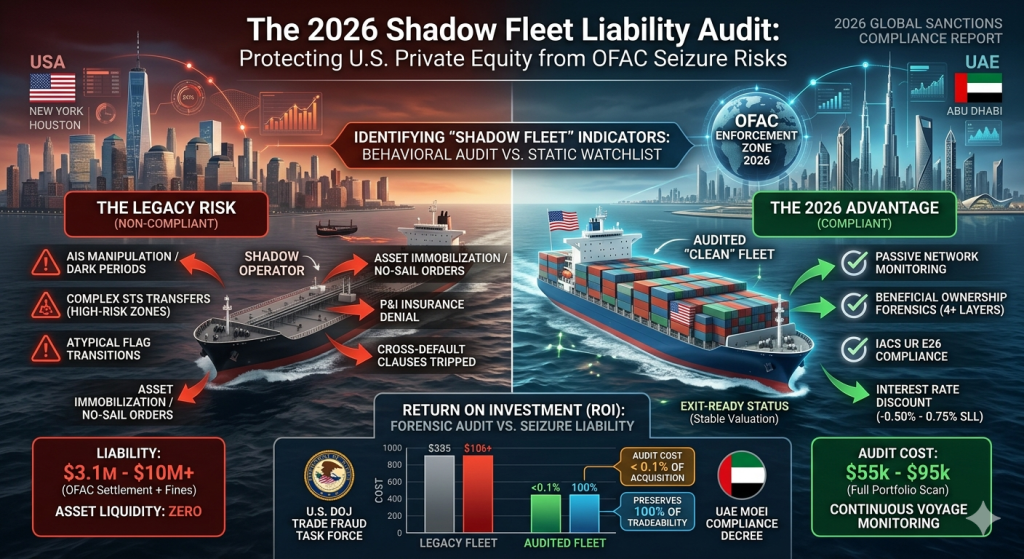
The 2026 “Shadow” Indicators:
Investors must now audit for Behavioral Red Flags that static watchlists miss:
- AIS Manipulation & “Dark” Periods: 2026 enforcement focuses on “Identity Spoofing” where a vessel mimics the signal of a decommissioned ship.
- Complex Ship-to-Ship (STS) Transfers: Multiple STS transfers in “high-risk” zones (e.g., west of Mumbai or the Mediterranean) are now viewed by the DOJ’s Trade Fraud Task Force as prima facie evidence of origin obfuscation.
- Atypical Flag Transitions: A sudden move to a “low-oversight” registry (e.g., Comoros, Palau, or Vanuatu) often precedes a vessel entering shadow operations.
2. Audit Costs vs. Seizure Liability (2026 Financial Analysis)
| Cost Category | Pre-Investment Forensic Audit | Post-Seizure / Ransomware / Legal Event |
| Direct Cash Outlay | $55,000 – $95,000 (Full Portfolio Scan) | $3.1M – $10M+ (OFAC Settlement + Fines) |
| Asset Liquidity | Confirms “Clean Title” for Exit | Zero (Asset becomes unsellable “Blocked Property”) |
| Financing Impact | 0.50% – 0.75% Interest Discount | Immediate Loan Recall (Cross-default) |
| Operational Impact | Continuous Trading | “No-Sail” Orders (USCG/Port State Control) |
Export to Sheets
The 2026 Reality: A forensic audit costs less than 0.1% of a standard $100M maritime acquisition, yet it protects 100% of the asset’s tradeability.
3. Regional Risks: USA, UAE, and the “Secondary Sanctions” Pivot
In 2026, the UAE and USA have become the twin poles of maritime finance, but they carry different risk profiles.
- USA (OFAC/DOJ): The launch of “Operation Epic Fury” in February 2026 signaled a “zero-tolerance” approach to shadow fleet facilitation. U.S. persons are prohibited from any dealings with “Specially Designated Nationals” (SDNs), which now include obscure technical managers and bunker suppliers.
- UAE (Financial Hub): While the UAE remains a primary hub for maritime trade, Secondary Sanctions now target foreign financial institutions that facilitate significant transactions for designated shadow vessels. For a U.S. PE firm with UAE-based co-investors, this creates a “Contagion Risk.”
4. The 2026 PE Compliance Roadmap: 5 Essential Steps
- Continuous Voyage Monitoring: Move from “onboarding checks” to real-time behavioral tracking. If a portfolio vessel’s AIS goes dark for more than 12 hours without a mechanical explanation, it triggers a mandatory audit.
- Sanctions-Proof Escrow: Use neutral, sanctions-agnostic payment channels for acquisitions to ensure that funds aren’t inadvertently transferred to a “Straw Purchaser” acting for a designated entity.
- Jones Act Awareness: Be aware of the 60-day Jones Act waivers (issued in March 2026) which allow foreign-flagged vessels to move critical cargo between U.S. ports—but ensure these vessels haven’t been “contaminated” by shadow fleet history.
- Operationalized Sanctions Clauses: Update charter-party agreements with specific triggers that allow for immediate termination if a sub-charterer engages in “Dark” operations.
- Beneficial Ownership Forensics: In 2026, shell companies are the norm. Your audit must penetrate at least four layers of ownership to find the “Ultimate Beneficial Owner” (UBO).
Frequently Asked Questions (FAQ)
1. What happens if a vessel in our portfolio is “Blocked” mid-voyage?
This is the “Stranded Cargo” nightmare. Under 2026 rules, U.S. persons must immediately cease all dealings. You must apply for a Specific License from OFAC just to pay for the crew’s food or to move the ship to a safe anchorage. This process can take 6–12 months, during which the asset earns zero revenue.
2. Are “Shadow Fleet” vessels insured?
Most operate with “dubious” or non-Western insurance that fails to meet international standards. If a shadow vessel collides with your “clean” asset, you may find that the counterparty has no valid P&I cover, leaving your fund to absorb the total loss.
3. How does the 2026 “50% Rule” apply to maritime assets?
If a designated person (SDN) owns 50% or more of an entity—even if that entity itself isn’t listed—the entity is considered “blocked.” In 2026, this applies to Vessel Management Companies and Chartering Desks, not just the ships themselves.
4. Can we rely on “General Licenses” for stranded Russian or Iranian oil?
OFAC issued General License 131C and General License U in early 2026 to stabilize markets, but these are temporary waivers. They usually have a 30-to-60 day window to “wind down” operations. They are not a green light for long-term trade.
5. What is the DOJ’s “Data-Driven Playbook”?
In 2026, the DOJ uses machine learning to cross-reference satellite imagery, port records, and financial wire transfers. They can now detect a “Sanctions-Evasion Event” before the vessel even reaches its destination.
⚖️ Final Strategist’s Conclusion: Auditing for “Alpha”
In 2026, a “Sanctions-Clean” fleet is a premium asset. By performing a Shadow Fleet Liability Audit, U.S. Private Equity firms aren’t just checking a compliance box—they are ensuring the exit-ready status of their investments.
In the 2026 maritime market, transparency is the ultimate hedge.
Recent Comments