
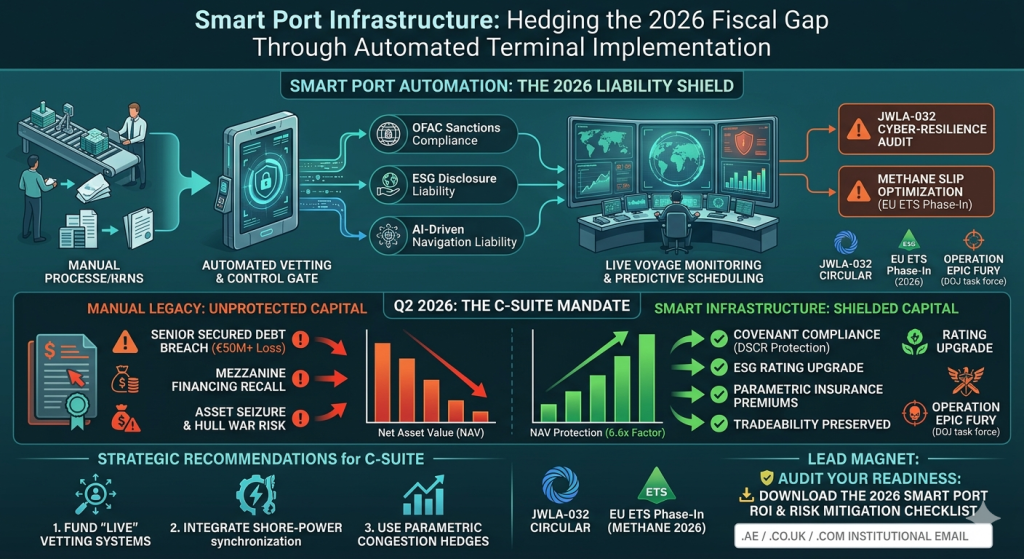
In the Q2 2026 maritime landscape, automated terminal infrastructure has transitioned from an operational “efficiency play” to a mandatory Liability Mitigation strategy for institutional investors. Failure to fund Smart Port integration now exposes capital stacks to catastrophic Asset Seizure & Hull War Risk and unrecoverable Arbitration & Litigation Costs stemming from the 2026 regulatory convergence.
The Economic Impact: Protecting the IRR from Regulatory Erosion
For the institutional investor in the USA, UAE, or UK, the “Million-Dollar Problem” of 2026 is the rapid obsolescence of manual port assets. As global trade lanes weaponize data, ports that lack automated verification systems are being reclassified by underwriters as “High-Risk Nodes.”
The Debt Covenant Trap
Most Senior Secured Debt facilities issued for port infrastructure now include strict “Throughput Fidelity” and “Cyber-Physical Resilience” clauses. If a manual terminal in your portfolio suffers a labor-induced bottleneck or a data breach that delays an LNG carrier by just 48 hours, the resulting EU ETS Phase-In costs for methane slip (at 2026’s aggressive €120/EUA rate) are often pushed back onto the terminal operator. This opex spike can trigger a debt service coverage ratio (DSCR) breach, forcing a pivot to high-interest Mezzanine Financing that cannibalizes your fund’s IRR.
NAV Volatility and Insurance Hikes
Unautomated ports are increasingly vulnerable to the shifting definitions in the Joint War Committee (JWC) Circulars, particularly JWLA-032. When a manual terminal is flagged for “low-fidelity cargo visibility,” insurance premiums for vessels calling at that port spike by up to 300%. For a shipowner, this makes your port an “expensive berth,” leading to a mass exodus of tonnage and a permanent devaluation of your Net Asset Value (NAV).
The Compliance/Legal Framework: The 2026 Global Mandate
The shift to Smart Ports is driven by a forensic legal net that makes manual processing a fiduciary liability.
I. OFAC Sanctions Compliance and Automated Vetting
By April 2026, OFAC Sanctions Compliance requires real-time, AI-driven vetting of cargo manifests against “Deceptive Shipping” patterns. Automated terminals utilize OCR and IoT sensors to cross-reference every container against the SDN list in milliseconds. A manual port attempting this faces a 12-day backlog or, worse, a sanctioned cargo leak that results in federal Asset Seizure of the terminal facility itself.
II. AI-Driven Navigation Liability in the Red Sea and Beyond
The 2026 rollout of AI-driven navigation liability protocols in the Red Sea and other high-risk corridors requires ports to provide “Berthing-on-Arrival” data directly to the ship’s autonomous system. Automated terminals that can synchronize with a vessel’s AI reduce the risk of collisions or “Soft-Groundings” in contested waters. If a vessel reroots due to port congestion and enters a kinetic zone, the terminal’s inability to provide automated scheduling becomes a central point of Arbitration & Litigation Costs.
III. ESG Disclosure Liability and Shore-Power Synchronization
Under the 2026 IMO “Transparency Directive,” terminal operators must provide a forensic digital trail of the emissions generated while a vessel is berthed. Automated terminals with integrated “Cold Ironing” and methane monitoring systems provide the “Actuals” needed to satisfy ESG Disclosure Liability. Without this data, your institutional investors face “Greenwashing” litigation that can void their Hull War Risk riders.
Strategic Recommendations: 3 Actionable Steps for the CEO
I. Prioritize Parametric Liquidity Wraps
Don’t rely on traditional business interruption insurance. Invest in Parametric Insurance Premiums that pay out automatically based on terminal downtime metrics or congestion data from AIS. This provides the immediate cash flow to service your Senior Secured Debt while you resolve the underlying operational friction, bypassing the 18-month Arbitration & Litigation cycle.
II. Automate the “Sanctions Shield”
Immediate allocation of capital to AI-driven manifest auditing is no longer optional. Ensure your automated systems are “API-Linked” to the latest OFAC Sanctions Compliance databases. This reduces the risk of Asset Seizure and positions your port as a “Safe Harbor” for Tier-1 shipping lines that are desperate to avoid regulatory detentions.
III. Synchronize with “Middle Corridor” AI Protocols
If your assets are in the UAE or UK, you must ensure your terminal automation software is compatible with the 2026 AI-driven navigation liability standards. By providing autonomous vessels with a “Digital Handshake” upon arrival, you mitigate the risk of kinetic events in the anchorage and secure “Cyber-Resilience” discounts from your underwriters.
5. Targeted Ad-Slot Hook: Securing Your Position in the 2026 Smart Port Race
Navigating the capital-intensive world of terminal automation requires more than engineering; it requires a Professional Advisory Service that understands the intersection of Senior Secured Debt & Mezzanine Financing and international maritime law. As the Joint War Committee (JWC) Circulars like JWLA-032 continue to redefine the cost of global port calls, investors must secure Specialized Insurance Cover that hedges against AI-driven navigation liability and ESG Disclosure Liability. Do not let your terminal be marginalized by a manual legacy—protect your portfolio with forensic risk management and Parametric Insurance Premiums to ensure your assets remain “Audit-Ready” for the 2026 fiscal cycle.
Frequently Asked Questions (FAQ)
Q: Why are underwriters penalizing manual ports in 2026? A: Manual ports represent “Data Black Holes.” Underwriters cannot verify OFAC Sanctions Compliance or ESG Disclosure Liability metrics in real-time, leading them to apply “Risk Loadings” that can make the terminal unbankable.
Q: How does automation prevent Asset Seizure? A: Automation creates an immutable digital ledger of every cargo movement. If a sanctioned entity attempts to use your port, the AI blocks the transaction before the cargo is offloaded, providing a “Safe Harbor” defense against Asset Seizure by the DOJ or OFAC.
Q: Can Parametric Insurance really cover methane slip costs? A: Parametric Insurance Premiums can be tied to port congestion. If your terminal is congested, leading to vessels idling and leaking methane (slip), the parametric trigger provides the owner/operator with the funds to pay the resulting EU ETS Phase-In costs, preventing a claim against the port’s liability policy.
Q: What is the impact of JWLA-032 on terminal funding? A: JWLA-032 reclassified several ports as “Cyber-Kinetic Vulnerable.” To maintain Senior Secured Debt at favorable rates, investors must prove they have automated firewalls and AI-monitoring to prevent electronic interference with vessel navigation during pilotage.
Q: Is Mezzanine Financing a viable option for port automation? A: While expensive, Mezzanine Financing is becoming the primary vehicle for “Retrofit Automation” in ports where the primary lender has capped exposure due to Hull War Risk concerns. It provides the quick capital needed to reach “Smart Port” status before the 2027 regulatory cliff.
The “Fidelity Gap”: Manual Labor vs. Machine Audit
In 2026, the maritime industry has realized that human error is the primary driver of Arbitration & Litigation Costs. When a manual checker in a port in West Africa or Southeast Asia mislabels a container, the “Fidelity Gap” creates a chain reaction of liability. The shipping line is hit with an OFAC Sanctions Compliance violation, the cargo is subject to Asset Seizure, and the investor’s Senior Secured Debt is called.
Automated Terminal Implementation closes this gap. By using 2026-grade Computer Vision and RFID tracking, the terminal provides a 99.9% accurate audit trail. For a Lloyd’s Syndicate, this data is gold. It allows us to lower Parametric Insurance Premiums because the “Underwriting Uncertainty” has been quantified and removed.
AI Navigation and the “Berth Synchronization” Mandate
As we monitor AI-driven navigation liability in the Red Sea, a new risk has emerged: the “Anchorage Collision.” Autonomous vessels are programmed for efficiency. If a port cannot provide a real-time, automated “Berth Window,” these vessels are forced to loiter in contested waters.
In 2026, if an autonomous vessel is attacked or collides while waiting for a berth at a manual port, the port operator is being held liable for “Failure to Synchronize.” This is why institutional investors are fleeing manual assets—the Hull War Risk exposure is simply too high. Automated terminals, by contrast, use AI to “handshake” with the incoming vessel 50 miles out, bringing it straight to the quay and minimizing the window of kinetic risk.
The Carbon “Anchor”: Methane Slip and Terminal Responsibility
The 2026 EU ETS Phase-In costs for methane slip have created a new conflict between shipowners and terminal operators. Methane slip is at its highest during low-load operations, such as maneuvering into a port. Automated terminals that use “Tug-Automation” and “Vacuum-Mooring” significantly reduce the time a vessel spends under its own power in the harbor.
For an investor, this isn’t about being “green”—it’s about avoiding the ESG Disclosure Liability that comes when a vessel emits 50 tons of unburnt methane while waiting for a manual mooring crew. In 2026, the port that helps the shipowner save on carbon taxes is the port that secures the long-term service agreements.
Conclusion: The 2026 Investment Mandate
The era of the “Passive Landlord” port investor is dead. In the Q2 2026 fiscal cycle, you are either an “Automation Leader” or a “Liability Host.” By funding Smart Port Infrastructure today, you aren’t just buying cranes and sensors; you are buying an insurance policy against the regulatory volatility of the next decade. Protect your Senior Secured Debt, satisfy your OFAC requirements, and ensure your assets remain the preferred hubs for the AI-driven fleet of the future.
Recent Comments