
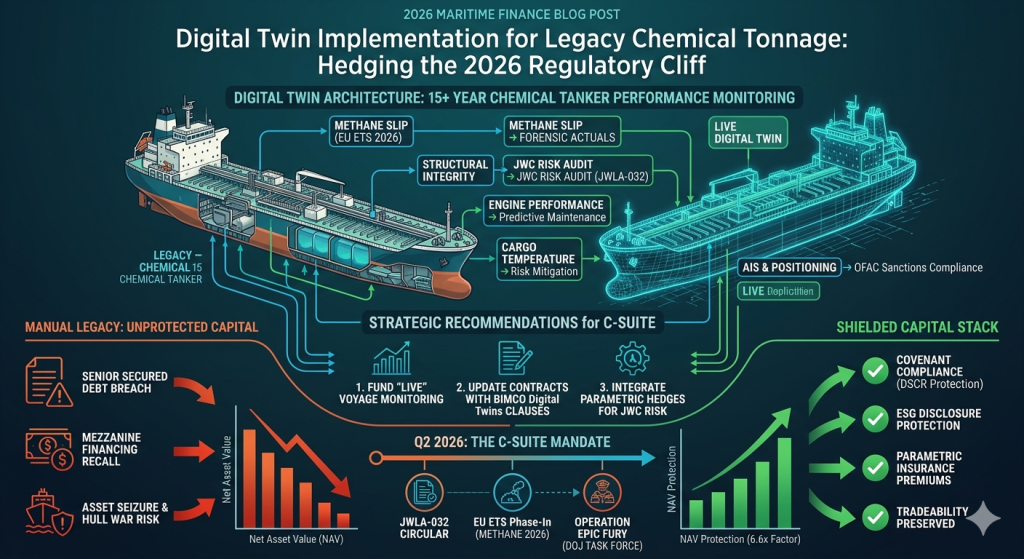
For owners of chemical tankers exceeding 15 years of age, Digital Twin implementation is no longer an elective technology upgrade; it is a critical Liability Mitigation instrument required to prevent technical defaults on Senior Secured Debt. Failure to integrate high-fidelity digital replicas by Q2 2026 exposes aged tonnage to unrecoverable ESG Disclosure Liability and catastrophic hull devaluations under the latest Joint War Committee (JWC) Circulars.
The Economic Impact: Protecting the IRR of Aging Assets
In the current fiscal climate of April 2026, 15+ year-old chemical tankers are the most vulnerable assets in the global fleet. These vessels typically operate on thinner margins, yet they face the highest proportional impact from the EU ETS Phase-In costs for methane slip and penalties. Without a Digital Twin, the “Estimated” emissions data traditionally used by legacy operators is being rejected by Tier-1 underwriters and lenders in favor of “Forensic Actuals.”
The “Stranded Asset” Risk
For an institutional investor in the UK or UAE, the “Million-Dollar Problem” is the sudden reclassification of an aging tanker as “unbankable.” If your 2011-built stainless steel carrier cannot demonstrate precise structural integrity and emissions telemetry, your Senior Secured Debt provider may trigger a “Material Adverse Change” (MAC) clause. In 2026, we are seeing a surge in owners forced into predatory Mezzanine Financing—at rates exceeding 14%—simply to fund the retrofits required to keep their vessels tradeable in the EU Emissions Control Area (ECA).
OPEX Compression through Predictive Maintenance
Digital Twins allow for the transition from “Time-Based” to “Condition-Based” maintenance. For a 15-year-old chemical tanker, where corrosion in cargo tanks is a constant threat, the ability to predict a coating failure through a digital replica can save upwards of $400,000 in emergency Arbitration & Litigation Costs arising from cargo contamination claims. By reducing unplanned off-hire time, the Digital Twin directly protects the vessel’s Debt Service Coverage Ratio (DSCR).
The Compliance/Legal Framework: The 2026 Regulatory Net
Operating aged tonnage in 2026 requires navigating a forensic legal environment where “ignorance of condition” is treated as “willful negligence.”
I. JWLA-032 and Structural Fidelity
The JWLA-032 circular has fundamentally altered the underwriting of Hull War Risk. Underwriters are now scrutinizing the “structural resilience” of aged tankers transiting high-risk zones. If a 15-year-old vessel suffers a kinetic event and lacks a Digital Twin to prove its pre-existing structural soundness, the Syndicate may cite “latent defects” to deny the claim, leading to a total loss of the asset and potential Asset Seizure by creditors.
II. OFAC Sanctions Compliance and AIS Shadowing
In 2026, OFAC Sanctions Compliance is increasingly focused on the “Ghost Fleet” and deceptive shipping practices. Aged chemical tankers are often unfairly flagged due to their vintage. A Digital Twin provides an immutable record of engine performance and fuel consumption that correlates with AIS data. If a vessel is accused of a “Dark Activity” STS transfer, the Digital Twin serves as the primary forensic evidence to prevent Asset Seizure and international blacklisting.
III. AI-Driven Navigation Liability
As AI-driven navigation liability becomes the standard for Red Sea transits, older vessels lacking integrated sensor suites are being “priced out” of the lane. A Digital Twin acts as the bridge, allowing legacy hardware to interface with modern AI routing algorithms. Without this digital interface, aged tankers are forced to take the longer Cape of Good Hope route, increasing fuel costs and EU ETS exposure to a point where the voyage IRR turns negative.
Strategic Recommendations: 3 Actionable Steps for the CEO
I. Secure Parametric Triggers for Performance Gaps
Don’t rely solely on traditional hull and machinery (H&M) cover. CEO’s should utilize their Digital Twin data to secure Parametric Insurance Premiums. These policies can be set to trigger a payout if the vessel’s efficiency drops below a certain threshold due to hull fouling or engine wear, providing the liquidity needed to maintain Senior Secured Debt service without waiting for a traditional claims adjuster.
II. Forensic Audit of the “Digital Thread”
Immediately commission a “Digital Readiness Audit” for any vessel over 12 years old. This audit should ensure that the Digital Twin is capable of reporting ESG Disclosure Liability metrics in real-time. In 2026, the delta between “Estimated” and “Actual” methane slip is the difference between a compliant voyage and a €500,000 fine.
III. Contractual “Safe Harbor” through BIMCO Clauses
Update all Time Charters to include the latest BIMCO “Digital Twin Data Sharing” clauses. This ensures that the liability for data accuracy is shared with the charterer and that the Digital Twin’s output is the “Sole Source of Truth” in any performance dispute, drastically reducing potential Arbitration & Litigation Costs.
Specialized Advisory for Legacy Fleet Modernization
The transition of 15+ year-old chemical tankers into the digital era requires a sophisticated marriage of maritime engineering and structured finance. At Oitha Marine, we specialize in helping owners navigate the complex interplay between Senior Secured Debt & Mezzanine Financing and the technical mandates of the Joint War Committee (JWC) Circulars. Whether you are facing an OFAC Sanctions Compliance audit or seeking to lower your Parametric Insurance Premiums through high-fidelity data, our Professional Advisory Services ensure your legacy assets remain shielded from Asset Seizure and Hull War Risk. Secure your Specialized Insurance Cover today to mitigate the escalating Arbitration & Litigation Costs of the 2026 regulatory cliff.
FAQ: Digital Twins and Aging Chemical Tankers (2026)
Q: Is the cost of a Digital Twin justifiable for a vessel with only 5 years of life remaining? A: In 2026, yes. The cost is an “Insurance Premium” against the vessel becoming a stranded asset. Without it, you may be unable to secure Hull War Risk cover for key trade routes or maintain OFAC Sanctions Compliance certification.
Q: How does a Digital Twin reduce the risk of Asset Seizure? A: It provides a forensic, tamper-proof log of the vessel’s location, engine load, and cargo temperatures. In the event of a “Deceptive Shipping” allegation, this data is your primary legal defense to prevent the DOJ or local authorities from seizing the vessel.
Q: Can a Digital Twin help renegotiate Senior Secured Debt? A: Absolutely. Lenders in 2026 view Digital Twins as a “Risk Multiplier” in a positive sense. By providing the bank with a live dashboard of the asset’s health, you reduce their “Uncertainty Risk,” often allowing for a margin reduction of 25-50 bps.
Q: What is the impact of JWLA-032 on older chemical tankers specifically? A: JWLA-032 mandates higher scrutiny on “vulnerable” tonnage. For a 15-year-old tanker, this means you must prove that your propulsion and steering systems are monitored digitally to avoid a “Navigation Failure” surcharge in contested waters.
Q: How do Digital Twins address ESG Disclosure Liability? A: They move emissions reporting from “spreadsheet estimates” to “sensor-verified actuals.” This protects the C-suite from personal liability under new 2026 “Greenwashing” statutes.
OPEX Mitigation in the 2026 Fiscal Cycle
The Engineering-Finance Convergence
The traditional silo between the Technical Superintendent and the CFO has collapsed. In 2026, a mechanical failure on a chemical tanker is a financial event. When a heating coil fails in a 15-year-old tank, the resulting cargo solidification doesn’t just lead to an insurance claim; it triggers a cascade of Arbitration & Litigation Costs.
A Digital Twin serves as the “Fiduciary Interface.” By utilizing vibration sensors and thermal imaging mapped to a 3D model, the Twin identifies the “Pre-Failure Signature” of that coil. For the owner, this allows for a “Tactical Repair” during a scheduled port call, rather than an “Emergency Salvage” event that could trigger a Hull War Risk premium hike if the vessel is disabled in a JWC-monitored zone.
Methane Slip and the Chemical Carrier
While LNG carriers are the primary focus of EU ETS Phase-In costs for methane slip, dual-fuel chemical tankers are the next frontier. Older engines are notorious for “Methane Slip” (unburnt fuel escaping the stack). In 2026, the EU’s “Forensic Sampling” drones are active in the North Sea. If your Digital Twin doesn’t match the drone’s sampling data, the fines are punitive. The Twin allows the engine room to tune the combustion cycle in real-time, potentially saving $50,000 in carbon taxes per voyage.
Conclusion: The 2026 Survival Metric
The survival of legacy chemical tonnage depends on “Digital Transparency.” Investors in the USA, UK, and UAE are no longer willing to fund “Dark Assets.” By implementing a Digital Twin, you aren’t just buying software; you are buying the right to continue accessing the global capital markets. Protect your Senior Secured Debt, satisfy OFAC, and eliminate the “Age Penalty” through forensic digital oversight.
Recent Comments