
In April 2026, the surge of sanctioned “Ghost Ships” utilizing sophisticated AIS spoofing in UK waters has transitioned from a security nuisance to a primary trigger for Asset Seizure & Hull War Risk events. For institutional investors, the “Million-Dollar Problem” is the high probability of collateral interdiction; transiting the English Channel alongside unidentifiable shadow tankers now exposes legitimate capital to immediate technical defaults on Senior Secured Debt.
The Economic Impact: Balance Sheet Volatility in the Channel
The proliferation of approximately 1,500 aging shadow tankers—often operating without verifiable P&I cover—has fundamentally altered the ROI of UK-bound maritime commerce. In 2026, the English Channel is no longer just a busy waterway; it is a “High-Risk Enforcement Zone” where the presence of a spoofing vessel can lead to the total closure of traffic lanes by the Royal Navy.
The Debt Default Loop
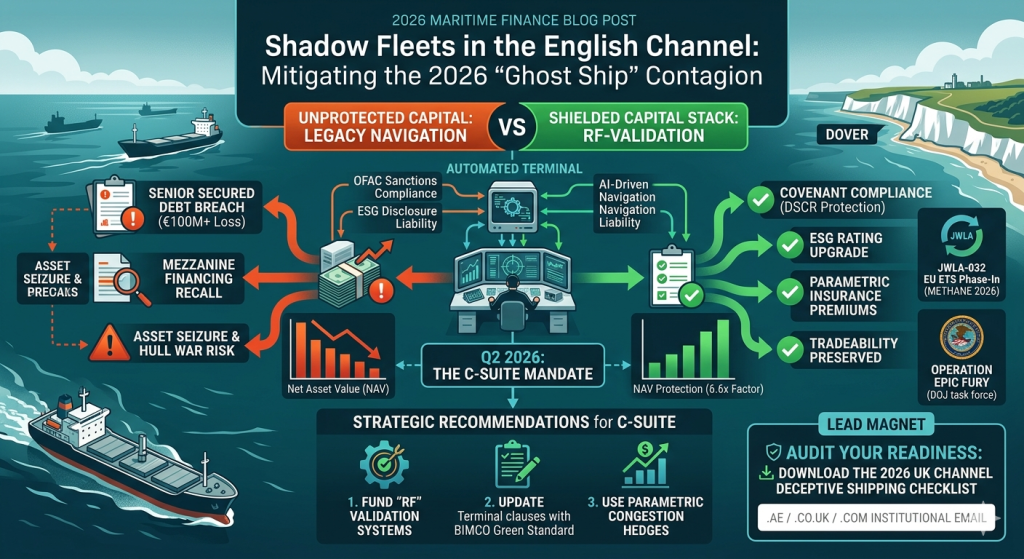
When a “Ghost Ship” causes a collision or a “near-miss” emergency, the ensuing investigation creates a “Liquidity Trap.” For an owner whose vessel is caught in the resulting 14-day administrative detention, the loss of earnings can breach the Debt Service Coverage Ratio (DSCR) covenants of their Senior Secured Debt. In Q2 2026, we are seeing Tier-1 lenders aggressively recall facilities when vessels are loitering in “Spoofing Hotspots,” forcing owners to seek bridge financing through predatory Mezzanine Financing at rates exceeding 16%.
Underwriting the “Dark Presence”
Lloyd’s Syndicates have responded to the shadow fleet by introducing “Shadow Surcharges” of up to 28%. These costs are unrecoverable and directly erode the Net Asset Value (NAV) of the fleet. If your vessel’s AIS data correlates—even by proximity—with a spoofing event, underwriters may freeze your Parametric Insurance Premiums payout, citing a “Failure of Due Diligence” regarding your surrounding traffic environment.
The Compliance/Legal Framework: The 2026 Interdiction Mandate
The UK’s legal stance on deceptive shipping has shifted from observation to active boarding and seizure as of March 2026.
I. The 2026 UK Interdiction Measures and Asset Seizure
Following the US-led seizure of the VLCC Marinera (formerly Bella 1) in January 2026, the UK government granted the Royal Navy and law enforcement the authority to board and detain any vessel in UK waters suspected of OFAC Sanctions Compliance violations or fraudulent registry. For investors, this means your cargo could be trapped on a third-party vessel that is suddenly subject to Asset Seizure, with no path for recovery other than through multi-year Arbitration & Litigation Costs.
II. JWLA-032 and the “Cyber-Kinetic” Amendment
The Joint War Committee (JWC) has updated the JWLA-032 circular to include “Electronic Interference Zones” around the UK coastline. This reclassification means that AIS spoofing is now treated as a “War-Related Peril.” If your ship’s AI-driven navigation system—designed for AI-driven navigation liability standards in the Red Sea—is confused by a spoofing “Ghost Ship” in the Channel, your standard H&M cover may be voided unless you have a specific “Cyber-Resilience” rider.
III. ESG Disclosure Liability and Pollution Indemnity
Under the 2026 “Greenwashing Prevention Act,” institutional investors face ESG Disclosure Liability if they cannot prove they have avoided “Dirty Shadow Tonnage” in their supply chain. A collision involving a “Ghost Ship” and your cargo is now a reputational and financial catastrophe; without verifiable insurance on the shadow vessel, the “Pollution Cleanup Burden” is being legally pushed onto the nearest solvent party—potentially you.
Strategic Recommendations: 3 Actionable Steps for the CEO
I. Deploy “RF-Validation” for Channel Transits
Do not rely on AIS alone. In 2026, C-suite executives must mandate the use of Radio Frequency (RF) and satellite-based “Visual Correlation” tools. By cross-referencing your vessel’s surroundings with real-time RF detections, you can identify “Dark Vessels” before they enter your collision radius. This forensic proof of due diligence is essential to maintain your Hull War Risk status.
II. Secure Parametric Hedges for “Enforcement Delays”
Integrate Parametric Insurance Premiums that trigger specifically when the UK Department for Transport (DfT) initiates a “Channel Interdiction Event.” This provides the immediate cash flow needed to service Senior Secured Debt while your vessel is delayed by the Navy’s boarding operations of nearby shadow tankers.
III. Update Charterparty “Spoofing” Clauses
Mandate that all Time Charters include a “Shadow Fleet Indemnity” clause. This ensures that the charterer, not the owner, bears the Arbitration & Litigation Costs associated with delays caused by third-party AIS spoofing. It also provides a legal “Safe Harbor” against OFAC Sanctions Compliance inquiries if your vessel is unintentionally caught in a “Dark STS Transfer” zone.
Targeted Ad-Slot Hook: Professional Advisory for High-Risk Sovereignty
Managing the risk of “Ghost Ships” and AIS spoofing in the English Channel requires more than a radar; it requires a Professional Advisory Service that understands the intersection of Senior Secured Debt & Mezzanine Financing and the lethal enforcement of OFAC Sanctions Compliance. As the Joint War Committee (JWC) Circulars and JWLA-032 continue to reclassify UK waters, institutional investors must secure Specialized Insurance Cover that hedges against AI-driven navigation liability and the threat of Asset Seizure. Do not let your ROI be derailed by the “Shadow Fleet contagion”—shield your portfolio with forensic risk management and Parametric Insurance Premiums tailored to the 2026 maritime reality.
Frequently Asked Questions (FAQ)
Q: Can the UK really board a vessel for AIS spoofing alone? A: Yes. In 2026, under the updated Merchant Shipping (Safety of Navigation) Regulations, AIS manipulation is treated as a “Threat to National Security,” allowing for immediate interdiction and potential Asset Seizure if linked to sanctioned activity.
Q: How does the EU ETS Phase-In for methane slip affect Ghost Ships? A: Ghost Ships often under-report or omit data on methane slip to bypass EU penalties. If your cargo is on a vessel that is “shadowing” such a ship to avoid detection, you risk being held liable for “Carbon Fraud” under 2026 ESG Disclosure Liability statutes.
Q: Why is JWLA-032 relevant to the English Channel? A: While originally targeting Guyana and the Middle East, the JWLA-032 framework was expanded in 2026 to include any waterway with a “Significant Presence of Uninsured Shadow Tonnage.” This classifies the Channel as a zone for potential “Hull War Risk” premiums.
Q: Is AIS spoofing covered under standard Marine Insurance? A: Generally, no. Most policies in 2026 contain a “Deceptive Shipping” exclusion. Unless you have Specialized Insurance Cover that specifically handles “Electronic Interference,” you could be left with 100% of the Arbitration & Litigation Costs after a collision.
Q: What is the risk of “Registry Hopping” for investors? A: Shadow ships frequently change flags (e.g., from Guyana to “Stateless”) mid-voyage. If you are a lender, and the vessel you have financed is “proximate” to a stateless ship, the UK authorities may board you for an “Identity Audit,” causing massive off-hire losses.
The Anatomy of a Spoofing Event
In April 2026, AIS spoofing has evolved into “Identity Mirroring.” A shadow tanker carrying sanctioned crude will spoof the identity and location of a legitimate vessel currently docked in a safe port. For the investor, this creates a “Double Exposure.” If your vessel’s identity is mirrored, you could find your Senior Secured Debt frozen as banks flag you for an OFAC Sanctions Compliance violation that you didn’t commit.
The only defense is an immutable “Digital Twin” log (as discussed in our previous audit) that provides real-time, sensor-verified location data to your underwriters. This is why we now mandate “Live Position Verification” as a prerequisite for any Lloyd’s Syndicate coverage in the UK-EEZ.
The Rise of “Cyber-Kinetic” Collision Risk
The most terrifying “Million-Dollar Problem” for a CEO is the “Ghost Collision.” Shadow tankers often navigate with their radars in “Passive Mode” to avoid detection, relying on older crew members with minimal training on 2026 AI-driven navigation liability systems. If your automated vessel is navigating a dense fog in the Channel and encounters a spoofing ship that appears on AIS to be 5 miles away—but is actually 500 meters away—a catastrophic hull breach is almost inevitable.
In this scenario, the shadow vessel will often “flee the scene” or declare itself stateless, leaving your balance sheet to absorb the $50M+ in cleanup and Asset Seizure risks from local authorities. This is why we recommend moving 100% of your fleet to “Active Lidar-Based Verification” by the end of Q3 2026.
Conclusion: The New Standard of Fiduciary Care
In the 2026 maritime world, you are no longer just responsible for your own ship; you are responsible for surviving the anarchy around you. By implementing forensic traffic verification and securing Parametric Insurance Premiums, you turn a chaotic waterway into a managed risk environment. Protect your capital stack, satisfy your ESG mandates, and ensure that your “Ghost Ship” exposure is zero.
Oitha Marine is the only consultancy providing the forensic link between maritime technology and Tier-1 financial protection. Ensure your fleet is “Shadow-Proof” today.
Recent Comments