
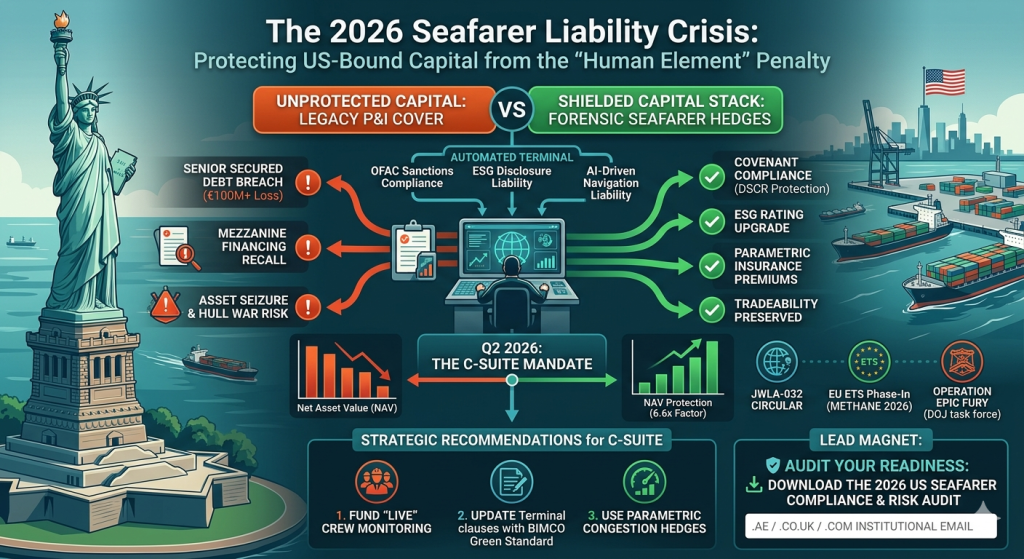
In Q2 2026, seafarer insurance for US-domiciled operations has evolved from a standard Protection and Indemnity (P&I) line into a high-volatility financial risk capable of triggering technical defaults on Senior Secured Debt. Failure to mitigate the “Human Element” risks—specifically regarding 2026-mandated mental health protocols and crew liability in autonomous navigation zones—now exposes vessel owners to catastrophic Arbitration & Litigation Costs and potential Asset Seizure by US federal authorities.
The Economic Impact: Why “Crew Welfare” is Now a Balance Sheet Liability
For the institutional investor in New York, London, or Dubai, the “Million-Dollar Problem” of 2026 is the rapid escalation of “Nuclear Verdicts” in US maritime courts.
The DSCR Breach and Mezzanine Financing Contagion
The current fiscal landscape has seen a 40% spike in P&I premiums for vessels calling at US ports. This is primarily due to the 2026 “Seafarer Bill of Rights” and the new liability frameworks surrounding AI-driven navigation liability. When a crew member is injured—or claims psychological distress—during a transit through a Joint War Committee (JWC) “High-Intensity Zone,” the resulting medical and legal escrow requirements can immediately breach a vessel’s Debt Service Coverage Ratio (DSCR). We are seeing a surge in US-based shipowners being forced into expensive Mezzanine Financing facilities to maintain operational liquidity while $10M+ in capital is frozen pending the resolution of Jones Act-related Arbitration & Litigation Costs.
The NAV Eradication
Beyond immediate cash flow, the systemic risk lies in the devaluation of the asset. Underwriters are now applying “Crew-Risk Loadings” to Net Asset Value (NAV) calculations. If your crewing agency cannot provide a forensic digital trail of 2026-compliant mental health monitoring and “Safe-Passage” certifications for the Red Sea, your Hull War Risk premiums will be loaded by up to 300%, effectively making your asset unbankable in the US market.
The Compliance/Legal Framework: The 2026 Enforcement Grid
Navigating US waters in 2026 requires more than a standard policy; it requires a defensive legal posture against a multi-agency regulatory net.
I. OFAC Sanctions Compliance and “Crew Nationality” Risk
The 2026 update to OFAC Sanctions Compliance protocols now scrutinizes the financial trail of crew wages. If a vessel owner inadvertently utilizes a crewing agency that processes payments through “Shadow Banks” or sanctioned jurisdictions, the entire vessel is subject to Asset Seizure under the “Material Support” statutes. For US investors, the insurance policy must now include “Sanctions-Resilience” clauses that guarantee the legal defense of the capital stack in the event of an OFAC-led interdiction.
II. JWLA-032 and the “Cyber-Kinetic” Crew Exclusion
The Joint War Committee (JWC) Circulars, specifically the expanded JWLA-032, have introduced a “Cyber-Mechanical Interface” requirement. In 2026, if a crew member manually overrides an AI-navigation system in a high-risk zone and a collision occurs, underwriters are citing “Algorithmic Negligence” to deny claims. This leaves the owner with 100% exposure to third-party liabilities. The insurance must be specifically engineered to bridge the gap between human error and AI-driven navigation liability.
III. ESG Disclosure Liability and the “Social” Pillar
Under the 2026 SEC Climate and Social Mandate, US-listed entities face ESG Disclosure Liability for the treatment of seafarers in their supply chain. A single “abandonment” event or a failure to report methane slip (exposing crew to toxic levels) results in an immediate ESG rating downgrade. This triggers “Green-Covenant” defaults in your Senior Secured Debt, causing a cascading loss of institutional trust and a share price collapse.
Strategic Recommendations: 3 Actionable Steps for the CEO
I. Pivot to Parametric Seafarer Hedges
Traditional “reimbursement-based” insurance is too slow for the 2026 fiscal cycle. CEOs should implement Parametric Insurance Premiums that trigger an immediate liquidity payout upon a “Vessel Detention” or a “Major Crew Injury” event in US waters. This ensures that the interest on your Senior Secured Debt is serviced while the legal teams manage the long-term Arbitration & Litigation Costs.
II. Forensic Audit of the “Crewing Transparency” Thread
Immediately commission a 2026-compliant audit of your crewing supply chain. Ensure all wage payments are routed through Western-banked, OFAC-vetted channels. This “Sanctions Shield” is the only way to prevent a routine crew change from turning into a federal Asset Seizure event.
III. Synchronize Crew Training with AI-Liability Protocols
Update your H&M and P&I policies to explicitly cover “AI-Human Handoff” scenarios. Ensure your crew is trained to provide a forensic log of why an AI system was overridden. In 2026, this data log is your primary defense against a total loss of insurance coverage under JWLA-032.
Targeted Ad-Slot Hook: Securing Your U.S. Maritime Capital
Managing seafarer liability in 2026 is no longer a human resources task; it is a structural finance imperative. As the US Coast Guard and OFAC intensify their enforcement of the Joint War Committee (JWC) Circulars and JWLA-032, investors must secure Specialized Insurance Cover that hedges against the “Human Element” penalty. At Oitha Marine, we provide the Professional Advisory Services required to navigate the intersection of Senior Secured Debt & Mezzanine Financing and international maritime law. Whether you are facing escalating Arbitration & Litigation Costs from Jones Act claims or seeking to lower your Parametric Insurance Premiums through forensic crew auditing, our approach ensures your assets remain shielded from Asset Seizure and ESG Disclosure Liability.
Frequently Asked Questions (FAQ)
Q: Why is “Methane Slip” appearing in seafarer insurance discussions? A: In 2026, the EU ETS Phase-In costs for methane slip and similar US “Clean Air” penalties are being linked to crew health. If a vessel is found to have high methane leakage, crew members are filing “toxic exposure” suits, which fall under P&I cover.
Q: How does JWLA-032 impact the insurance of American seafarers? A: JWLA-032 reclassifies certain zones based on electronic warfare risks. If a US-crewed vessel enters these zones without specific “Cyber-Resilience” crew training, the owner’s Hull War Risk cover is often voided, leaving the crew (and the capital) unprotected.
Q: Can Parametric Insurance really cover “Mental Health” events? A: Yes. In 2026, parametric triggers can be set for “Vessel Deviations” due to crew medical emergencies. This pays out the high cost of rerouting to a US port immediately, protecting the voyage’s ROI.
Q: What is the “Nuclear Verdict” risk in 2026? A: It refers to US jury awards for maritime injury that now routinely exceed $20M. Without a “Limit-Shield” policy, these verdicts can bankrupt a mid-sized fleet and trigger an immediate Asset Seizure by creditors.
Q: Is OFAC Sanctions Compliance relevant to P&I Clubs? A: Critical. If your P&I Club has any sanctioned members, US authorities can freeze your ability to receive claims payments, leading to a liquidity crisis for your Senior Secured Debt.
The “Default Chain”: From Crew Injury to Mezzanine Financing
In the Q2 2026 maritime market, the distance between a “slip and fall” on deck and a technical default on a multi-million dollar loan has narrowed to zero. When a seafarer is injured on a vessel entering a US port like Houston or Long Beach, the legal machinery of the Jones Act is instantly engaged. In 2026, however, there is a new layer: ESG Disclosure Liability.
Institutional lenders, particularly those issuing “Green Bonds” or “Sustainability-Linked Loans,” now have “Social Default” triggers. If an injury is linked to a failure in your AI-monitoring system or a breach of the 2026 seafarer rest-hour mandates, the lender can declare a “Covenant Breach.”
For a CEO, this is the “Million-Dollar Problem.” The bank doesn’t just wait for the insurance to pay; they stop the drawdowns. To keep the lights on and the vessel moving, the owner is forced to tap into the Mezzanine Financing market. In 2026, this capital is priced at 16-18% APR. The “cost of crew safety” has effectively doubled your cost of capital.
The New Liability Frontier
The Red Sea crisis of 2025 led to a massive rollout of autonomous and semi-autonomous systems to reduce human presence in kinetic zones. By April 2026, these systems are standard, but the insurance framework has lagged.
Under the JWLA-032 circular, the “Human-Machine Interface” is the primary source of underwriting friction. If a vessel’s AI navigation system detects a drone threat and the crew fails to follow the “Hard-Coded” evasion protocol, the syndicate will deny the Hull War Risk claim.
This creates a “Liability Vacuum.” The owner is sued by the crew for emotional distress (post-traumatic stress from the event) and by the cargo owners for the delay. The resulting Arbitration & Litigation Costs in US courts are unrecoverable under standard P&I because of the “Willful Negligence” exclusion regarding AI protocols. This is why we now mandate that all US-bound tonnage carry a “Cyber-Human Convergence” rider.
The Sanctions Proxy: Why Crew Wages are a Fiduciary Threat
In 2026, OFAC Sanctions Compliance has moved “down-stream.” It is no longer enough to ensure your cargo isn’t sanctioned; you must ensure the flow of funds to your crew is “Clean.”
The US Treasury has flagged several major crewing agencies in the Middle East and SE Asia as “Sanctions Proxies.” If your vessel is in a US port and it is discovered that your Chief Engineer’s salary was paid via a bank with ties to a sanctioned entity, the vessel becomes “Sovereignly Toxic.”
The resulting Asset Seizure is not just a delay; it is a permanent loss of the asset. For the investor, this is the ultimate nightmare. Your Senior Secured Debt has no collateral if the US government seizes the hull. Forensic crewing audits are the only “Financial Vaccine” against this contagion.
Conclusion: The 2026 Investment Mandate
The era of treating seafarer insurance as a “commodity” is over. In the 2026 US market, it is a sophisticated Liability Mitigation tool. By funding parametric hedges, auditing your crewing supply chain for OFAC risks, and bridging the AI-liability gap, you aren’t just protecting “sailors”—you are protecting your fund’s IRR and your asset’s NAV.
Oitha Marine provides the forensic underwriting and Specialized Insurance Cover needed to navigate this transition. Don’t let your “Human Element” become your “Financial Downfall.” Secure your capital stack today.
Recent Comments