
The maritime financing landscape of 2026 has undergone a structural schism. As traditional Tier-1 banks tighten their belts under the full weight of Basel IV capital requirements, a massive “liquidity gap” has emerged. This gap is being aggressively filled by Private Credit funds, creating a two-tier lending market where the choice between a syndicated loan and private debt is no longer just about the interest rate—it is about leverage, speed, and regulatory flexibility.
The Tier-1 Landscape: Why Spreads are Tightening for “Green” Assets
Tier-1 banks (the traditional European and Asian giants) have not left the building, but they have moved to the “Penthouse.” In 2026, bank syndication is almost exclusively reserved for Top-Tier Corporate Credits and ESG-compliant “Green” vessels.
1. The Basel IV Effect on Bank Spreads
With the 2026 implementation of the Basel IV “Output Floor,” banks are forced to hold more capital against their shipping portfolios. To maintain their Return on Equity (ROE), banks have shifted their focus to low-risk, high-volume syndicated loans.
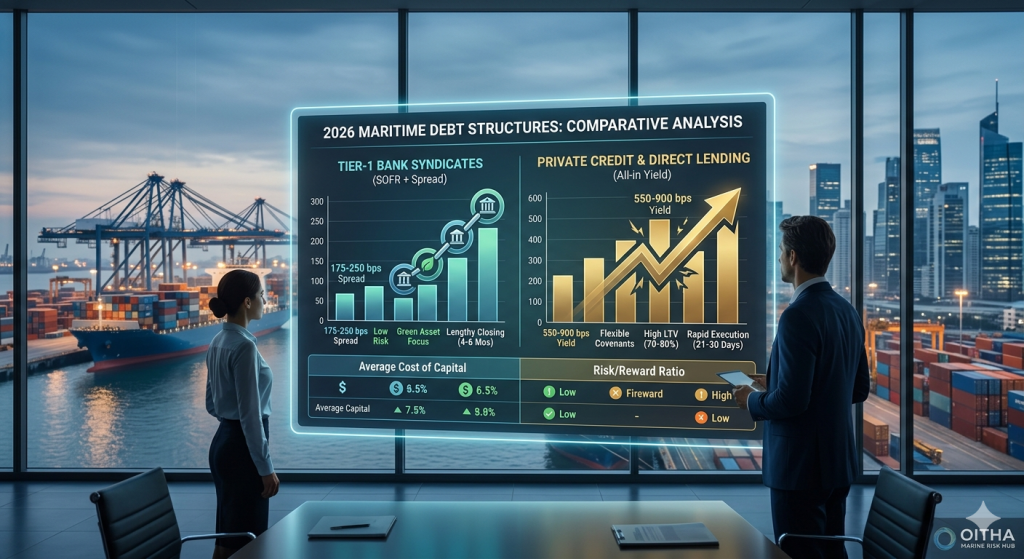
- Current Tier-1 Spreads: For a 2026-build LNG carrier or a dual-fuel VLCC, spreads are currently hovering between 175 and 250 basis points (bps) over SOFR (Secured Overnight Financing Rate).
- The “Green Discount”: Banks are offering “Sustainability Linked Loans” (SLLs) where the spread can drop by an additional 10–15 bps if the vessel meets specific IMO 2026 carbon intensity targets.
2. Syndication Hurdles
The challenge in 2026 is the “Club Deal” complexity. Tier-1 banks are less willing to take massive “hold” positions. A $200M refinance now requires a syndicate of 4–6 banks, each with rigorous KYC and environmental due diligence, often pushing closing times to 4–6 months.
The Private Credit Revolution: Yields vs. Flexibility
Where the banks have retreated, Private Credit (PC) has surged. In 2026, private debt now accounts for nearly 25% of all new maritime debt originations. These are not “lenders of last resort” anymore; they are sophisticated institutional funds providing bespoke capital.
1. The Yield Reality: Paying for Speed
Private credit yields are significantly higher than bank spreads. Investors in these funds expect “equity-like” returns for “debt-like” risk.
- Current Private Credit Yields: Typically ranging from 550 to 900 bps over SOFR.
- Total Cost of Capital: When including original issue discounts (OID) and exit fees, the All-in Yield for a maritime private debt deal in 2026 often exceeds 10% – 12%.
2. Why Shipowners Choose the Higher Yield
If bank debt is 3% and private debt is 10%, why choose the latter?
- Higher LTV (Loan-to-Value): Banks rarely exceed 55–60% LTV in 2026. Private credit funds are comfortably lending at 70–80% LTV.
- Covenant Light (Cov-Lite) Structures: Private lenders often skip the rigid “Value Maintenance Clauses” that allow banks to trigger defaults if ship values dip slightly.
- Execution Speed: A private credit fund can close a $50M deal in 21 days, whereas a syndicated bank loan might take half a year.
Direct Comparison: Syndicated Bank Debt vs. Private Credit (Q2 2026)
| Feature | Tier-1 Syndicated Loan | Private Credit / Direct Lending |
| Average Spread | 180 – 260 bps over SOFR | 550 – 950 bps over SOFR |
| Max LTV | 55% – 60% | 75% – 82% |
| Amortization | Strict (8-12 year profile) | Flexible / Bullet payments |
| Collateral | Modern, Green, Tier-1 Assets | Legacy Tonnage, Specialized Assets |
| KYC/Audit | Exhaustive (Regulatory focus) | Commercial (Asset focus) |
Strategic Implications for Maritime Investors
In 2026, the savvy CFO is using a “Barbell Strategy.” They secure Tier-1 syndicated bank debt for their most modern, ESG-compliant assets to keep their weighted average cost of capital (WACC) low. Simultaneously, they utilize Private Credit for “bridge financing,” acquisitions of mid-age tonnage, or to maximize leverage on specific projects.
The Role of Junior and Mezzanine Debt
We are also seeing the rise of “Hybrid Deals” where a Tier-1 bank takes the Senior Tranche (the first 50% of the value) and a Private Credit fund takes a Junior or Mezzanine Tranche (the next 20%). This allows the shipowner to achieve 70% leverage while keeping the average interest rate lower than a pure private debt play.
2026 Market Outlook: Where is the Capital Flowing?
As we look toward the second half of 2026, expect Private Credit yields to remain sticky even if SOFR fluctuates. The demand for maritime capital—driven by the $3 trillion need for fleet decarbonization—is far outstripping the supply of bank balance sheets.
For the investor, the “Alpha” is no longer found in hunting for the lowest spread, but in finding the lender whose covenant structure allows the vessel to operate profitably in a volatile, sanctioned, and carbon-taxed global economy.
Frequently Asked Questions (FAQ)
1. What is a “Syndicated Marine Loan”?
A syndicated loan is a large-scale financing provided by a group of lenders (a syndicate) rather than a single bank. It is structured by a “Lead Arranger” who handles the negotiations and then “sells” portions of the loan to other banks to spread the risk.
2. Why are Basel IV regulations affecting my ship loan?
Basel IV changes how banks calculate “Risk-Weighted Assets” (RWA). For shipping, which is seen as a volatile industry, banks are now required to hold significantly more cash in reserve against these loans. This makes lending more “expensive” for the bank, leading them to only lend to the safest, lowest-risk “Green” projects.
3. Is Private Credit safe for shipowners?
Yes, but it is “expensive” safety. Private credit funds are usually backed by pension funds and insurance companies. While the interest rates are higher, they offer much more flexibility during market downturns than traditional banks, which are often forced by regulators to foreclose during a crisis.
4. What is “SOFR” and why is it used instead of LIBOR?
LIBOR was phased out years ago. SOFR (Secured Overnight Financing Rate) is the standard benchmark in 2026. It is based on actual transactions in the U.S. Treasury repurchase market, making it more transparent and less prone to manipulation than the old LIBOR system.
5. Can I get a bank loan for an older vessel (15+ years)?
In 2026, it is extremely difficult to get Tier-1 syndicated bank debt for vessels over 15 years old due to “Environmental Risk” and “Asset Obsolescence.” Most owners of legacy tonnage now rely on Private Credit or Chinese Leasing houses for financing.
Recent Comments