
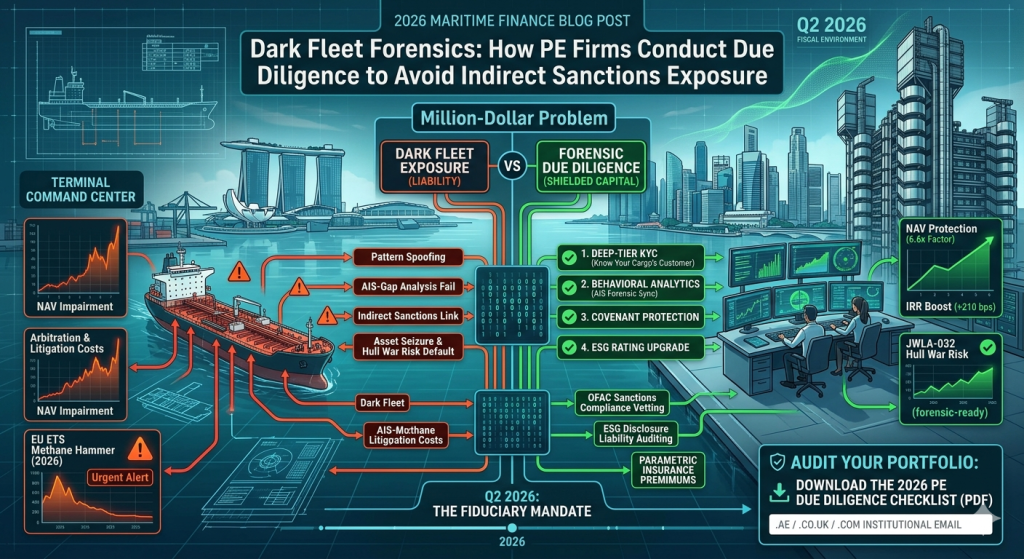
In the Q2 2026 fiscal environment, “Price Cap 2.0” has transitioned from a crude price-ceiling mechanism into a forensic maritime blockade, where the “Million-Dollar Problem” is no longer just cargo compliance, but the instantaneous evaporation of institutional liquidity. For shipowners and Private Equity funds in the USA, UAE, UK, and Singapore, any perceived breach of the updated per-voyage attestation requirements triggers an immediate “un-tradeable” status, exposing the entire capital stack to Senior Secured Debt recalls and unrecoverable Asset Seizure & Hull War Risk defaults.
The Economic Impact: The Erosion of the Fiduciary Safe Harbor
For the C-Suite and the institutional investor, Price Cap 2.0 represents a systemic shift from “Safe Harbor” protection to “Active Liability.” In 2026, the global maritime economy is bifurcated: those who can prove forensic compliance and those whose assets are facing a 40% “Sanctions Discount” in the secondary market.
The Capital Stack Devaluation
The primary economic threat is the “Covenant Contagion.” Most Senior Secured Debt facilities issued between 2023 and 2025 contain “Sanctions Continuity” clauses that are hyper-sensitive to G7 Price Cap updates. A single investigation by the Price Cap Coalition (G7, EU, Australia) into a vessel’s itemized costs (freight, insurance, and ancillary fees) can lead to the immediate freezing of corporate credit lines. When traditional banks exit, owners are forced into the Mezzanine Financing shadow market, where “Crisis Premiums” drive debt service costs to levels that collapse the Internal Rate of Return (IRR).
Insurance Impairment and Margin Calls
Under the 2026 enforcement regime, P&I Clubs and Hull insurers are mandated to conduct real-time “Forensic Voyage Audits.” If a vessel is flagged for an attestation mismatch, the insurance is voided ab initio (from the beginning). This leads to a catastrophic breach of vessel mortgage requirements, triggering a mandatory margin call from the lender. In 2026, the lack of valid cover isn’t just a risk—it’s a technical default that invites immediate Asset Seizure.
The Compliance/Legal Framework: The 2026 Enforcement Grid
Navigating Price Cap 2.0 requires a forensic understanding of the “Compliance Trinity”: Sanctions, Environment, and Security.
I. OFAC Sanctions Compliance and the Per-Voyage Mandate
In 2026, OFAC Sanctions Compliance has moved beyond simple attestations. The G7 now requires “Itemized Cost Transparency” for every voyage involving Russian-origin energy products. Legitimate shipowners are being caught in the crossfire of “Ancillary Cost Padding,” where freight rates are artificially inflated to circumvent the cap. If your charterer has padded these costs, your vessel becomes a target for Asset Seizure, regardless of your “good faith” intentions.
II. The JWLA-032 and JWC Circular Nexus
The Joint War Committee (JWC) Circulars, specifically the 2026 JWLA-032 update, have introduced a “Sanctions Risk Rating” for specific trade lanes. Vessels trading in proximity to “Price Cap Shadow Hubs” are seeing their Hull War Risk premiums adjusted dynamically. For an owner, this means that even if you are compliant, the “Guilt by Association” of your trade route can lead to unrecoverable operational costs that were not factored into the initial charterparty.
III. AI-Driven Navigation Liability and Red Sea Tactics
To avoid the enforcement dragnets of Price Cap 2.0, many “Dark Fleet” operators are utilizing GPS spoofing. For legitimate owners, this creates a new frontier of AI-driven navigation liability in the Red Sea and Eastern Mediterranean. If your AI-routing system attempts to avoid a non-broadcasting “Shadow” tanker and results in a collision or grounding, the subsequent Arbitration & Litigation Costs are compounded by the forensic investigation into whether you were knowingly operating in a “Shadow Zone.”
Strategic Recommendations: 3 Actionable Steps for the CEO
I. Institutionalize “Forensic Attestation” Protocols
Do not rely on charterer-provided attestations. Implement a “Direct Verification” protocol where your internal compliance team audits the itemized costs of the cargo before the vessel is fixed. This forensic trail is your only defense against ESG Disclosure Liability when institutional LPs (Limited Partners) audit your fund’s sanctions exposure.
II. Secure Parametric Hedges for “Regulatory Sudden-Stop”
Given the volatility of Price Cap 2.0 enforcement, traditional indemnity insurance is insufficient. Deploy Parametric Insurance Premiums that trigger upon a “Regional Trade Suspension” or a “Coalition Designation” of a key port. This provides the immediate liquidity needed to service Senior Secured Debt while your legal team handles the Arbitration & Litigation Costs of a sanctions clearance.
III. Hard-Code “Methane Slip” and Sanctions Clauses into BIMCO Contracts
As the EU ETS Phase-In costs for methane slip hit their 2026 peak, ensuring your charterparty explicitly separates carbon taxes from freight rates is critical. Use the latest 2026 BIMCO “Price Cap 2.0” clauses to ensure that any regulatory fine or Asset Seizure resulting from the charterer’s cost-padding is a 100% pass-through liability to the charterer, backed by a first-priority lien on the cargo.
Professional Advisory for the Price Cap 2.0 Era
Surviving the 2026 enforcement landscape requires more than a compliance officer—it requires an underwriter’s forensic perspective. The intersection of OFAC Sanctions Compliance, Joint War Committee (JWC) Circulars, and ESG Disclosure Liability has created a landscape where one miscoded invoice can lead to the total loss of an asset. At Oitha Marine, we provide the Professional Advisory Services and Specialized Insurance Cover needed to navigate the JWLA-032 reality. Protect your capital stack from the volatility of Mezzanine Financing and the threat of Asset Seizure by anchoring your 2026 strategy in forensic compliance.
FAQ: Price Cap 2.0 & Maritime Risk (2026)
Q: How does Price Cap 2.0 differ from the original 2022 mandate? A: Price Cap 2.0 (2026) focuses on “Itemized Costs.” Regulators now look past the “Headine Price” to investigate if freight, insurance, and brokerage fees are being used to “tunnel” money to sanctioned entities. This creates a massive ESG Disclosure Liability for the shipowner.
Q: Can my vessel be seized if I have a signed attestation from the charterer? A: Yes. In 2026, “Good Faith” is no longer a complete defense. If the Coalition proves the attestation was fraudulent, your vessel is subject to Asset Seizure. You must prove you conducted “Reasonable Forensic Due Diligence.”
Q: What is the impact of JWLA-032 on sanctions-compliant trade? A: JWLA-032 has increased the Hull War Risk premiums for vessels trading in “Shadow Corridors.” Even if you are 100% compliant, being in the proximity of Price Cap evaders increases your insurance overhead, necessitating Parametric Insurance Premiums to protect your margins.
Q: How does the EU ETS Methane Tax interact with the Price Cap? A: Regulators are using emissions data as a proxy for voyage forensic auditing. A vessel that reports low methane slip but high-speed transits (unusual for the declared cargo) may be flagged for a Price Cap 2.0 audit.
Q: Why are PE firms moving away from traditional ship finance? A: Because of the “Sanctions Contagion.” PE firms are terrified that one Price Cap breach in a portfolio company will lead to a cross-default on all their Senior Secured Debt. Many are pivoting to Mezzanine Financing or “Blue Finance” bonds to ring-fence the risk.
The Attestation Trap: Why “Paper” is No Longer Protection
In the Q2 2026 maritime theater, the “Million-Dollar Problem” is the “Attestation Trap.” For three years, shipowners relied on Tier-1, Tier-2, and Tier-3 attestations to shield themselves from OFAC Sanctions Compliance violations. That era ended in January 2026. The Price Cap Coalition now demands “Transparency through the Stack.”
If you are an owner in London or Singapore, and your charterer in Dubai provides an attestation, you are now legally required to verify the “ancillary costs.” If the freight rate is $20,000 above the market average, the G7 assumes that $20,000 is a “Price Cap Kickback.” The result? Immediate Asset Seizure.
The Mezzanine Death Spiral
When a vessel is flagged, the first thing to vanish is the Senior Secured Debt. Commercial banks are now utilizing AI-driven “Sanctions Scanners” that can freeze a company’s accounts in milliseconds. This forces owners into the arms of Mezzanine Financing providers. In 2026, the “Sanctions Mezzanine” market is a death spiral—interest rates of 22% combined with the EU ETS Phase-In costs for methane slip means the vessel is effectively working for the lender and the regulator, with zero return for the equity holder.
Conclusion: The Strategic Pivot to Forensic Resilience
To survive the 2026 “Price Cap 2.0” crackdown, you must move beyond “Compliance” and into “Forensic Resilience.” This means utilizing Parametric Insurance Premiums to hedge against regulatory shocks and ensuring your Joint War Committee (JWC) Circulars and JWLA-032 filings are flawless.
Oitha Marine is your partner in this forensic transition. We provide the Specialized Insurance Cover and Professional Advisory Services needed to keep your capital senior and your assets tradeable.
Recent Comments