
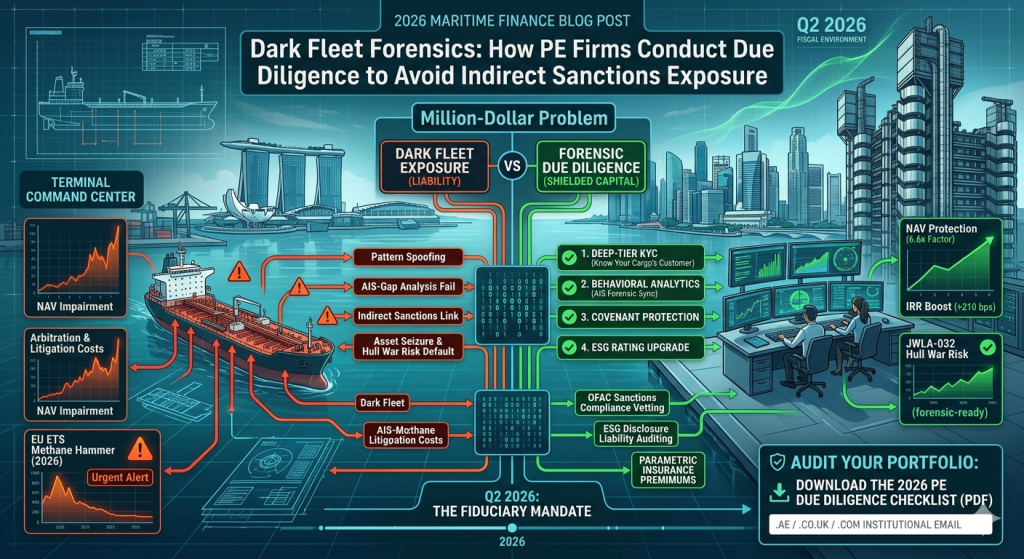
In the Q2 2026 maritime theater, the proliferation of the “Dark Fleet” has moved beyond a regulatory nuisance to a systemic threat capable of triggering instantaneous Asset Seizure & Hull War Risk defaults across a Private Equity (PE) portfolio. Sophisticated institutional investors are now deploying forensic AIS-gap analysis and behavioral pattern recognition to shield their Senior Secured Debt from the catastrophic contagion of indirect sanctions exposure.
The Economic Impact: The High Cost of “Sanctions Contagion”
For Private Equity firms and C-Suite executives in Singapore, London, and the UAE, the “Million-Dollar Problem” is no longer the loss of a single vessel, but the total impairment of a fund’s liquidity. In 2026, the regulatory architecture has evolved into a “Zero-Trust” environment where “indirect” exposure is treated with the same severity as direct violations.
The Devaluation Spiral
When a portfolio company is linked—even tangentially—to a Dark Fleet Ship-to-Ship (STS) transfer, the financial fallout is immediate. Lenders, hyper-sensitive to OFAC Sanctions Compliance, will often trigger “Material Adverse Change” (MAC) clauses, leading to an immediate recall of Senior Secured Debt. If the fund cannot bridge this liquidity gap via expensive Mezzanine Financing, the equity value of the entire maritime platform can be zeroed out in a single fiscal quarter.
Insurance and Impairment
The 2026 insurance market has “hardened” to a point of forensic scrutiny. Under the current Joint War Committee (JWC) Circulars, any vessel found to have traded in proximity to Dark Fleet hubs is subject to astronomical Parametric Insurance Premiums or outright policy cancellation. This operational friction collapses the Internal Rate of Return (IRR) and leaves the investor holding a “stranded asset” that is un-charterable and un-sellable.
The Compliance/Legal Framework: Navigating the 2026 Enforcement Net
The legal landscape of 2026 is defined by a convergence of environmental mandates and national security enforcement.
I. JWLA-032 and the New “Risk Areas”
The JWLA-032 circular has expanded the definition of high-risk zones to include traditional STS hubs previously considered neutral. Insurers now mandate “Forensic AIS Integrity” as a condition of cover. If a vessel exhibits “pattern spoofing”—a common Dark Fleet tactic—the owner faces a total denial of Hull War Risk claims, leading to unrecoverable Arbitration & Litigation Costs.
II. ESG Disclosure Liability and Dark Fleet Linkage
The “Social and Governance” pillars of 2026 mandates now explicitly include supply chain integrity. ESG Disclosure Liability is triggered if a PE firm fails to report that its vessels are trading with entities that utilize Dark Fleet logistics. Furthermore, with the EU ETS Phase-In costs for methane slip now fully integrated, Dark Fleet vessels (which typically lack emissions monitoring) provide a “carbon-opaque” alternative that regulators are aggressively targeting.
III. AI-Driven Navigation Liability
As the “Dark Fleet” adopts more aggressive “Dark Mode” navigation, the risk of collisions in high-traffic corridors like the Red Sea has surged. For legitimate owners, AI-driven navigation liability arises when their automated systems attempt to avoid a Dark Fleet vessel that is not broadcasting an AIS signal. The resulting litigation often hinges on whether the PE firm conducted sufficient due diligence on the “Behavioral Risk” of the trade lanes they operate in.
Strategic Recommendations: 3 Actionable Steps for the CEO
I. Mandate “Deep-Tier” KYC in All Charterparties
Traditional “Know Your Customer” (KYC) is obsolete. CEOs must insist on “Know Your Cargo’s Customer” (KYCC). Ensure all BIMCO 2026 Sanctions Clauses include a right of “Forensic Termination” if any counterparty—up to three tiers removed—is linked to Dark Fleet logistics. This is your primary defense against Asset Seizure.
II. Integrate Parametric Hedges for “Sanctions Volatility”
Given the unpredictable nature of OFAC designations, PE firms should utilize Parametric Insurance Premiums that pay out upon the “Designation” of a major regional trade hub. This provides the immediate cash flow needed to reroute a fleet without breaching debt covenants or requiring emergency Mezzanine Financing.
III. Deploy AIS-Gap Behavioral Analytics
Do not rely on static sanction lists. Deploy AI-driven forensics that flag “ghosting” events and abnormal speed-over-ground patterns in STS zones. If a potential acquisition or a current portfolio vessel shows these markers, it must be treated as a toxic asset. This proactive stance significantly reduces potential Arbitration & Litigation Costs by proving a “Culture of Compliance” to regulators.
Securing Your Fiduciary Future
Navigating the 2026 “Dark Fleet” reality requires a lead underwriter’s forensic eye and a risk consultant’s strategic depth. As the enforcement of Joint War Committee (JWC) Circulars and JWLA-032 intensifies, the gap between “Compliance” and “Safety” has never been wider. At Oitha Marine, we provide the Professional Advisory Services and Specialized Insurance Cover required to bridge this gap. Whether you are conducting pre-acquisition due diligence or restructuring Senior Secured Debt & Mezzanine Financing, our forensic approach ensures your capital remains senior and your operations remain tradeable. Protect your portfolio from the contagion of the Dark Fleet today.
FAQ: Dark Fleet Forensics & Maritime Risk (2026)
Q: How does the Dark Fleet affect my Senior Secured Debt? A: In 2026, most loan agreements include “Sanctions Continuity” clauses. If a vessel is linked to Dark Fleet activity, the bank can immediately declare a technical default, recalling the Senior Secured Debt and forcing a fire-sale or a desperate pivot to Mezzanine Financing.
Q: Why is JWLA-032 so critical for PE firms? A: JWLA-032 is the benchmark for Hull War Risk. Dark Fleet activity often correlates with high-risk zones. If your fleet is operating near these “Shadow STS” hubs, your premiums will skyrocket unless you can prove forensic AIS-integrity.
Q: Can AI-driven navigation liability be avoided? A: Not entirely, but it can be mitigated. PE firms must ensure their portfolio companies use “Defensive AI” that is trained to recognize non-broadcasting Dark Fleet hulls. This technical due diligence is now a requirement for Tier-1 P&I cover.
Q: What is the “Methane Hammer” in the Dark Fleet context? A: Dark Fleet vessels are usually older and highly inefficient. Under the EU ETS Phase-In costs for methane slip, these vessels are facing massive surcharges. Regulators are using these emissions spikes as a “Digital Fingerprint” to identify and seize vessels that are operating “Dark.”
Q: Does ESG Disclosure Liability apply to indirect sanctions? A: Yes. Under 2026 reporting standards, “Indirect Involvement” in unsanctioned or opaque trades is considered a material ESG failure. This can lead to divestment from major institutional LPs (Limited Partners) and significant Arbitration & Litigation Costs.
The “Ghosting” Phenomenon: A Fiduciary Nightmare
The “Million-Dollar Problem” for a PE Managing Director is the “Ghosting” event. In 2026, AIS-manipulation has become so sophisticated that Dark Fleet vessels can “project” their location hundreds of miles away from their actual STS transfer point. If your portfolio vessel happens to be the counterparty in what was marketed as a “clean” fuel transfer, you have effectively inherited a sanctions violation.
This is where “Dark Fleet Forensics” comes in. It is no longer about where the vessel says it is; it is about the “Forensic Digital Twin” of the vessel’s engine data. Does the fuel consumption match the reported voyage? If not, the vessel is likely “Ghosting,” and your Asset Seizure risk is at 90%.
The Capital Stack Pivot: Why Mezzanine Financing is a Trap
When OFAC Sanctions Compliance is breached, the Senior Secured Debt vanishes. PE firms often look to Mezzanine Financing as a bridge. However, in 2026, “Mezzanine” providers are charging “Contagion Premiums.” If you are borrowing to cover a sanctions-related liquidity gap, you are likely paying 20%+ APR. This is a “Death Spiral” that leads to total fund impairment.
Conclusion: The Strategic Mandate for 2026
The Private Equity firm of 2026 must act as a “Sovereign Intelligence Agency.” By utilizing Parametric Insurance Premiums and behavioral analytics, you can insulate your fund from the Dark Fleet contagion. The Joint War Committee (JWC) Circulars and JWLA-032 are not just rules—they are the roadmap for survival in an era of “Shadow” trade.
Oitha Marine is your lead underwriter in this transition. We provide the Professional Advisory Services needed to audit your trade lanes and the Specialized Insurance Cover needed to protect your capital. Don’t let your fund be the next case study in Asset Seizure. Anchor in forensic reality today.
Recent Comments