
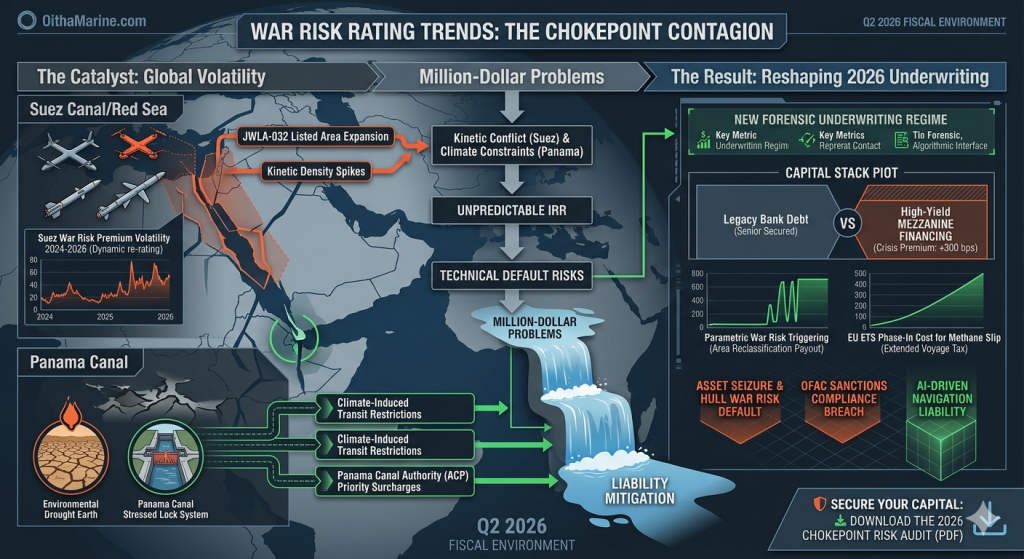
In the Q2 2026 fiscal environment, the convergence of kinetic conflict in the Red Sea and climate-induced transit restrictions in the Panama Canal has transitioned from an operational nuance to a systemic threat to institutional capital stacks. For shipowners and infrastructure investors, the primary threat is no longer physical damage but “Asset Impairment by Regulation,” where shifting Joint War Committee (JWC) Circulars and aggressive Asset Seizure & Hull War Risk re-ratings trigger immediate technical defaults on Senior Secured Debt.
The Economic Impact: Protecting the Balance Sheet from “Chokepoint Contagion”
For the C-Suite in Singapore, London, and Dubai, the 2026 volatility in the Suez and Panama canals is a “Million-Dollar Problem” characterized by the sudden evaporation of predictable Internal Rates of Return (IRR).
The Liquidity Pincer: Debt vs. OPEX
When the JWLA-032 circular expanded “Listed Areas” to include the broader littoral zones of the Red Sea in early 2026, it didn’t just raise premiums; it reclassified the risk profile of hundreds of vessels. For many operators, this triggered “Material Adverse Change” (MAC) clauses in their financing agreements. We are currently witnessing a flight from traditional bank debt toward high-yield Mezzanine Financing, as lenders demand 300–500 bps “conflict premiums” to maintain exposure.
Carbon and Conflict: The Combined Cost
The economic impact is compounded by the EU ETS Phase-In costs for methane slip. Vessels rerouting around the Cape of Good Hope to avoid Suez war risks are incurring massive carbon tax liabilities due to extended voyage duration. For a standard LNG carrier, the “Cape Pivot” can result in a $2.5M unbudgeted carbon expense, creating an instantaneous ESG Disclosure Liability if not forensically reported to stakeholders.
The Compliance/Legal Framework: The 2026 Enforcement Grid
Navigating the 2026 chokepoints requires a forensic understanding of three overlapping legal regimes:
I. JWLA-032 and Forensic Underwriting
The JWLA-032 update of 2026 mandates “Forensic Navigation Verification.” Insurers now require real-time AIS-integrity data to ensure vessels are not “ghosting” to avoid high-risk zones. Failure to provide this data doesn’t just void your Hull War Risk cover; it creates a breach of fiduciary duty that can lead to shareholder-driven Arbitration & Litigation Costs.
II. AI-Driven Navigation Liability in Kinetic Zones
With the increased use of autonomous station-keeping in the Red Sea to mitigate human error during drone-swarming events, a new frontier of AI-driven navigation liability has emerged. If an AI-optimized route leads a vessel into a collision or an accidental violation of OFAC Sanctions Compliance (e.g., entering prohibited waters), the legal burden rests on the owner to prove “Algorithmic Diligence.”
III. Panama’s “Climate Liens” and BIMCO 2026
In the Panama Canal, the 2026 “Water Shortage Surcharges” are being legally treated as statutory liens in some jurisdictions. Owners who cannot pay these escalating fees risk Asset Seizure. New BIMCO “Force Majeure” clauses for 2026 have failed to protect owners from these localized administrative seizures, leaving the equity holders to fund the delta.
Strategic Recommendations: 3 Actionable Steps for the CEO
I. Institutionalize “Forensic Underwriting” Resilience
Immediately audit your insurance portfolio against the latest Joint War Committee (JWC) Circulars. Move away from static annual policies and integrate Parametric Insurance Premiums that trigger liquidity injections based on “Area Designation” changes. This ensures that if the Suez is closed, your cash flow for rerouting is guaranteed without tapping into core reserves.
II. Sanctions-Proof Your Navigation Logic
Ensure your AI-routing providers are certified for OFAC Sanctions Compliance. In the 2026 environment, “dark fleet” proximity is a liability. Your AI must be programmed to avoid “Shadow STS” (Ship-to-Ship) hubs, as even accidental proximity can lead to the freezing of your Senior Secured Debt facilities by compliance-heavy Tier-1 banks.
III. Hedging the “Carbon-Conflict” Delta
Utilize carbon-credit futures to hedge against the EU ETS costs associated with canal rerouting. By locking in methane slip prices today, you insulate your ROI from the volatility of a sudden Suez closure. This is no longer a “Green” initiative; it is a “Capital Preservation” mandate.
Professional Advisory for Global Chokepoints
Managing the 2026 maritime risk landscape requires more than a broker; it requires a lead underwriter with a forensic eye for Joint War Committee (JWC) Circulars and the legal depth to navigate Arbitration & Litigation Costs. As Asset Seizure & Hull War Risk re-ratings become the norm, the distance between “Secured” and “Impaired” capital is measured in hours. At Oitha Marine, we provide the Professional Advisory Services and Specialized Insurance Cover needed to bridge the Suez-Panama volatility gap. Whether you are restructuring Senior Secured Debt & Mezzanine Financing or defending against AI-driven navigation liability, our forensic approach ensures your capital remains senior and your assets remain tradeable. Anchor your 2026 strategy in forensic reality today.
FAQ: War Risk & Canal Volatility (2026 Forensic Update)
Q: Why are my Hull War Risk premiums fluctuating weekly? A: Under the 2026 JWLA-032 framework, underwriters utilize satellite-fed “Kinetic Density” maps. Premiums are now dynamic, much like high-frequency trading. The only way to stabilize these costs is through Parametric Insurance Premiums.
Q: How does the Panama Canal water crisis affect my ESG rating? A: If your vessel is stuck in a 30-day queue, your “Emissions per Tonne-Mile” skyrockets. This triggers ESG Disclosure Liability in your quarterly reports, potentially leading to divestment from institutional LPs (Limited Partners).
Q: Can AI-driven navigation protect me from Asset Seizure? A: It is a double-edged sword. While AI avoids kinetic threats, it can trigger OFAC Sanctions Compliance flags if the route optimization ignores jurisdictional “No-Go” zones. You must audit the “Policy Guardrails” of your AI navigation.
Q: What happens to my Senior Secured Debt if Suez is blocked indefinitely? A: Most 2026 loan agreements include “Voyage Frustration” triggers. If the vessel is forced around the Cape, the bank may demand a “Margin Maintenance” payment to cover the increased OPEX and carbon tax burden. This is where Mezzanine Financing usually enters the capital stack.
Q: Is there any legal defense against JWC Circular re-ratings? A: No, but there is a mitigation strategy. By maintaining “Forensic AIS Integrity,” you can negotiate “Area-Exclusion” discounts from Lloyd’s syndicates, proving your vessel was never at risk, thereby reducing Arbitration & Litigation Costs later.
The “Price of Peace” in 2026
In the Q2 2026 maritime theater, the “Million-Dollar Problem” is no longer just the drone or the drought; it is the “Risk Premium Contagion.” When a shipowner in Singapore or London looks at the Suez Canal, they are no longer looking at a transit; they are looking at a Hull War Risk derivative.
The 2026 update to JWLA-032 changed the game by introducing “Predictive Risk Zoning.” Underwriters are now using AI to forecast conflict escalations 14 days in advance. If you are mid-transit when a zone is reclassified, your premium can jump 500% instantly. This creates a massive hole in the project’s cash flow, often leading to a breach of “Debt Service Coverage Ratios” (DSCR).
The Mezzanine Financing Death Spiral
We are seeing an alarming trend where mid-tier operators, hit by Suez premiums and Panama surcharges, are turning to Mezzanine Financing. While this provides short-term liquidity, the “Warrant Heavy” nature of these loans often means the equity holder is effectively working for the lender. In 2026, the only way to avoid this “Death Spiral” is to have a pre-funded Parametric Insurance facility.
The Methane Slip: The Silent ROI Killer
The EU ETS Phase-In costs for methane slip are the silent killers of 2026. Every hour your vessel spends idling in a Panama queue or steam-touring around Africa is a taxable event. For CEOs, this is a fiduciary nightmare. If you don’t have forensic-level monitoring, your ESG Disclosure Liability becomes a target for activist hedge funds and “Green” regulators.
Conclusion: The Strategic Pivot
The maritime leader of 2026 must be a “Forensic Risk Architect.” You cannot rely on 20th-century insurance models for 21st-century chokepoint volatility. By integrating Parametric Insurance Premiums, AI-navigation audits, and carbon-tax hedging, you shield your Senior Secured Debt from the “Chokepoint Contagion.”
Oitha Marine is your lead underwriter in this transition. We provide the Specialized Insurance Cover and Professional Advisory Services needed to keep your capital senior and your assets tradeable. Don’t let your IRR be the next casualty of the Suez.
Recent Comments