
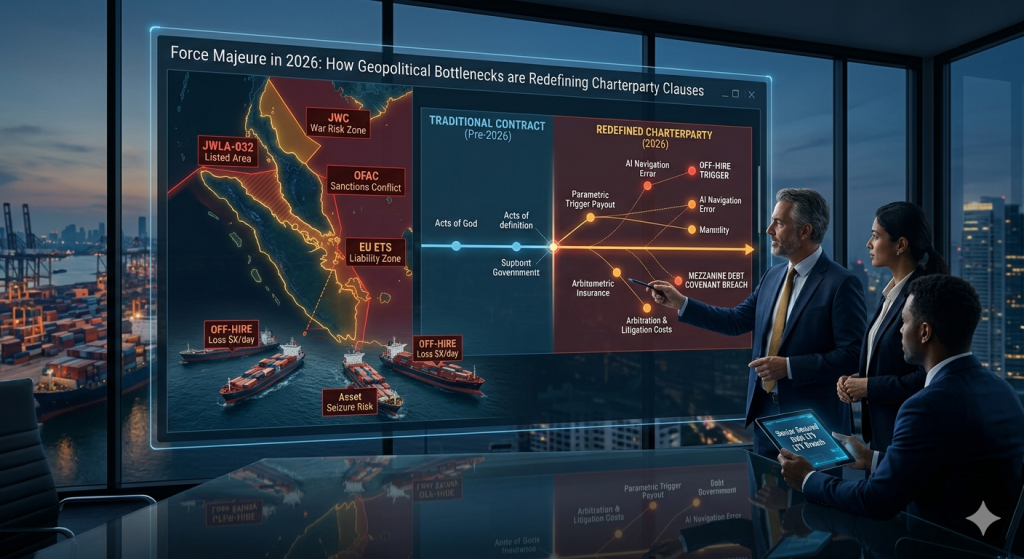
In 2026, the traditional definition of Force Majeure has collapsed under the weight of systemic geopolitical volatility, shifting from an “Act of God” defense to a quantifiable liability trigger for institutional investors. Failure to recalibrate charterparty clauses against modern bottlenecks now directly exposes Senior Secured Debt and Mezzanine Financing structures to unrecoverable “Off-Hire” losses and catastrophic default cascades.
The Economic Impact: Erosion of the Maritime Balance Sheet
For the C-Suite executive in London, Dubai, or Singapore, a geopolitical bottleneck is no longer a mere logistical delay—it is an aggressive assault on the corporate balance sheet. As we navigate the mid-point of 2026, the fiscal friction caused by inadequate contract language has a direct, measurable impact on Return on Investment (ROI) and debt serviceability.
The Cost of “Frozen” Capital
When a vessel is trapped behind a bottleneck—whether it be the Suez transit restricted by Joint War Committee (JWC) Circulars or a South China Sea standoff—the interest on high-leverage financing does not stop. For portfolios backed by Senior Secured Debt, a 30-day Force Majeure event without a “Liberty to Deviate” clause can result in a liquidity crunch that breaches loan-to-value (LTV) covenants.
Volatility in Insurance Opex
The economic fallout extends to Hull War Risk premiums. In 2026, underwriters are no longer providing blanket coverage. We are seeing a pivot toward Parametric Insurance Premiums, where payouts are triggered by specific geolocation data points rather than subjective damage assessments. If your charterparty doesn’t explicitly define who bears the cost of these surging premiums during a “Geopolitical Bottleneck,” the shipowner is often left holding a seven-figure bill that was never factored into the initial voyage estimate.
The Compliance and Legal Framework: Navigating the 2026 Regulatory Minefield
The legal landscape of 2026 has rendered 20th-century Force Majeure templates obsolete. Three primary regulatory pillars now dictate whether a delay is a “contractual excuse” or a “billable breach.”
1. The Impact of JWLA-032 and JWC Circulars
The issuance of the JWLA-032 circular has fundamentally altered the “Listed Areas.” Underwriters now require 24-hour notice for transits through newly designated high-risk zones. If a charterer orders a vessel into a zone that was “clear” at the time of fixture but is “listed” by the time of arrival, traditional Force Majeure clauses rarely protect the owner from the resulting Asset Seizure risks or the astronomical spike in war risk additional premiums (APs).
2. OFAC Sanctions Compliance & The “Shadow Fleet” Friction
OFAC Sanctions Compliance is now a real-time operational requirement. In 2026, geopolitical bottlenecks are often created by “compliance chokepoints” where port authorities seize vessels suspected of carrying sanctioned cargo or utilizing the “Shadow Fleet” for transshipments. If your Force Majeure clause does not specifically exclude “Regulatory Seizure due to Sanction Non-Compliance,” an investor’s entire maritime asset could be tied up in Arbitration & Litigation Costs for years, with no revenue stream to support the underlying debt.
3. EU ETS & Methane Slip: The New “Operational” Force Majeure
As of 2026, the EU ETS phase-in is at its most aggressive stage, specifically targeting methane slip for dual-fuel vessels. When a vessel is forced into a bottleneck-induced delay, the carbon tax liability continues to accrue. We are seeing a rise in “Carbon Force Majeure” disputes: Does a geopolitical blockade excuse the charterer from paying the EU ETS surcharges? Without explicit 2026 BIMCO “Emission Trading Scheme” clauses, the ESG Disclosure Liability becomes an unhedged risk on the corporate disclosure forms.
Strategic Recommendations: Protecting US-Bound and Global Capital
To mitigate these million-dollar exposures, C-Suite executives must move beyond standard templates and adopt “Aggressive Protective Language.”
I. Implementation of Parametric Trigger Clauses
Replace subjective “reasonable endeavor” language with objective triggers linked to Parametric Insurance Premiums. If the JWC raises a specific area’s risk rating by X%, the contract should automatically trigger a cost-sharing mechanism. This removes the need for expensive Arbitration & Litigation Costs by creating a mathematical certainty for payment obligations.
II. AI-Navigation Liability Audits
With the integration of AI-driven navigation in the Red Sea and other high-traffic corridors, Force Majeure must now address “Algorithmic Error.” If an AI navigation system refuses to enter a bottleneck due to perceived risk, is that a “Navigational Error” (Owner’s risk) or “Force Majeure” (Neutral)? CEOs must ensure their P&I and H&M coverage are aligned with these new AI-liability frameworks.
III. Sanctions-Proofing Debt Structures
For those utilizing Mezzanine Financing, ensure that “Intercreditor Agreements” include “Sanction-Induced Force Majeure” provisions. This prevents a “Cross-Default” if one vessel in a fleet is caught in a geopolitical seizure, protecting the rest of the portfolio from a predatory “Asset Seizure” by junior lenders.
The Need for Specialized Maritime Advisory
As the maritime sector moves into the high-volatility era of late 2026, the margin for error in charterparty negotiation has vanished. Navigating the intersection of OFAC Sanctions Compliance, JWC Circulars, and ESG Disclosure Liability requires more than just a legal team—it requires a holistic risk-mitigation strategy. Institutional investors are strongly advised to seek Professional Advisory Services and Specialized War Risk Underwriting to ensure that their Senior Secured Debt remains protected against the redefining of Force Majeure in an age of permanent geopolitical friction.
Frequently Asked Questions (FAQ)
Q1: How does the JWLA-032 circular specifically affect my current charterparty? Answer: The JWLA-032 update drastically expands the reporting requirements for “listed areas.” If your contract uses an older version of the “War Risk” clause, you may be contractually obligated to enter zones that your insurers have now effectively blacklisted, leading to a total loss of cover or Asset Seizure.
Q2: Can I use Force Majeure to avoid EU ETS methane slip costs during a delay? Answer: Generally, no. Most 2026 legal precedents suggest that carbon taxes are an operational cost of doing business, not an “unforeseeable act” that triggers Force Majeure. Specialized “Carbon Indemnity” clauses are required to shift this liability to the charterer.
Q3: What is the average cost of Arbitration & Litigation for a Force Majeure dispute in 2026? Answer: For high-value chemical or LNG tonnage, Arbitration & Litigation Costs in London or Singapore now average between $250,000 and $750,000 per case, excluding the lost revenue of the vessel while it remains “Off-Hire.”
Q4: How does Parametric Insurance help in a Geopolitical Bottleneck? Answer: Unlike traditional insurance which requires a lengthy “claims adjustment” process, Parametric Insurance Premiums pay out immediately once a specific event occurs (e.g., a port is closed for 48+ hours). This provides the immediate liquidity needed to prevent a default on Senior Secured Debt.
Q5: Are AI-driven navigation errors covered under standard Force Majeure? Answer: This is the “Million-Dollar Question” of 2026. Most standard BIMCO clauses do not account for AI decision-making. We recommend adding a “Technological Force Majeure” rider to any contract involving Tier-3 autonomous or AI-assisted vessels.
Recent Comments