
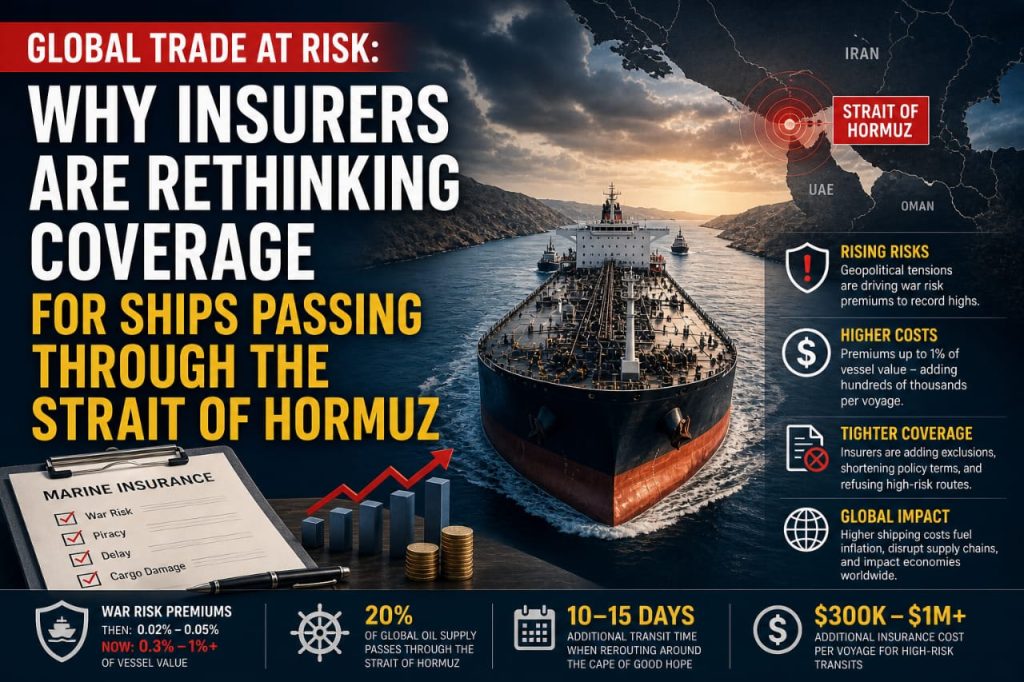
The Invisible Risk Driving Global Trade Costs
Global trade is built on predictability. Ships move. Cargo flows. Insurance underwrites the risk.
But in 2026, that stability is being challenged—quietly but aggressively—by rising tensions in the Strait of Hormuz.
While headlines focus on oil prices and geopolitics, a deeper shift is unfolding behind the scenes:
Marine insurers are fundamentally rethinking how they price—and even offer—coverage for vessels passing through one of the world’s most critical maritime chokepoints.
This shift has far-reaching consequences, not just for shipowners, but for global supply chains, energy markets, and consumers across the United States, United Kingdom, and Canada.
Why the Strait of Hormuz Is a Global Trade Flashpoint
The Strait of Hormuz is one of the most strategically important waterways in the world.
Roughly 20% of global oil supply passes through it
Critical route for liquefied natural gas (LNG) exports
Essential for connecting Middle Eastern energy producers to global markets
Any disruption—or perceived risk—in this narrow corridor immediately impacts shipping routes, insurance pricing, and global economic stability.
The Insurance Industry’s Role in Global Shipping
Shipping doesn’t move without insurance.
Marine insurance covers:
Vessel damage
Cargo loss
Liability risks
War and political risks
Markets like Lloyd’s of London and global reinsurers such as Munich Re are central to underwriting these risks.
But when risk becomes unpredictable, insurers don’t just raise prices—they change the rules entirely.
What’s Changing: A Shift From Pricing Risk to Avoiding It
Historically, insurers managed geopolitical risks by adjusting premiums.
Today, that model is evolving into something more restrictive.
1. Surge in War Risk Premiums
War risk insurance—once a minor add-on—is now a major cost driver.
Pre-2024: 0.02%–0.05% of vessel value
2026: 0.3%–1% or higher in extreme scenarios
For a $100 million vessel:
Before: $20,000 – $50,000
Now: $300,000 – $1,000,000 per voyage
2. Shortened Coverage Windows
Instead of annual policies, insurers are increasingly offering:
Voyage-specific coverage
Limited-duration policies
This increases uncertainty and administrative complexity.
3. Expanded Exclusions
Policies now often exclude:
Specific regions
Certain types of cargo
Political or military incidents
This shifts more risk onto shipowners and cargo clients.
4. Selective Underwriting
Some insurers are simply refusing to cover certain voyages through the Strait of Hormuz.
This marks a major shift: From pricing risk → to avoiding risk altogether
The Role of Reinsurers in Driving Market Behavior
Reinsurers—companies that insure insurers—play a critical role in shaping the market.
Firms like Munich Re and others:
Absorb large-scale risks
Set capital requirements
Influence premium pricing
When reinsurers tighten their models:
Primary insurers follow
Premiums rise across the board
Coverage availability shrinks
This creates a global ripple effect across the entire shipping ecosystem.
Impact on Shipowners and Charterers
1. Rising Operational Costs
Shipowners must now absorb:
Higher insurance premiums
Additional compliance requirements
Security costs (armed guards, monitoring systems)
2. Increased Contract Complexity
Charter agreements now include:
Risk-sharing clauses
Insurance cost pass-through mechanisms
Force majeure provisions tied to geopolitical events
3. Route Optimization Challenges
Avoiding the Strait of Hormuz is not always viable.
Alternative routes:
Add 10–15 days to voyages
Increase fuel consumption
Reduce fleet efficiency
The Global Economic Ripple Effect
1. Energy Market Volatility
Higher shipping insurance costs directly impact oil transportation.
Result:
Increased crude oil prices
Higher fuel costs in Western markets
2. Supply Chain Pressure
Increased shipping costs lead to:
Higher freight rates
Delays in goods delivery
Reduced reliability in logistics networks
3. Inflation Across Economies
Businesses pass increased costs to consumers, leading to:
Rising prices on goods
Increased inflation pressure
Reduced consumer purchasing power
Financial data platforms
Logistics technology companies
Energy and commodity trading firms
These advertisers target decision-makers with high purchasing power, especially in the US, UK, and Canada.
The Future of Marine Insurance in High-Risk Regions
The industry is moving toward:
1. Dynamic Pricing Models
Using real-time data:
Satellite tracking
Naval intelligence
AI-driven risk analysis
2. Increased Collaboration
Between:
Governments
Naval forces
Insurance providers
3. Alternative Risk Structures
Such as:
Risk pooling
Self-insurance by large shipping firms
Specialized high-risk underwriting markets
Strategic Insight: A New Era of Risk in Global Trade
The shift happening in the Strait of Hormuz is not temporary.
It signals a broader transformation:
Geopolitical risk is becoming a permanent cost factor in global trade
For businesses, investors, and policymakers, this means:
Higher baseline costs
Greater volatility
Increased need for risk management strategies
Conclusion: The Cost of Uncertainty
Shipping has always been exposed to risk—but what’s changing now is how that risk is priced, managed, and transferred.
The insurance industry’s response to tensions in the Strait of Hormuz reveals a deeper truth:
Global trade is no longer just about supply and demand—it’s about managing uncertainty at scale.
And as insurers rethink coverage, the cost of that uncertainty will be felt across every layer of the global economy.
Frequently Asked Questions (FAQ)
1. Why are insurers concerned about the Strait of Hormuz?
The Strait of Hormuz is a high-risk geopolitical zone with strategic importance for global energy supply, making it vulnerable to disruptions that increase insurance risk.
2. What is war risk insurance in shipping?
War risk insurance covers losses caused by conflict, terrorism, piracy, or political instability. It is typically added to standard marine insurance policies and priced based on regional risk levels.
3. How much have premiums increased recently?
Premiums have risen from about 0.02%–0.05% of vessel value to 0.3%–1%, significantly increasing shipping costs.
4. Are insurers refusing coverage in high-risk zones?
Yes, some insurers are limiting or denying coverage for voyages through high-risk areas, especially during periods of heightened tension.
5. How does this affect global consumers?
Higher shipping and insurance costs lead to increased prices for fuel, goods, and services, contributing to inflation.
6. Can shipping companies avoid the Strait of Hormuz?
They can reroute, but it often increases travel time, fuel costs, and operational expenses.
7. Who controls marine insurance pricing globally?
Major insurance markets like Lloyd’s of London and reinsurers such as Munich Re play key roles.
8. Is this a long-term trend?
Yes, many experts believe geopolitical risks will continue to influence insurance pricing and coverage decisions in the long term.
Recent Comments