
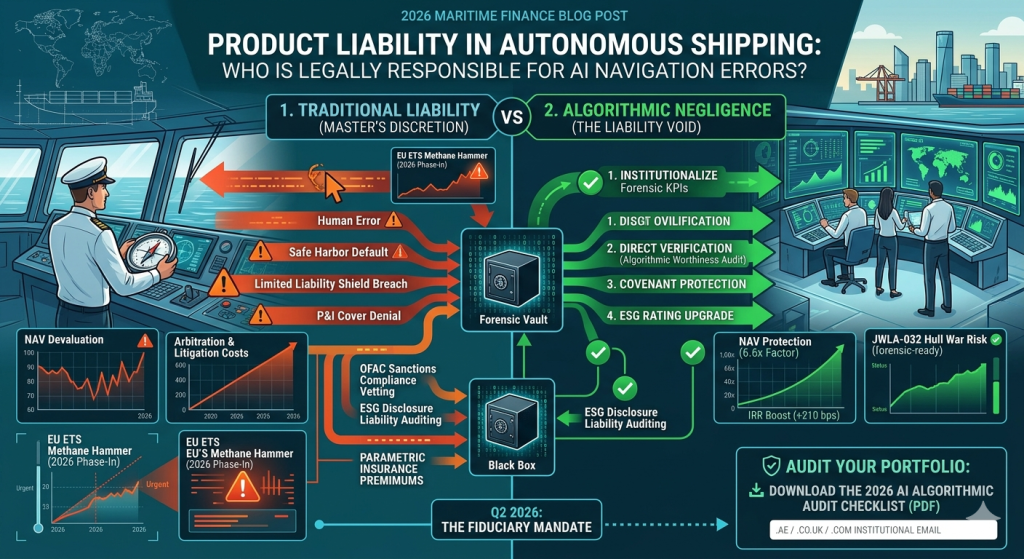
In the Q2 2026 maritime theater, the transition from “human error” to “algorithmic negligence” has created a multi-billion dollar liability void that threatens the stability of institutional capital stacks. For Private Equity firms and shipowners, an AI navigation failure is no longer a localized casualty; it is a systemic trigger for Asset Seizure & Hull War Risk defaults and the immediate acceleration of Senior Secured Debt.
The Economic Impact: The Anatomy of Algorithmic Impairment
The “Million-Dollar Problem” for 2026 is the erosion of the “Limited Liability” shield. When an autonomous system fails, the resulting Arbitration & Litigation Costs do not just target the shipowner; they cascade upward to the tech providers and downward to the financiers.
The Capital Stack Collapse
For investors in the USA, UAE, UK, and Singapore, the ROI on autonomous tonnage is being cannibalized by “Risk Tail” expansion. Traditional P&I cover is increasingly insufficient to handle the “Black Box” uncertainty of AI-driven navigation liability in the Red Sea. If a vessel’s AI initiates a collision while navigating a “Listed Area” under the JWLA-032 circular, the owner faces a total policy voidance if the algorithm’s decision-making logic cannot be forensically audited to meet Joint War Committee (JWC) standards.
Balance Sheet Contagion
- NAV Devaluation: A single high-profile AI error can render an entire class of autonomous vessels “un-financeable” overnight, forcing owners into the predatory Mezzanine Financing market to maintain liquidity.
- The Carbon Tax Hammer: In 2026, AI navigation isn’t just about safety; it’s about emissions. If an AI error leads to inefficient routing, the EU ETS Phase-In costs for methane slip skyrocket, creating an unbudgeted ESG Disclosure Liability that can trigger divestment from institutional LPs.
The Compliance/Legal Framework: The 2026 “Black Box” Mandate
The legal landscape of 2026 has moved from “Master under God” to “Developer under Audit.”
I. OFAC Sanctions Compliance and Algorithmic “Ghosting”
In 2026, OFAC Sanctions Compliance is a primary driver of autonomous risk. If an AI system autonomously adjusts its course to avoid kinetic threats in the Red Sea and accidentally skirts a sanctioned port or “Shadow STS” hub, the owner is strictly liable. Regulators no longer accept “software glitch” as a defense. The vessel becomes subject to immediate Asset Seizure, regardless of the owner’s intent.
II. BIMCO “AUTO-NAV” Clauses and IMO 2026
The 2026 BIMCO Autonomous Shipping clauses have shifted the burden of proof. Shipowners must now maintain “Algorithmic Worthiness” certificates. If a navigation error occurs and the owner cannot prove that the AI was updated with the latest Joint War Committee (JWC) Circulars, the liability moves from “General Average” to “Product Liability,” exposing the tech provider’s balance sheet to massive subrogation claims.
III. JWLA-032 and the Insurance Trigger
The JWLA-032 circular has introduced “Dynamic Navigation Surcharges.” For autonomous vessels, these surcharges are tied to the AI’s ability to detect and avoid “Dark Fleet” patterns. If the AI fails to recognize a non-broadcasting tanker and a collision ensues, the resulting Hull War Risk claim is often denied under the “Failure to Exercise Due Diligence” clause.
Strategic Recommendations: 3 Actionable Steps for the CEO
I. Institutionalize “Algorithmic Forensics”
Before deploying autonomous assets, establish a “Forensic Data Vault” independent of the AI provider. This vault must record every decision-point the AI makes in relation to OFAC Sanctions Compliance and Red Sea kinetic threats. This data is your only shield against unrecoverable Arbitration & Litigation Costs.
II. Secure Parametric Hedges for “Systemic Tech-Fail”
Move beyond traditional indemnity. Deploy Parametric Insurance Premiums that trigger upon “Fleet-Wide Software Suspension” or “Regional AI Denied-Access.” This provides the immediate liquidity needed to service Senior Secured Debt while the legal battle over “Product Liability” vs. “Navigational Error” plays out.
III. Address ESG Disclosure Liability Head-On
Your 2026 ESG reports must include a “Methane Slip Contingency” for AI routing. Ensure your tech providers provide a guarantee on the EU ETS Phase-In costs generated by their algorithms. If the AI prioritizes safety over emissions, your balance sheet must be prepared for the carbon tax delta.
Professional Advisory for Autonomous Risks
Navigating the transition to autonomous trade requires more than a software update; it requires an underwriter’s forensic perspective on Product Liability and Hull War Risk. As the Joint War Committee (JWC) Circulars evolve to meet the AI era, the margin for error has disappeared. At Oitha Marine, we provide the Professional Advisory Services and Specialized Insurance Cover needed to insulate your capital stack from algorithmic negligence. Whether you are restructuring Senior Secured Debt & Mezzanine Financing or defending an OFAC Sanctions Compliance audit, our lead underwriters offer the forensic oversight needed to keep your assets tradeable. Protect your ROI by anchoring your autonomous strategy in forensic reality today.
FAQ: AI Navigation & Product Liability (2026)
Q: Who is the “Master” of an autonomous vessel in 2026? A: Legally, the “Master” is now a split entity. While the shipowner retains operational liability, the “Technical Master” (the software provider) is increasingly vulnerable to “Product Liability” claims if the AI fails to adhere to Joint War Committee (JWC) Circulars.
Q: Can AI errors trigger a default on Senior Secured Debt? A: Yes. Most 2026 maritime loan agreements include “Algorithmic Integrity” covenants. A significant AI error that leads to Asset Seizure or a massive OFAC fine is a material breach of these covenants, leading to debt acceleration.
Q: How does the Red Sea conflict impact AI navigation liability? A: The Red Sea is the “Testing Ground” for AI-driven navigation liability. If an AI attempts to “spoof” its location to avoid an attack and causes a collision, the owner is liable for the collision, and the insurer may deny the Hull War Risk claim due to “Intentional Misrepresentation” of position.
Q: Does Parametric Insurance cover software glitches? A: Yes, if the policy is structured correctly. Parametric Insurance Premiums are now being designed to pay out based on “Software Downtime” or “Cloud Connectivity Loss” in high-risk straits, providing the cash flow to hire emergency tugs or manual pilots.
Q: What is the “Methane Signature” of an AI error? A: If an AI optimizes for speed over engine efficiency, the resulting EU ETS Phase-In costs for methane slip increase. In 2026, this is a reportable ESG Disclosure Liability that can affect the fund’s overall “Green” rating.
The “Black Box” Liability Gap
In the Q2 2026 fiscal environment, the maritime industry has reached a “Fiduciary Cliff.” We have vessels capable of navigating the Malacca Strait without a human on the bridge, but our legal frameworks are still anchored in the 19th-century concept of “Master’s Discretion.”
When an autonomous vessel causes a $500M grounding, the first question from the Lloyd’s syndicate isn’t “What happened?” but “Who wrote the code?” If the error is traced back to a faulty update of the OFAC Sanctions Compliance module, the liability moves from the shipowner’s P&I club to the tech provider’s Professional Indemnity (PI) cover. This shift is causing a massive spike in Arbitration & Litigation Costs, as insurers fight to subrogate the claim to the deep pockets of Silicon Valley.
Mezzanine Financing as the “Risk Buffer”
We are seeing a trend where traditional banks refuse to finance autonomous hulls unless there is a significant layer of Mezzanine Financing to act as a “Liability Buffer.” This mezzanine layer absorbs the first loss in the event of an Asset Seizure or a regulatory-driven grounding. For the institutional investor, this means the cost of capital for autonomous shipping is significantly higher than for manned vessels, despite the theoretical OPEX savings.
The JWLA-032 and AI Navigation in the Red Sea
The JWLA-032 circular was specifically updated in 2026 to address the “Autonomous Threat.” Insurers now charge a “Silent Pilot” surcharge for AI vessels entering the Red Sea. If the AI is programmed to enter “Silent Mode” (turning off AIS and other identifiers) to avoid missile targeting, it creates a “Compliance Vacuum.” If that vessel is then seized by a regional power, the Hull War Risk claim will be contested unless the owner can prove the “Silent Mode” was a last-resort fiduciary decision and not a software-default error.
Conclusion: The Strategic Fiduciary Pivot
The maritime leader of 2026 must be as much a “Data Auditor” as a “Vessel Operator.” You cannot outsource your liability to an AI provider and expect your Senior Secured Debt to remain protected. By integrating Parametric Insurance Premiums, conducting deep-tier ESG Disclosure Liability audits, and maintaining a forensic data trail, you protect your capital stack from the volatility of algorithmic negligence.
Oitha Marine is your partner in this forensic transition. We provide the Specialized Insurance Cover and Professional Advisory Services to ensure your autonomous fleet is a “Safe Harbor” for institutional capital, not a “Ghost Ship” of liability.
Recent Comments