
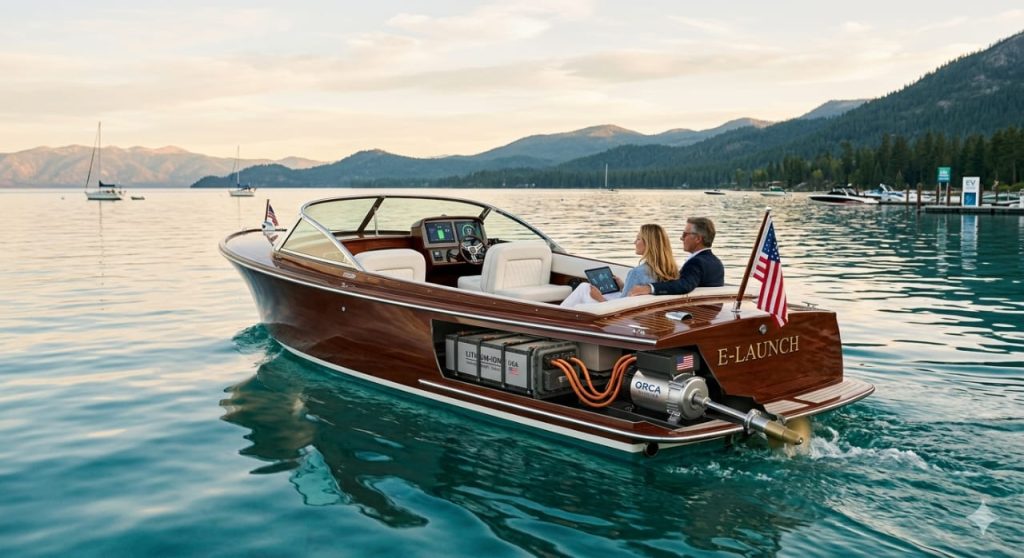
The American boating landscape is undergoing its most significant transformation since the transition from oars to internal combustion. Across the waterways of the United States—from the Great Lakes and the Florida Intercoastal to the wakeboarding havens of Lake Tahoe and Austin—a quiet revolution is taking place.
Electric inboard propulsion is no longer a futuristic concept reserved for experimental vessels or low-speed rental fleets. Today, advanced battery chemistry, high-torque permanent magnet motors, and escalating environmental regulations are converging to push electric inboard motors into the mainstream of the American recreational and commercial marine sectors.
For boat builders, retrofitters, and forward-thinking yacht owners, making the switch to electric power is an investment in unparalleled refinement, near-zero maintenance, and long-term compliance with evolving emissions standards. This comprehensive guide explores the technology, economic realities, and top American market options for electric inboard propulsion.
1. Why Electric Inboard Propulsion is Dominating the US Marine Market
For decades, gas and diesel inboard engines from legacy brands dominated American hulls. However, traditional internal combustion engines (ICEs) carry inherent liabilities: complex exhaust systems, high vibration, winterization requirements, and the constant threat of oil or fuel spills.
Electric inboard systems replace these pain points with an elegant, direct-drive configuration. By capitalizing on advancements from the automotive EV sector, modern marine electric motors offer several distinct advantages tailored to American boaters:
- Instantaneous Torque: Unlike gas or diesel engines that must climb an RPM curve to reach peak torque, electric motors deliver 100% of their torque instantly. This is crucial for heavy displacement boats, sailing yachts fighting strong currents, and wakeboarding boats needing to pop riders out of the hole.
- Near-Silent Operation: The absence of mechanical explosions, pistons, and exhaust noise transforms the boating experience. Passengers can converse at normal volumes while cruising, and anglers can approach pristine fishing grounds without scaring off wildlife.
- Radically Simplified Maintenance: A traditional marine engine requires oil changes, fuel filters, impeller replacements, winterization, and exhaust manifold inspections. A direct-drive electric inboard features essentially one moving part: the rotor. This eliminates the vast majority of annual maintenance costs and mechanical failure points.
- Regulatory Future-Proofing: An increasing number of pristine inland lakes and reservoirs across California, Colorado, and the Northeast are implementing strict bans or surcharges on internal combustion engines. Electric propulsion ensures unrestricted access to every waterway in the United States.
2. The Core Components of an Electric Inboard System
An electric marine drivetrain is a highly integrated ecosystem engineered to withstand harsh marine environments—including corrosive saltwater and continuous heavy loading.
+——————+ +——————-+ +——————+ +——————–+
| Shore Power / | –> | Battery Bank | –> | Motor Controller | –> | Electric Inboard |
| Solar / Hydro | | (Lithium LiFePO4) | | (Inverter) | | Motor (PMSM / AC) |
+——————+ +——————-+ +——————+ +——————–+
|
v
+——————–+
| Direct Shaft Drive |
+——————–+
The Motor: Permanent Magnet AC vs. Asynchronous Induction
Most high-end electric inboards in the USA utilize Permanent Magnet Synchronous Motors (PMSM) or advanced AC induction systems. These motors are incredibly compact—often a fraction of the size of the diesel engines they replace—yet they deliver equivalent or superior thrust. They are typically enclosed in IP67- or IP69K-rated waterproof housings to prevent water ingress.
The Battery Bank: Lithium Iron Phosphate ($\text{LiFePO}_4$)
The heart of any electric boat is its energy storage. While early electric conversions relied on heavy, inefficient lead-acid batteries, modern marine systems universally rely on lithium chemistry. Lithium Iron Phosphate ($\text{LiFePO}_4$) has emerged as the gold standard for American marine applications due to its exceptional thermal stability, resistance to thermal runaway, and long life cycle (often exceeding 3,000 to 5,000 complete charge-discharge cycles).
The Inverter/Controller
The controller acts as the brain of the vessel, translating throttle input into precise electrical frequencies sent to the motor. Advanced controllers also manage hydrogeneration—a process where, under sail or tow, the water moving past the propeller spins the shaft backward, turning the electric motor into a generator that pumps electricity back into the battery bank.
3. Top Electric Inboard Manufacturers Serving the US Market
Several elite marine engineering firms provide turnkey electric inboard systems and conversion kits designed to drop directly into standard American engine beds.
| Manufacturer | Base Voltage | Power Output Range | Primary Application | Key Features |
| Torqeedo (Deep Blue) | 360V / 48V | 10 kW to 100 kW+ | Yachts, Commercial, Large Cruisers | Industrial integration, BMW i3 battery partnerships, global support network. |
| Oceanvolt (AXC / ServoProp) | 48V | 10 kW to 30 kW+ | Daysailers, Catamarans, Cruising Sailboats | Award-winning hydrogeneration, space-saving designs, variable-pitch props. |
| ePropulsion (H-Series) | 48V / 96V | 1 kW to 200 kW | Pontoon Boats, Workboats, Inland Cruisers | Modular architecture, highly competitive pricing, extensive US dealer network. |
| Bellmarine (DriveMaster) | 48V / 96V | 2 kW to 130 kW | Classic Launches, Inland Canal Boats, Retrofits | Heavy-duty liquid-cooled options, traditional shaft-drive optimization. |
4. The Economics: Cost, Retrofitting, and Return on Investment
Investing in an electric inboard propulsion system involves higher upfront capital expenditure compared to buying a crate gas engine. However, the long-term total cost of ownership (TCO) paints a much more lucrative picture for American boaters.
The Initial Investment Breakdown
A complete 48V or 96V mid-range electric inboard system (including a 10 kW to 20 kW motor, standard controller, digital helm display, and a matching $10\text{ kWh}$ to $20\text{ kWh}$ lithium battery bank) typically runs between $\$12,000$ and $\$35,000$ depending on the brand and range requirements. High-voltage commercial systems ($360\text{V}+$ systems like Torqeedo Deep Blue) intended for large yachts or high-speed planing hulls can exceed $\$70,000$.
Calculating the Long-Term ROI
While the upfront price is premium, an electric conversion pays dividends over time:
- Zero Fuel Costs: Charging a marine battery bank at a US marina averages a fraction of the cost of marine gas or diesel per gallon.
- Eliminated Scheduled Maintenance: No winterization fees, no oil changes, no spark plugs, and no manifold replacements save the owner an estimated $\$1,500$ to $\$4,000$ annually in marine mechanic labor and parts.
- Increased Vessel Resale Value: Hulls retrofitted with premium, modern electric powertrains command a distinct premium on the brokerage market, as buyers look to avoid inheriting legacy combustion problems.
5. Charging Infrastructure and Shore Power in the United States
One of the most frequent concerns for American boaters transitioning to electric propulsion is charging accessibility. Fortunately, the infrastructure required to charge an electric boat already exists at almost every formal dock in the United States.
- Standard Shore Power (Level 1 & Level 2): Most electric inboard chargers plug directly into standard marine shore power pedestals. A typical $30\text{-amp}$ or $50\text{-amp, } 120\text{V/240V}$ shore power connection can easily recharge a standard marine battery bank overnight while docked.
- Marine Fast-Charging Networks: Dedicated DC fast-charging networks for boats are expanding rapidly across major American coastal and inland hubs. Companies like Aqua superPower are rolling out dedicated high-speed marine charging stations along major coastlines, capable of replenishing high-voltage electric boats in under an hour.
- Off-Grid Solar Integration: Because many electric inboards run on standardized 48V systems, they integrate seamlessly with marine-grade bimini solar arrays. For cruising sailboats and trawlers, a well-mapped solar array can supply enough trickle-charge energy to run onboard electronics and provide auxiliary motoring range indefinitely.
Frequently Asked Questions (FAQ)
How long does an electric inboard battery last on a single charge?
Range depends entirely on hull design, displacement, and cruising speed. For example, a 30-foot sailboat equipped with a $15\text{ kWh}$ lithium battery pack can typically cruise at an economical hull speed of 4 to 5 knots for 6 to 8 hours, yielding a range of roughly 30 miles. However, running at maximum throttle increases power consumption exponentially, which can exhaust the same battery in 1 to 2 hours.
Can I convert my existing gas or diesel inboard hull to electric?
Yes. Retrofitting is highly popular in the United States. Because electric motors are significantly smaller and lighter than the ICE engines they replace, they easily fit into existing engine bays. Conversion kits utilize adjustable engine mounts that align directly with your boat’s existing propeller shaft, minimizing structural modifications.
Are electric inboard motors safe in saltwater environments?
Absolutely. Top-tier marine electric components are engineered explicitly for harsh saltwater use. They feature marine-grade anodized aluminum alloys, stainless steel components, and are completely sealed (IP67+ rating) to ensure that corrosive salt air and water never make contact with the internal electrical windings or electronics.
Do electric boats require winterization?
Unlike traditional engines, electric inboards do not have water jackets, heat exchangers, or exhaust manifolds that can trap water and crack during a hard freeze. The motor itself requires zero winterization. The only winter maintenance involves keeping the lithium battery bank charged to its recommended storage capacity (usually around 50% to 60%) and turning off the main master switch.
What happens if the battery gets wet or submerged?
Modern marine lithium battery packs are built inside heavy-duty, waterproof, pressure-tested enclosures. They feature integrated Battery Management Systems (BMS) that monitor for faults. In the rare event of water ingress or an electrical short, the BMS automatically disconnects the battery cells within milliseconds, isolating the voltage and preventing shocks or thermal events.
Conclusion: Seizing the Clean Marine Era
Electric inboard propulsion represents a major step forward for the American marine industry. By combining silent luxury, instantaneous control, and a near-total absence of ongoing maintenance, electric drivetrains offer an unparalleled experience on the water. Whether you are eco-conscious, tired of volatile marine fuel prices, or looking to maximize the reliability of your vessel, the shift toward electric power provides a clear, high-performance path forward for American yacht owners and commercial mariners alike.
Recent Comments