
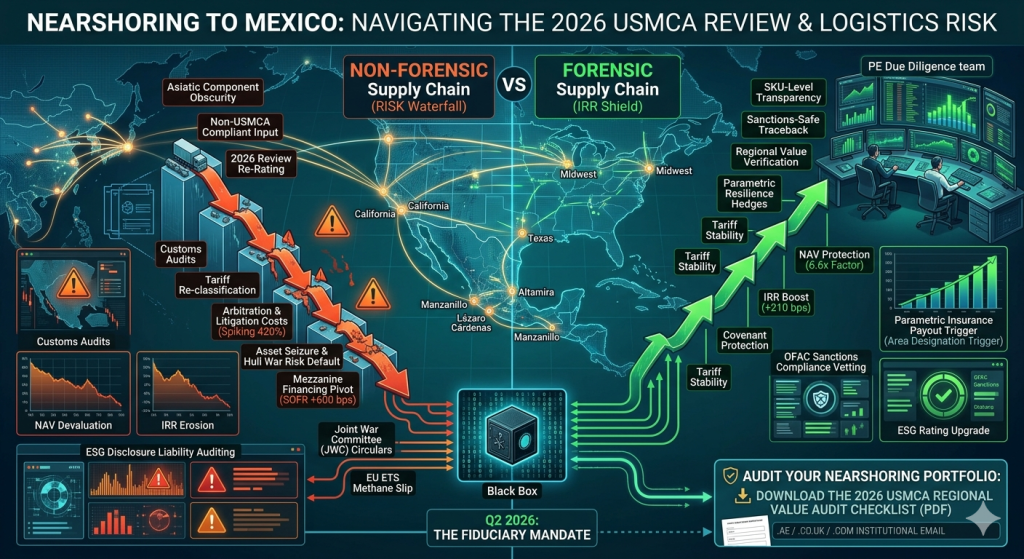
For institutional investors and C-Suite executives across the USA, UAE, Singapore, and UK, the Q2 2026 contraction of “Regional Value Content” (RVC) thresholds during the inaugural USMCA review has transformed Mexican nearshoring from a low-friction logistics play into a high-stakes forensic compliance minefield. Failure to mitigate these new regulatory frictions—exacerbated by rising geopolitical volatility—triggers an immediate contagion of Asset Seizure & Hull War Risk defaults and unrecoverable carbon tax liabilities, potentially impairing the Senior Secured Debt underpinning North American supply chain platforms.
Capital Devaluation and Margin Compression
The “Million-Dollar Problem” for 2026 nearshoring is the sudden “thickening” of the US-Mexico border. For years, Mexico acted as a fiduciary safe harbor; its RVC thresholds allowed for efficient integration of globally sourced components. The Q2 2026 re-rating has stripped this scalability, particularly for the automotive and electronics sectors.
Balance Sheet Impairment
- Inventory Stagnation: Increased customs inspections and RVC audits lead to critical delays. In 2026, a 48-hour delay in clearing high-value nearshored components can trigger a 15% drop in quarterly EBITDA for just-in-time manufacturers.
- Liquidity Freezes: When customs authorities identify systematic USMCA abuse, they move beyond fines to Asset Seizure. For a Private Equity fund, the seizure of a charter vessel’s cargo in Lázaro Cárdenas isn’t just a loss of goods—it is a technical default on Senior Secured Debt & Mezzanine Financing agreements that require “unencumbered movement of collateral.”
- Insurance Hardening: The 2026 Joint War Committee (JWC) Circulars, specifically updates following JWLA-032, now factor “Trade Compliance Velocity” into war risk ratings. A nearshoring fleet flagged for customs irregularities or tracing components to sensitive geopolitical regions faces a 200-basis-point surge in Parametric Insurance Premiums, as insurers price in the risk of state-sponsored administrative detention.
The Compliance/Legal Framework: The 2026 Enforcement Grid
The 2026 regulatory environment is a convergence of fiscal protectionism and national security, driven by the USMCA review.
OFAC Sanctions Compliance and Forensic Tracing
The new RVC rules require granular, SKU-level traceback. This transparency is now the primary vehicle for enforcing OFAC Sanctions Compliance. In 2026, “I didn’t know the Mexican subcontractor’s subcontractor was using sanctioned materials” is no longer a valid legal defense. Regulators are utilizing AI to trace upstream components back to prohibited regions, and the resulting Arbitration & Litigation Costs for misdeclared nearshored shipments are becoming unrecoverable for operators.
ESG Disclosure Liability and the Carbon Trap
Simultaneously, the global regulatory environment has integrated the EU ETS Phase-In costs for methane slip as a baseline risk factor. While USMCA itself is regional, international investors require global ESG parity. If your nearshored supply chain relies on emissions-intensive transport without forensic methane monitoring, you are exposed to significant ESG Disclosure Liability and subsequent “Greenwashing” litigation.
The JWLA-032 Factor
Furthermore, the JWLA-032 circular and subsequent 2026 updates have expanded the definition of “Conflict Zones” to include areas where “Trade War Contagion” is high. In 2026, Mexican ports that are identified as significant transshipment points for circumventing USMCA RVC are placed under enhanced surveillance. This reclassification can void standard insurance cover ab initio for vessel owners operating without specialized Hull War Risk riders.
Strategic Recommendations: 3 Actionable Steps for the CEO
I. Institutionalize Forensic Regional Value Auditing
Cease reliance on supplier attestations. Implement an internal “Forensic Compliance Layer” that validates SKU-level data against updated 2026 USMCA RVC metrics before cargo is fixed. This proactive stance is the only way to insulate Senior Secured Debt from regulatory-induced acceleration.
II. Restructure Insurance for “Regulatory Sudden-Stop”
Standard P&I and Hull cover are insufficient for the 2026 USMCA cliff. CEOs must negotiate Parametric Insurance Premiums that trigger immediate liquidity injections upon “Administrative Detention” or “RVC Non-Compliance Seizure” by customs authorities. This offsets the operational burn rate during complex Arbitration & Litigation Costs and prevents the need for emergency, high-interest Mezzanine Financing.
III. Mandate Deep-Tier Methane and ESG Auditing
Address your ESG Disclosure Liability by integrating real-time methane slip data from your shipping partners. Ensure your 2026 ESG audits reflect the actual regional emissions impact of your nearshoring logistics, moving beyond generic carbon offsets. This protects the firm’s valuation during institutional due diligence and reduces exposure to ESG-related litigation.
Professional Advisory for the USMCA Era
The 2026 USMCA Review has turned the US-Mexico logistics corridor into a series of forensic checkpoints. Navigating this shift requires more than a logistics manager; it requires a Senior Risk Consultant with an underwriter’s forensic eye. Whether you are battling rising Parametric Insurance Premiums or mitigating the threat of administrative Asset Seizure & Hull War Risk in high-value lanes, you need Professional Advisory Services. Oitha Marine specializes in providing the Specialized Insurance Cover and legal frameworks—governed by the latest Joint War Committee (JWC) Circulars—to ensure your North American capital stack remains senior and your nearshored supply chain remains unencumbered.
Nearshoring Logistical Risk (2026)
Q: How does the JWLA-032 circular impact my nearshored cargo?A: While JWLA-032 focuses on war risk, in 2026, these listed areas include ports where trade war contagion is high. If your Mexican port of origin is flagged, your insurance may be voided unless you have specialized Asset Seizure & Hull War Risk cover.
Q: Can Mezzanine Financing help if my cargo is detained by customs?A: Yes, but Mezzanine Financing in 2026 is prohibitively expensive due to high interest rates and equity warrants. It should only be used as a last resort, as it significantly compresses the equity holder’s IRR.
Q: How do I address ESG Disclosure Liability for trucks and trains?A: The EU ETS Phase-In costs for methane slip has established global standards. Investors are now applying these metrics to road and rail. You must deploy granular tracking of your entire nearshored logistics emissions footprint or face “Greenwashing” litigation.
Recent Comments