
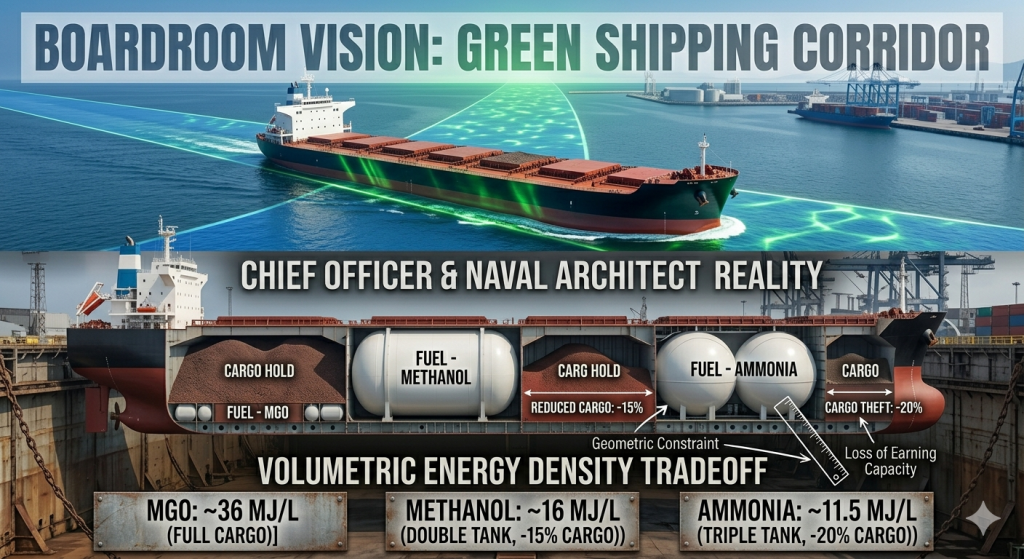
The boardrooms see a “Green Shipping Corridor.” The Chief Officers and Naval Architects see an asset-utilization nightmare.
Right now, the maritime industry is pouring billions into alternative fuel infrastructure—specifically Green Methanol and Ammonia—to satisfy ESG mandates and carbon taxes. But the macro-investment conversations are routinely ignoring a brutal law of volume.
It’s not just about the cost of the fuel. It’s about the theft of cargo space.
Let’s look at the volumetric energy density (MJ/L) behind the physics:
• Marine Gas Oil (MGO): ~36 MJ/L
• Methanol: ~16 MJ/L
• Liquid Ammonia: ~11.5 MJ/L
What does this mean on the water? To execute the exact same voyage length, a Methanol-fueled vessel requires roughly more than double the fuel tank volume of a traditional diesel hull. An Ammonia-fueled asset requires nearly triple.
Because you cannot simply make the hull infinitely larger without introducing severe hydrodynamic drag penalties, that extra fuel infrastructure has to expand inward. It directly swallows your cargo holds.
If you are a charterer or shipowner running a Handysize or Capesize bulk carrier, a 15% to 20% reduction in cubic cargo capacity to accommodate massive, specialized fuel tanks means your voyage yield economics are fundamentally broken from Day 1. You have to run more voyages or charge astronomical freight rate premiums just to break even on a payload basis.
The transition away from hydrocarbons isn’t just an engine modification challenge. It is a fundamental geometric challenge to the earning capacity of the asset.
Until the financial markets calculate the permanent loss of payload efficiency alongside the capital expenditure of the engine, “green shipping” remains a luxury asset class, not a macro supply chain solution.
Question for the network: Are you seeing charter parties beginning to adjust laytime or freight-per-metric-ton models to account for alternative fuel volumetric penalties, or are shipowners bearing the entire structural risk?
#maritimeindustry #shipowners #navalarchitecture #maritimefinance #offshoreenergy #supplychain #OithaMarine
Recent Comments