
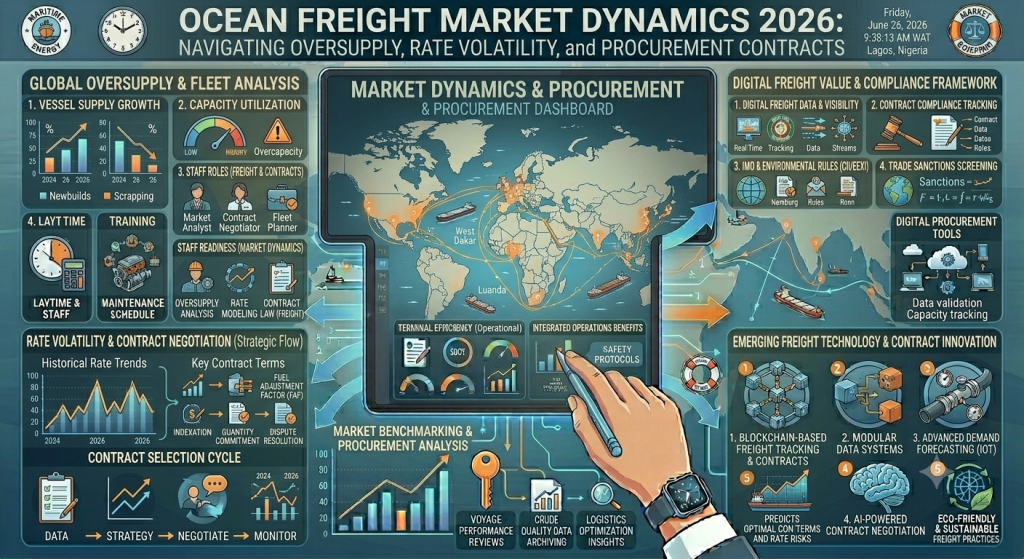
The global logistics landscape in 2026 is defined by a striking paradox: structural oversupply colliding with intense operational volatility. Following the historic post-pandemic supply chain chaos, the maritime industry has entered a complex downcycle. An unprecedented wave of new vessel deliveries has flooded the market with raw capacity, yet freight rates remain highly reactive due to geopolitical chokepoint disruptions, carrier capacity management, and shifting global trade lanes.
For shippers, enterprise supply chain executives, and logistics procurement managers, navigating this environment requires moving past transactional, short-term thinking. Relying solely on the spot market can expose your operations to sudden rollings and equipment shortages, while locking into rigid, legacy 12-month agreements risks overpaying as structural capacity pressures mount.
This strategic guide breaks down the core structural drivers of the 2026 ocean freight market and outlines enterprise-grade, risk-mitigated procurement strategies designed to protect margins and secure space.
The Macro Economic Reality: Structural Oversupply vs. Fragile Trade Demand
The fundamental backdrop of the 2026 shipping market is an oversupply of tonnage. During the highly profitable pandemic era, global liner operators invested billions in newbuild contracts. That historic orderbook is now fully materializing.
The Fleet Capacity Surge
According to industrial maritime intelligence from Alphaliner, the global container fleet now stands at more than 7,545 vessels in operation, commanding a massive 34.2 million TEUs (Twenty-Foot Equivalent Units). Over the past 12 months alone, the global fleet expanded by approximately 5.7% year-on-year, adding roughly 1.84 million TEUs of capacity to the water.
This influx of raw tonnage would typically trigger a prolonged downcycle in ocean freight rates. However, effective capacity—the actual volume of vessel space available on a specific trade lane at a specific time—tells a much more volatile story.
The Disruption Cushion & Effective Capacity
Raw oversupply has been heavily masked and absorbed by critical macroeconomic and geopolitical headwinds:
- Geopolitical Routing Extensions: Strategic bottlenecks and maritime security disruptions have forced hundreds of vessels to bypass standard trade corridors in favor of extended transits, such as routing around the Cape of Good Hope. These longer voyages absorb massive amounts of vessel capacity simply to maintain regular weekly departure schedules.
- Active Capacity Management: Top-tier ocean carriers have moved away from passive pricing. Shipping lines are aggressively defending rate floors using operational levers like blank sailings (cancelled scheduled port calls), slow steaming (reducing vessel speeds to save fuel and absorb capacity), and tactical service suspensions.
- Shifting Trade Lanes: Global manufacturing diversification and nearshoring trends are quietly redrawing global trade lanes. Production volumes are shifting significantly into Southeast Asia, creating localized equipment imbalances and infrastructure pressures at alternative regional maritime gateways.
Global Freight Rate Benchmarks (Q2 2026 Snapshot)
The structural divergence across global trade lanes is clearly visible in the major transacting indexes. Market pricing is no longer moving uniformly; instead, lanes highly exposed to operational disruptions carry significant risk premiums, while secondary lanes face strong downward pressure.
| Trade Lane Corridor | Average Market Rate Range (per FEU / 40ft) | Primary Market Driver |
| Far East to US West Coast (USWC) | $2,100 – $2,800 | Balanced import demand; minor capacity management adjustments. |
| Far East to US East Coast (USEC) | $3,000 – $3,900 | Subject to infrastructure bottlenecks and coast-specific routing pressures. |
| Far East to North Europe | $2,600 – $2,750 | Directly impacted by routing extensions; heavily managed via blank sailings. |
| Far East to Mediterranean | $3,800 – $4,200 | High operational risk premiums and elevated local routing costs. |
| North Europe to US East Coast | $1,400 – $2,100 | Under pressure from softer outbound volumes; highly favorable to shippers. |
Critical Procurement Note: Opening public tariff bids or General Rate Increases (GRIs) announced by carriers are frequently commercial anchors. True transacting market levels are often significantly lower for volume-shielded enterprise accounts.
High-Tier Contract Strategies for 2026
With deep oversupply putting long-term downward pressure on base rates, but localized disruptions causing sudden spot spikes, enterprise shippers must abandon rigid, single-track procurement models. The standard 12-month fixed-rate contract is increasingly being replaced by agile, multi-tiered architectures.
Strategy A: The Hybrid Sourcing Model (Core-and-Satellite)
Rather than committing 100% of your projected annual volume to a fixed ocean freight contract, top-tier B2B supply chains deploy a 60/40 or 70/30 allocation matrix:
- The Fixed Core (60-70%): Commit your stable, predictable baseline inventory volumes to asset-based Ocean Common Carriers (VOCCs) via long-term agreements. This guarantees baseline equipment allocation, priority loading, and predictable landed costs.
- The Agile Satellite (30-40%): Play the volatile capacity baseline by floating your remaining volumes on the spot market or allocating them to digital, NVOCC (Non-Vessel Operating Common Carrier) freight forwarders. This allows your business to instantly capitalize on downcycle rate dips when carriers scramble for volume.
Strategy B: Index-Linked Container Contracts (ILCCs)
To eliminate the friction of constant mid-year contract renegotiations, procure index-linked contract clauses. These agreements anchor your contract pricing to verified, independent third-party market benchmarks (such as Xeneta, Drewry, or the Freightos Baltic Index).
The rate automatically adjusts monthly or quarterly within a predefined floor and ceiling, protecting the carrier from sudden cost spikes while ensuring the shipper automatically captures structural market drops.
Strategy C: Two-Way Commitment Contracts
Historically, shippers regularly rolled volume commitments without penalty, and carriers regularly rolled cargo during peak spikes. In 2026, sophisticated B2B agreements deploy Mutual Commitment Frameworks:
- Enforceable MQCs: Shippers guarantee a tight Minimum Quantity Commitment (e.g., 20 FEUs per week) with capped flexibility tolerances (+/- 10%).
- No-Roll Guarantees: In exchange for rigid volume visibility, carriers provide formal space protection and equipment availability guarantees, backed by immediate financial liquidated damages or tier-one tier offsets if cargo is rolled.
Key Procurement Framework for Shippers
Before approaching carrier tenders or Request for Proposals (RFPs), B2B logistics teams should deploy the following structural framework:
[Procurement Matrix Overview]
│
├─► 1. Data Validation ───► Cross-reference public GRIs against transactional spot indexes.
│
├─► 2. Ancillary Audits ──► Enforce rigid caps on Emergency Fuel Surcharges (EFS).
│
└─► 3. Structural Flex ──► Secure extended origin/destination container free-time (10-14 days).
- Line-by-Line Cost Segregation: Do not negotiate bundled, all-in ocean rates. Demand a completely transparent unbundling of base ocean freight, destination terminal handling charges (DTHC), security fees, and inland haulage.
- Surcharge Mitigation Frameworks: Establish strict audit rights on fuel mechanisms. Ensure that Emergency Fuel Surcharges (EFS) or bunker adjustment factors (BAF) are tied directly to transparent, public marine fuel indexes, rather than arbitrary carrier declarations.
- Demurrage & Detention Free-Time Optimization: In an oversupplied market, carriers are highly flexible with non-rate assets. Use your leverage to negotiate extended origin and destination container free-time (targeting 10 to 14 days), effectively eliminating high-cost exposure to container storage penalties.
Frequently Asked Questions (FAQ)
Why are ocean freight rates fluctuating if there is a global oversupply of ships?
While global vessel capacity has grown substantially, effective capacity remains constrained by operational realities. Geopolitical re-routing around major chokepoints requires significantly more ships to maintain standard weekly service loops. Additionally, carriers actively deploy capacity management tools like blank sailings and slow steaming to artificially tighten capacity on specific trade lanes, preventing a total collapse in pricing.
Should my business sign a 12-month fixed freight contract in 2026?
Signing a rigid, traditional 12-month fixed contract is not recommended unless it contains clear market-adjustment clauses. Because underlying structural oversupply favors long-term downward rate trends, a fixed agreement without flexibility risks locking your business into uncompetitive pricing. A hybrid contract structure or an index-linked agreement is highly preferable.
What is “effective capacity” and how does it impact procurement?
Effective capacity represents the actual, usable vessel space available on a given trade route, as opposed to nominal capacity, which is the total size of the global fleet. Even if the global market is oversupplied with vessels, effective capacity can drop sharply due to port congestion, container equipment imbalances, or vessel diversions, causing localized spikes in spot rates.
How can small-to-medium shippers gain leverage against major ocean carriers?
Smaller shippers can gain leverage by consolidating their volumes through co-loading strategies or partnering with premium NVOCCs and digital freight forwarders. Forwarders aggregate volume across thousands of smaller accounts, allowing smaller businesses to gain access to tiered, high-volume contract rates, extended free-time allowances, and superior equipment allocation that are typically reserved for enterprise-scale BCOs (Beneficial Cargo Owners).
Recent Comments