
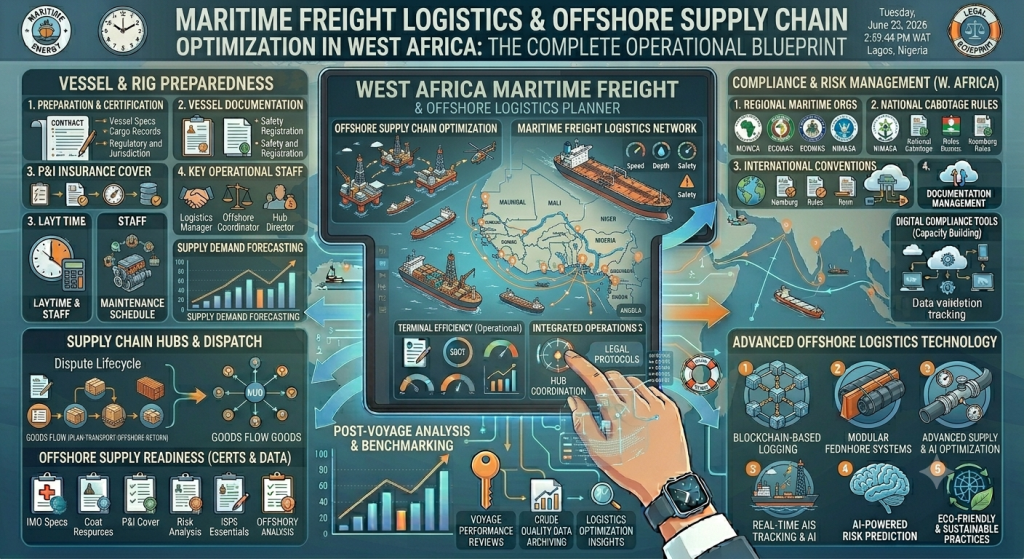
The global energy supply chain relies heavily on the efficiency of marine transportation networks. In the offshore oil fields and busy commercial ports of West Africa, which stretch from the Nouadhibou basin to the maritime borders of Angola, this dependency is highly critical. For upstream energy companies, mining multinationals, and bulk commodity traders, executing smooth voyages in this region requires a deep, calculated understanding of maritime logistics.
When a single day of vessel delay can cost upward of $35,000 for a medium-range (MR) product tanker or $90,000 for an offshore drilling rig, general, high-level transportation plans are insufficient. To protect voyage margins, operators must adopt a rigorous, mathematically optimized approach to maritime freight logistics and offshore supply chain management.
This guide provides a detailed analysis of the operational challenges, mathematical optimization frameworks, and regional compliance strategies required to run high-performance marine logistics campaigns in West Africa.
+———————————————————————————+
| WEST AFRICAN OFFSHORE SUPPLY CHAIN HUB |
+———————————–+———————————————+
| Upstream Exploration Operations | Midstream Distribution & Freight |
| (Rig Supply & Anchor Handling) | (Tanker Logistics & STS Hubs) |
| | |
| • Drilling platform replenishment | • Crude oil export coordination |
| • Dry bulk mud & water transfer | • Refined product double-banking (STS) |
| • Crew change & utility services | • Inland channel draft optimization |
+———————————–+———————————————+
What is Maritime Logistics? An Operational Definition
To optimize a commercial maritime pipeline, operators must first understand the distinction between basic port services and integrated supply chain management.
Defining the Logistics Scope
When analyzing the question, what is maritime logistics, we are looking at the systematic planning, execution, and control of the movement of cargo and support vessels across maritime corridors. In a B2B context, maritime freight logistics is not merely the shipment of goods from Port A to Port B. It is an end-to-end framework that integrates:
- Vessel Husbandry & Port Operations: Coordinating custom clearances, pilotage, tug services, and waste disposal to ensure zero idle time at berth.
- Offshore Support Vessel (OSV) Management: Supplying deepwater drilling rigs and Floating Production Storage and Offloading (FPSO) units with essential operational materials, including dry bulk, fuel, and specialized drilling muds.
- Inventory and Bunker Management: Optimizing refuelling schedules and spare parts storage to avoid emergency, high-cost procurements.
- Multi-Modal Transshipment: Managing the seamless transfer of cargo from deep-draft ocean-going vessels to shallow-draft coastal barges or land-based truck networks.
In West Africa, where land transport infrastructure is frequently congested or unavailable, the sea lanes of the Gulf of Guinea act as the primary highway for industrial cargo, making robust logistics maritime planning a strategic business requirement.
The Core Bottlenecks of West African Marine Freight Logistics
Operating a vessel fleet in West African waters requires managing several regional challenges. Understanding these bottlenecks is the first step toward optimizing your supply chain.
Infrastructure Deficits and Port Congestion
Many major ports in West Africa suffer from significant physical constraints, including shallow approach channels and limited container yard space. These draft limitations prevent modern, fully laden cargo vessels from berthing directly, forcing operators to wait at offshore anchorages. This delay quickly leads to expensive demurrage charges that can erode spot arbitrage profit margins.
Security and Risk-Adjusted Navigation
The Gulf of Guinea has historically presented security challenges that require specific maritime logistics preparations. Operating in these high-risk areas requires:
- Vessel Vetting and Hardening: Equipping vessels with physical security structures, secure crew areas, and advanced radar monitoring.
- Armed Escorts and Security Patrols: Coordinating with regional navies to deploy certified security escort vessels during transit.
- Spike in Insurance Premiums: Factoring Kidnap and Ransom (K&R) coverages and War Risk surcharges into your financial planning.
Complex Regulatory and Customs Frameworks
Passing port state controls in West Africa requires navigating a complex system of local regulations. Each country maintains distinct customs procedures, cabotage rules, and environmental standards. For instance, in Nigeria, logistics operators must comply with the strict local crewing and building guidelines of the Coastal and Inland Shipping (Cabotage) Act, managed by the Nigerian Maritime Administration and Safety Agency (NIMASA).
Failing to submit correct pre-arrival declarations or secure the necessary ministerial waivers can lead to vessel detentions, heavy regulatory fines, and missed charter windows.
Optimizing the Supply Chain: A Mathematical Cost Model
To systematically reduce operational waste, logistics managers should use a mathematical model to calculate the total cost of a maritime campaign. By identifying the exact financial impact of transit delays and port congestion, you can make data-driven chartering and routing decisions.
The Total Maritime Logistics Cost ($TC_M$) Formula
The total cost of a marine logistics campaign can be modeled using the following calculation:
$$TC_M = C_d \cdot T_{sea} + \sum_{p=1}^{n} \left( P_p + D_p \cdot P_d(E_{risk}) \right) + L_{cargo}$$
Where:
- $TC_M$ represents the Total Maritime Logistics Cost for a specific voyage or campaign.
- $C_d$ is the daily charter rate of the vessel (including fuel oil consumption and crew expenses).
- $T_{sea}$ is the duration of sea transit in days, calculated as a function of distance and vessel speed.
- $P_p$ represents static port tariffs, cargo handling fees, and pilotage costs at port $p$.
- $D_p$ is the expected waiting time and berthing delay in days at port $p$.
- $P_d(E_{risk})$ is the daily risk-adjusted demurrage rate, calculated based on regional congestion and local risk variables ($E_{risk}$).
- $L_{cargo}$ represents cargo handling losses, evaporation, or physical shrinkage during transit (including ship-to-ship transfer variances).
+—————————————+
| DEMURRAGE ESCALATION IMPACT |
+—————————————+
|
+——————————-+——————————-+
| |
v v
[LOW PORT CONGESTION] [HIGH PORT CONGESTION]
• Expected delay (D_p): 1.5 days. • Expected delay (D_p): 8.5 days.
• Demurrage cost (D_p * P_d): $45,000 • Demurrage cost (D_p * P_d): $255,000
• Vessel sails on schedule. • Project margin severely depleted.
Using this mathematical model, we see that a minor delay of $7$ days in approach channels ($D_p$) can increase the total cost of a standard product delivery by over $200,000 USD. This highlights why proactive port coordination and logistics planning are critical to margin protection.
Key Strategies for Offshore Supply Chain Optimization
To minimize the Total Maritime Logistics Cost ($TC_M$), forward-looking logistics directors should implement three operational strategies:
1. Offshore Ship-to-Ship (STS) Transfers
When draft limitations prevent deep-draft tankers from entering regional ports, shipowners can utilize offshore ship-to-ship (STS) transfers. By double-banking a large vessel (such as a Suezmax tanker) with smaller, shallow-draft product tankers in designated offshore zones, you can safely discharge cargo without waiting for deepwater port access. This strategic move bypasses port congestion, eliminates port demurrage, and keeps your supply chain moving.
2. Consolidated Supply Runs for Offshore Support Vessels (OSVs)
In upstream drilling operations, running half-empty supply boats to offshore platforms is highly inefficient. Integrating supply runs through a central logistics hub allows operators to maximize deck space utilization and reduce fuel consumption.
+————————————————————————-+
| OSV CONSOLIDATED LOGISTICS FLOW |
+——————-+—————————+————————-+
| Phase 1: Hub | Phase 2: Deck Packing | Phase 3: Route Plan |
| Consolidation | Rig fuel, water, and bulks| Optimal routing to |
| Mud, fuel, spares | packed for maximum deck | multiple platforms on |
| stored at port. | capacity utilization. | a single sea voyage. |
+——————-+—————————+————————-+
3. Rigorous Pre-Arrival Document Auditing
To prevent costly delays during customs clearance, logistics teams must conduct thorough pre-arrival document audits. This involves verifying:
- Customs Declarations: Reviewing cargo manifests, bills of lading, and certificate of origin documents to ensure full accuracy.
- STCW Crew Certifications: Confirming all onboard personnel hold valid, international certifications to pass port state control.
- Cabotage Compliance: Ensuring the vessel holds active operating waivers before beginning domestic shipping runs.
Driving Operational Efficiency with Oitha Marine
Navigating the logistical, legal, and operational complexities of West African waters requires a reliable, on-the-ground marine partner.
Oitha Marine provides end-to-end maritime logistics, vessel husbandry, and offshore support services across the Gulf of Guinea. Combining deep local expertise with international safety standards, we help shipowners, charterers, and energy companies protect their margins and run secure, efficient voyages.
Our Support Capabilities
- Vessel Husbandry & Port Agency Support: We coordinate directly with port authorities, managing custom clearances, pilotage, and bunkering to minimize turnaround times.
- Offshore Support Fleet Operations: We operate a modern, audited fleet of Anchor Handling Tugs, Platform Supply Vessels (PSVs), and fast crew boats to keep your drilling platforms running smoothly.
- Regulatory Vetting & Compliance Consulting: Our legal advisory team helps you navigate complex cabotage laws, ensuring full compliance while optimizing your local content strategies.
- STS Transfer Coordination: We manage high-safety, offshore ship-to-ship transfers, supplying the certified advisors and specialized fendering equipment needed for secure double-banking maneuvers.
Streamline your maritime operations, eliminate expensive delays, and protect your voyage margins. Partner with Oitha Marine to secure your supply chain in West Africa.
Frequently Asked Questions (FAQ)
Q: What is maritime logistics, and how does it differ from standard freight forwarding?
A: Maritime logistics is the integrated coordination of vessel operations, port state clearance, bunkering, crew changes, and multi-modal cargo transfers. Unlike basic freight forwarding, which simply books cargo space, maritime logistics manages the actual marine assets and regulatory frameworks on the ground to optimize voyage efficiency.
Q: Why is West Africa considered a high-cost environment for maritime logistics?
A: The region faces specific structural challenges, including shallow approach channels that cause vessel delays, high war-risk insurance premiums, complex customs procedures, and strict local content and cabotage regulations. These variables can lead to expensive demurrage fees if not managed correctly.
Q: How can a shipowner protect their fleet from anchorage delays in West Africa?
A: Shipowners can minimize delays by utilizing offshore Ship-to-Ship (STS) transfers, coordinating with local protective agents like Oitha Marine for pre-arrival document vetting, and scheduling bunkering and husbandry services during active port operations.
Q: What is the purpose of the Risk-Adjusted Demurrage ($P_d(E_{risk})$) value in your cost model?
A: This factor adjusts your estimated daily demurrage costs based on regional risk variables, such as harbor pilot availability, local weather conditions, custom processing times, and regional security risks. Factoring this value into your plans helps you make realistic voyage estimates.
Q: How does Oitha Marine ensure local content compliance under the Cabotage Act?
A: We guide international shipowners through the NIMASA waiver application process for crewing, building, and vessel registration, ensuring full compliance while utilizing local crewing pipelines to keep your vessels operating legally.
Partner with West Africa’s High-Intent Logistics Provider Optimize your marine supply chain, secure regulatory clearances, and protect your project margins. Contact Oitha Marine’s 24/7 commercial operations desk at oithamarine.com or visit our corporate office at 1, Funmi Okere Str, Maryland Estate, Lagos, Nigeria to discuss your custom logistics requirements.
Recent Comments