
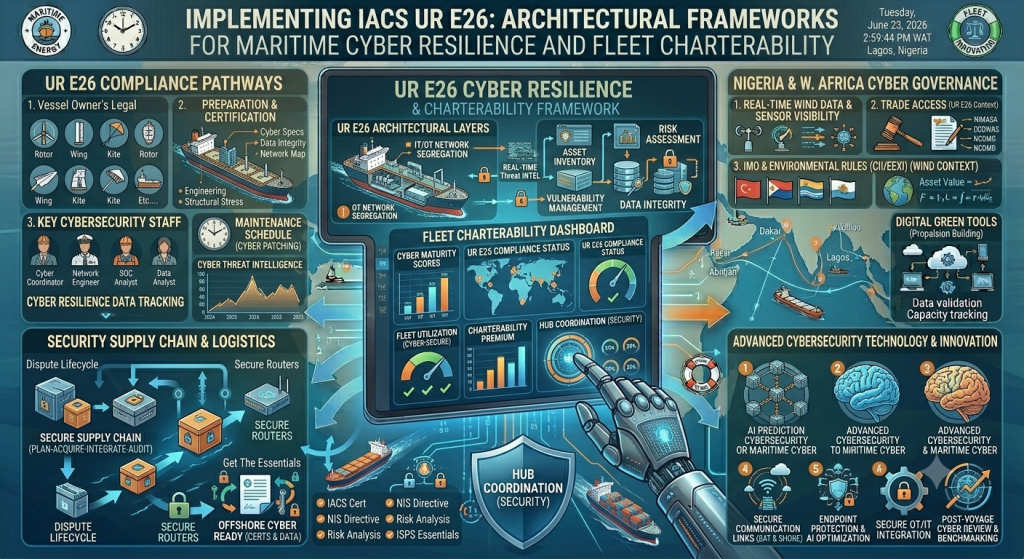
The rapid acceleration of maritime digitalization has fundamentally shifted the nature of operational risk. Modern merchant vessels are no longer isolated steel platforms; they are highly interconnected nodes within global corporate networks. The integration of satellite communication arrays, real-time IoT performance monitoring, and remote diagnostics has dramatically expanded the cyber-attack surface of the global merchant fleet.
This technological evolution has prompted a strict regulatory response. As of 2026, compliance with the International Association of Classification Societies (IACS) Unified Requirement E26 (UR E26) is a mandatory international standard for the cyber resilience of newly built vessels. Furthermore, major charterers, energy majors, and marine underwriters have integrated these cyber-resilience frameworks directly into standard B2B charter-party agreements and vessel vetting protocols (such as TMSA 3 Element 13).
For shipowners, shipbuilders, and marine engineering executives, establishing verifiable compliance with UR E26 is no longer optional—it is a critical prerequisite for commercial viability and fleet charterability.
Deconstructing the IACS UR E26 Framework
Unlike previous high-level, principle-based guidelines, UR E26 targets the ship as a collective operational entity. It mandates the secure, systematic integration of both Information Technology (IT) networks and Operational Technology (OT) systems throughout a vessel’s design, construction, commissioning, and operational lifecycle.
The regulation applies to all IACS-classed vessels of 500 Gross Tonnage (GT) or more engaged in international voyages. It categorizes security requirements across five core functional capabilities derived from recognized industrial cybersecurity standards (such as IEC 62443):
The Five Functional Pillars of UR E26
[IACS UR E26 Cyber Resilience Pillars]
│
├─► 1. Identify ──► Comprehensive IT/OT Computer-Based System (CBS) Asset Inventory.
│
├─► 2. Protect ───► Hard network segmentation (Zones & Conduits) and access control.
│
├─► 3. Detect ────► Continuous network traffic logging and real-time anomaly tracking.
│
├─► 4. Respond ───► Incident containment plans with physical manual overrides.
│
└─► 5. Recover ───► Air-gapped immutable backups for rapid cold-start restoration.
- Identify: Shipbuilders and owners must maintain a granular, up-to-date inventory of all onboard Computer-Based Systems (CBSs), tracking exact hardware models, software versions, and physical network connections.
- Protect: Implementation of rigid technical barriers to prevent unauthorized access. This requires network segmentation, multi-factor authentication (MFA) for remote sessions, and strict data encryption protocols.
- Detect: Continuous monitoring of network traffic to identify potential anomalies or malicious behavior before an exploit can spread to critical machinery.
- Respond: Documented incident response procedures, defining clear emergency roles for crew members, along with the preservation of localized manual overrides for critical ship functions.
- Recover: Structured recovery strategies and air-gapped system backups designed to restore essential shipboard services following a catastrophic cyber event.
Technical Implementation: Network Segmentation (Zones & Conduits)
The technical core of UR E26 compliance lies in the elimination of flat network architectures. A compromised crew-welfare Wi-Fi access point must never provide a lateral pathway into the main engine control room or electronic chart display systems.
Compliance requires partitioning the vessel’s digital architecture into distinct, isolated Security Zones, connected only by tightly controlled, firewalled Conduits:
Typical Onboard Security Segmentation Matrix
| Security Zone | Onboard Systems Contained | Mandatory Technical Controls |
| Zone 1: Safety-Critical OT | Main propulsion control, steering gear, power management systems (PMS). | Zero direct internet exposure; physical isolation or unidirectional data diodes. |
| Zone 2: Essential Control OT | Integrated Navigation (ECDIS, RADAR), cargo pumping, ballast control systems. | Next-Generation Firewalls (NGFW); strict MAC address filtering; access logging. |
| Zone 3: Administrative IT | Ship’s office computers, customs/manifest processing, port documentation servers. | Role-Based Access Control (RBAC); centralized endpoint anti-malware; regular patching. |
| Zone 4: Crew & Guest Public | Crew cabin Wi-Fi networks, entertainment servers, public internet lounges. | Complete logical and physical isolation from all OT networks; rate-limiting. |
Critical Compliance Rule: Any system that possesses an IP address, physical ethernet port, or serial link to an onboard network must be accounted for within this matrix. Systems that are entirely isolated from all other networks may be exempt, but their isolation must be physically verified during annual classification audits.
Shifting Responsibilities: Shipbuilders vs. Shipowners
Achieving and maintaining a certified cyber-resilient notation requires a structured transfer of documentation and operational ownership as a vessel moves from construction to active commercial deployment.
The Construction Phase (Yards & OEMs)
During design and construction, the shipbuilder holds primary responsibility for engineering the vessel’s cyber defenses. Collaborating with original equipment manufacturers (OEMs) adhering to sister regulation UR E27 (which governs component-level hardening), the yard must deliver a comprehensive technical documentation package to the classification society:
- Zones and Conduits Diagrams: Detailed logical and physical topologies of the onboard network.
- Cyber Security Design Description: A formal document outlining the technical security capabilities integrated into the hull.
- Ship Cyber Resilience Test Procedure: A validated testing matrix used during dockside and sea trials to prove firewalls actively block unauthorized lateral movement.
The Operational Phase (Shipowners & Managers)
Upon delivery, operational accountability shifts entirely to the shipowner. To pass the mandatory annual classification surveys and maintain chartering eligibility, owners must implement and document a live Ship Cyber Security and Resilience Program. This program must integrate directly into the vessel’s Safety Management System (SMS) under the ISM Code (IMO Resolution MSC.428(98)), showing verifiable proof of regular crew training, portable media scanning protocols, and endpoint update logs.
Frequently Asked Questions (FAQ)
What is the structural difference between IACS UR E26 and UR E27?
UR E26 treats the ship as a collective, integrated asset, holding the shipyard and shipowner responsible for secure network design, overall system integration, and lifetime operational procedures. UR E27 focuses strictly on the component level, requiring third-party marine equipment manufacturers and OEMs to internally harden their computerized systems (such as ensuring secure development lifecycles and disabling unused physical service ports) before delivering them to the shipyard.
Can an older vessel built before July 2024 be formally certified under UR E26?
Formally, UR E26 is only mandatory for newbuild vessels with construction contracts signed on or after July 1, 2024. However, existing vessels can undergo voluntary gap analyses and retrofits to achieve equivalent “Cyber Secure” class notations. Because premier charterers are increasingly demanding identical levels of cyber resilience across entire chartered fleets, retrofitting older assets has become a common commercial strategy to protect long-term asset marketability.
How are remote access diagnostics managed under the UR E26 framework?
Remote access for shoreside engineering support or OEM software maintenance is heavily restricted under UR E26. Any remote connection must terminate within a highly secure demilitarized zone (DMZ) conduit. It requires explicit, manual activation from the vessel’s bridge or engine control room, utilizes encrypted VPN tunnels with multi-factor authentication, and must automatically log all data transactions for subsequent internal or class auditing.
Recent Comments