
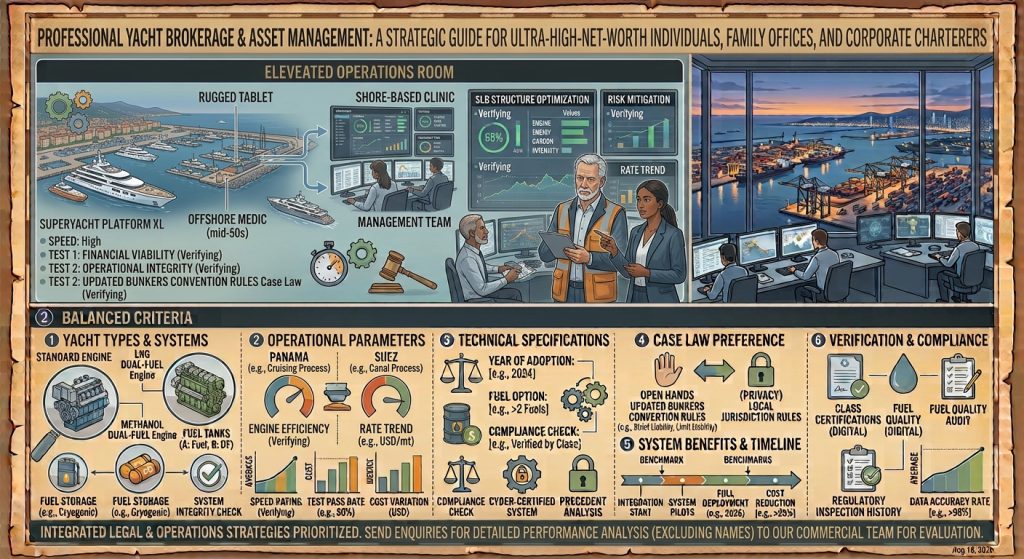
Acquiring, chartering, or managing a high-value marine asset involves navigating complex legal, regulatory, and technical requirements. For family offices, high-net-worth individuals (HNWIs), corporate entities, and marine investment groups across the United States, Canada, and the United Kingdom, partnering with qualified yacht brokers provides essential risk management and commercial oversight.
Superyachts and commercial charter vessels operate within complex regulatory frameworks. Decisions regarding registration, crew employment contracts, classification society audits, and flag state compliance directly impact vessel valuation, operational freedom, and long-term resale potential.
This guide examines superyacht acquisition strategies, commercial charter compliance under major flag states, vessel management frameworks, and the advisory role of professional luxury yacht brokers.
1. The Strategic Role of Professional Yacht Brokers
Professional yacht brokers provide comprehensive transaction management, serving as commercial negotiators, technical auditors, regulatory advisors, and legal intermediaries.
[ The Integrated Yacht Brokerage Ecosystem ]
│
┌─────────────────────────────────┼─────────────────────────────────┐
▼ ▼ ▼
[ Market Sourcing & Valuations ] [ Regulatory & Flag State Vetting ] [ Charter Party & Commercial ]
• Off-Market Fleet Intelligence • Red Ensign / USCG / Transport Canada • MYBA / AYCA Charter Frameworks
• Comparative Market Analysis • IMO, SOLAS, & MARPOL Compliance • APA & Escrow Fund Security
• Refit & Residual Asset Audit • MLC 2006 & STCW Crewing Mandates • Dispute Resolution & Arbitration
A. Market Access and Off-Market Asset Sourcing
A significant portion of global superyacht transactions—particularly for custom motor yachts exceeding 40 meters (130 feet)—occurs off-market. Specialized charter yacht brokers and purchase advisors track global fleet movements, shipyard delivery slots, and private owner availability before vessels are listed on public MLS portals.
B. Independent Technical and Valuation Audits
A professional broker evaluates a vessel’s market position by analyzing sales history, class survey status, machinery overhaul intervals, and refit records. Independent valuation audits protect buyers and charterers from overpaying for deferred maintenance or non-compliant engineering modifications.
C. Commercial Negotiation and Escrow Integrity
Utilizing standardized contracts—such as those developed by the Mediterranean Yacht Brokers Association (MYBA) or the American Yacht Charter Association (AYCA)—brokers manage deposit structures, pre-purchase sea trials, hauled-bottom surveys, and Advanced Provisioning Allowance (APA) escrow protocols.
2. Global Regulatory Frameworks: USA, Canada, and the United Kingdom
Operating a private or commercial charter vessel across North America and Europe requires strict adherence to regional maritime laws and flag-state registries.
[ Cross-Border Regulatory Matrix ]
│
┌───────────────────────────────────┼───────────────────────────────────┐
▼ ▼ ▼
[ United States (USCG) ] [ Canada (Transport Canada) ] [ United Kingdom & REG ]
• Jones Act (46 U.S.C. § 55102) • Canada Shipping Act, 2001 • Red Ensign Group Yacht Code
• MARAD Commercial Waiver • Coasting Trade Act Compliance • MCA Commercial Certification
• USCG Passenger Vessel Safety • Import Duties & GST/PST Surcharges• ISM / ISPS Code Thresholds
A. United States Jurisdictional Nuances (USCG & Jones Act)
Chartering or acquiring a vessel within U.S. territorial waters involves strict cabotage laws:
- The Merchant Marine Act of 1920 (Jones Act): Foreign-built vessels cannot engage in coastwise trade (carrying passengers for hire between U.S. ports) unless granted a specialized MARAD Small Vessel Waiver.
- Bareboat vs. Demise Charters: To avoid classification as a USCG Small Passenger Vessel, bareboat charter agreements must transfer full operational control, command, and navigation responsibilities directly to the charterer.
- Regional Brokerage Hotspots: Working with yacht brokers in Florida or coastal hubs requires navigating state-specific sales and use taxes, partial tax caps, and offshore closing protocols in international waters.
B. Canadian Regulatory Architecture (Transport Canada)
Operating or importing charter assets within Canadian waters requires compliance with Transport Canada Marine Safety and Security (TCMSS) directives:
- Coasting Trade Act: Foreign-flagged commercial charter yachts operating between Canadian ports must secure a Coasting Trade License, proving that no suitable Canadian-flagged vessel is available.
- Import & Tax Compliance: Bringing a vessel permanently into Canada incurs customs duties and applicable Goods and Services Tax (GST) / Harmonized Sales Tax (HST), requiring strategic tax structuring prior to vessel delivery.
C. United Kingdom & Red Ensign Group Standards (MCA)
The United Kingdom Maritime and Coastguard Agency (MCA) establishes international standards for commercial luxury yachts via the Red Ensign Group Yacht Code (REG-YC):
- The 24-Meter Threshold: Vessels measuring 24 meters (79 feet) or greater in load line length operated commercially must comply with REG-YC Part A construction, fire safety, and stability standards.
- The 12-Passenger Rule: Carrying more than 12 charter guests classifies a vessel as a passenger ship under SOLAS conventions, triggering additional safety and structural requirements under REG-YC Part B.
- International Group Flag States: Registries including the Cayman Islands, Bermuda, Isle of Man, and Marshall Islands provide strong legal backstops, tax-neutral operations, and widespread acceptance by P&I clubs.
3. Comparative Technical & Compliance Audit Matrix
Before finalizing a purchase or commercial charter party agreement through yachting brokers, charterers and buyers must audit vessel specifications against international maritime thresholds:
| Tonnage / Length Parameter | Applicable Maritime Code | Required Compliance Framework | Operational Impact |
| Below 24m LOA | Local Flag / USCG Uninspected Passenger Vessel | National Safety Standards & Local Registration | Restricted passenger capacity; simplified crewing and survey requirements. |
| 24m+ LOA (Under 500 GT) | REG-YC Part A / MCA Code / Transport Canada | Mini-ISM, MLC 2006, Approved Class Society | Standard commercial charter rating; permits up to 12 paying guests worldwide. |
| 500 Gross Tons (GT) + | Full IMO SOLAS / MARPOL / STCW / ISM / ISPS | Full Safety Management System (SMS) & DPA | Triggers mandatory International Ship Management (ISM) Code compliance, formal security plans, and full STCW officer qualifications. |
| 13 to 36 Passengers | REG-YC Part B / SOLAS Passenger Ship Code | Enhanced Structural Fire Protection & Subdivisions | Allows larger guest groups; requires specialized stability, fire containment, and life-saving apparatus. |
4. The Yacht Procurement & Charter Lifecycle
Partnering with established yacht charter brokers ensures a structured, risk-mitigated acquisition or charter campaign:
[ The 6-Stage Yacht Brokerage Lifecycle ]
│
[Stage 1] Operational Profiling & Cruising Intent Assessment
└─► [Stage 2] Global Fleet Sourcing & Off-Market Shortlisting
└─► [Stage 3] Pre-Purchase Survey, Sea Trial & Flag Audit
└─► [Stage 4] MYBA / AYCA Contract Structuring & Escrow Funding
└─► [Stage 5] Flag State Registration, Crewing & Insurance Placement
└─► [Stage 6] Post-Delivery Management & Commercial Charter Program
- Stage 1: Requirement Scoping: Defining geographical cruising preferences, passenger capacity, water-toy inventory, and private versus commercial charter objectives.
- Stage 2: Market Screening: Identifying suitable options across international databases and private broker networks.
- Stage 3: Technical Survey: Conducting sea trials, haul-out hull inspections, oil analysis, and class survey verifications.
- Stage 4: Contract Finalization: Negotiating purchase or charter agreements under established MYBA/AYCA terms, including clear clauses for defect rectification or escrow adjustments.
- Stage 5: Registration & Insurance: Assigning flag state placement, placing Hull & Machinery (H&M) and Protection & Indemnity (P&I) insurance, and ensuring MLC 2006 crewing compliance.
- Stage 6: Ongoing Management: Implementing Safety Management Systems (SMS), coordinating annual class surveys, and managing charter revenue streams.
Frequently Asked Questions (FAQ)
Q1: What is the difference between private yacht registration and commercial charter registration?
A private yacht is registered exclusively for the owner’s personal enjoyment and cannot engage in commercial trade or charter operations for compensation. A commercially registered yacht must meet strict safety, construction, crewing, and survey requirements set by its flag state (such as the MCA Red Ensign Group Yacht Code), allowing it to be legally offered for charter.
Q2: Why are most charter yachts strictly limited to 12 guests?
Under international maritime law (including IMO SOLAS conventions and the MCA Code), any commercial vessel carrying more than 12 passengers is classified as a passenger ship rather than a commercial yacht. Meeting passenger ship compliance requires significantly higher structural, fire safety, and stability standards.
Q3: How do MYBA charter contracts protect charterers and owners?
MYBA (Mediterranean Yacht Brokers Association) contracts are the global standard for luxury yacht charters. They clearly define the responsibilities of both parties, establish structured payment schedules, mandate comprehensive insurance coverage, and govern the management of the Advanced Provisioning Allowance (APA)—a dedicated fund used to cover variable operating expenses such as fuel, food, and berthing fees.
Q4: What is an Advanced Provisioning Allowance (APA), and how is it calculated?
The APA is a advance payment—typically calculated at 30% to 35% of the base charter fee—used by the captain to cover operational expenses during the charter, including diesel fuel, dockage fees, food, beverages, and communications. The captain maintains an itemized account of expenses, and any unspent funds are refunded to the charterer at the conclusion of the charter.
Q5: What role does a broker play in verifying vessel class and flag state compliance?
A broker reviews class society certificates (such as Lloyd’s Register, ABS, or DNV), flag state registry documentation, and safety management records. This pre-screening confirms the vessel holds active commercial status, possesses valid safety equipment certificates, and complies with international crewing and environmental standards.
🌐 Technical Asset Procurement & Charter Management with Oitha Marine
Navigating luxury marine transactions requires independent advice, market access, and technical competence. Whether acquiring a motor yacht, placing a commercial vessel into charter management, or sourcing specialized tonnage across North America, Europe, or international waters, Oitha Marine provides comprehensive brokerage, charter administration, and marine advisory services.
Immediate Chartering & Procurement Inquiry:
Clients seeking qualified advice on superyacht sales, commercial charter compliance, or global asset sourcing can contact the Oitha Marine Advisory Desk for assistance.
- Direct Email: info@oithamarine.com
- Official Web Portal for Partnership: inboardboat.com
Recent Comments