
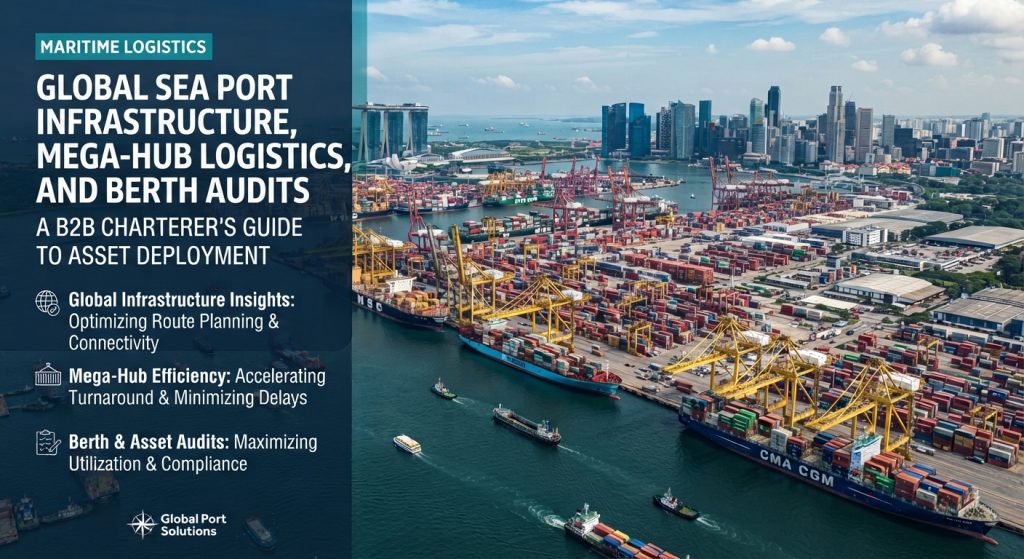
Deploying modern maritime assets into global supply chains requires rigorous technical alignment between vessel specifications and physical port infrastructure. For charterers, freight traders, and commercial operators, a failure to audit berth compatibility and terminal logistics prior to fixing a vessel on time or voyage charter introduces substantial financial exposure. Demurrage rates—frequently exceeding $25,000 to $50,000 per day for bulkers and tankers, and substantially higher for large container units—can rapidly erode charter party margins if quay crane productivity, dredged channels, or evacuation bottlenecks stall turnaround times.
This guide delivers an operational blueprint for technical berth audits, mega-hub logistics analysis, and infrastructure assessment:
- Infrastructure Criticality: Physical parameters—including Chart Datum (CD) depths, Under-Keel Clearance (UKC) allowances, quay crane outreach/lift height, and bollard pull ratings—dictate maximum permissible vessel dimensions and operational safety.
- Mega-Hub Bottlenecks: High berth occupancy rates (>70%) create non-linear queuing delays. Inland multimodal evacuees (rail, barge, road) frequently dictate landside productivity, regardless of seaside crane capability.
- Technical Berth Audits: A structured 5-stage audit framework evaluates structural, operational, navigational, legal, and environmental metrics before fixing a charter party.
- Contractual Protection: Charter party clauses must explicitly address berth availability, safe port warranties, draft guarantees, and quay equipment performance benchmarks (e.g., net gang hour productivity).
1. The Commercial and Operational Imperative of Port Infrastructure Audits
In commercial shipping, the physical interface between vessel and shore represents the point of maximum operational risk and financial concentration. While modern vessel designs emphasize energy efficiency, enlarged intake capacities, and optimized hydrodynamics, marine terminal infrastructure has developed at an uneven pace globally.
+———————————————————————————–+
| VESSEL – TERMINAL INTERFACE RISK MATRIX |
+———————————————————————————–+
| NAVIGATIONAL RISKS |
| • Air Draft / Crane Outreach Misalignment |
| • Shallow Draft / Siltation -> Stranding & Grounding |
| • Inadequate Tidal Windows -> Demurrage Accumulated at Anchorage |
+———————————————————————————–+
│
v
| STRUCTURAL & OPERATIONAL RISKS |
| • Excessive Displacement vs. Quay Design Energy Absorption |
| • Insufficient Bollard Pull vs. Hydrodynamic Drag & Windage Forces |
| • Crane Productivity Failure -> Extended Port Stays & Slot Loss |
+———————————————————————————–+
│
v
| FINANCIAL & CONTRACTUAL IMPACT |
| • Demurrage Claims ($25,000 – $75,000+/day) |
| • Unsafe Port / Unsafe Berth Litigation (BALTIME / NANYOZAI / GENCON) |
| • Cargo Degradation & Off-Hire Penalties |
+———————————————————————————–+
When a charterer commits a vessel to a port or berth without verifying structural and operational capabilities, the commercial ramifications are immediate:
- Direct Demurrage Exposure: Vessels waiting at anchorage due to draft restrictions, insufficient quay length, or crane breakdowns accumulate demurrage charges that fall on the charterer under standard voyage terms.
- Unsafe Port / Unsafe Berth Declarations: Under standard charter party forms (e.g., NMT, NANYOZAI, BALTIME, GENCON 1994), charterers warrant that the vessel will be ordered to a “safe port and safe berth.” Rejection of an unsafe berth by a Master can trigger off-hire disputes, substitute port performance costs, or cargo loss claims.
- Cargo Degradation and Cancellation Dates (Cancode): Extended port stays compromise perishable agricultural bulk, chemical parcels, or strict just-in-time (JIT) manufacturing supply chains, resulting in contract cancellations or quality claims.
2. Technical Infrastructure Parameters: What Charterers Must Audit
Evaluating a port or terminal requires quantifying five fundamental physical and operational metrics against the specific characteristics of the target vessel class.
+———————————————————————————–+
| FIVE CORE INFRASTRUCTURE METRICS |
+———————————————————————————–+
| 1. DRAFT & UNDER-KEEL CLEARANCE (UKC) |
| Chart Datum (CD) Depth | Siltation Rates | Static/Dynamic Squat Allowance |
+———————————————————————————–+
│
v
| 2. AIR DRAFT & CRANE GEOMETRY |
| High Water Level Clearance | Lift Height Above High Water | Crane Outreach |
+———————————————————————————–+
│
v
| 3. QUAY LENGTH, DISPLACEMENT & FENDERING |
| Continuous Quay Length | Max Vessel Displacement | Fender Energy Absorption |
+———————————————————————————–+
│
v
| 4. MOORING & BOLLARD CAPACITY |
| Bollard Pull Ratings (SWL) | Tensioning Systems | Local Wind/Current Loads |
+———————————————————————————–+
│
v
| 5. CARGO HANDLING MACHINERY |
| Net Gang Hour Rates | Continuous Ship Unloaders (CSU) | Manifold Alignments |
+———————————————————————————–+
A. Draft, Chart Datum, and Under-Keel Clearance (UKC)
The water depth at a berth or within an approach channel is dynamic. Charterers must evaluate depth relative to local Chart Datum (CD)—typically Lowest Astronomical Tide (LAT)—while factoring in seasonal siltation, density variations (fresh vs. salt water allowance), and dynamic vessel movements.

- Static Draft vs. Dynamic Squat: As a vessel moves through shallow approach channels, hydrodynamic pressure changes cause the vessel to sink deeper into the water (squat). Squat increases proportionally with the square of vessel speed (
) and is amplified in narrow channels.
- Net Under-Keel Clearance (UKC) Mandates: Port authorities enforce strict minimum UKC rules (typically 10% of draft in open channels and 0.5m to 1.0m alongside berths). Failure to account for localized siltation between maintenance dredging cycles can leave a fully laden vessel tide-bound or stranded.
B. Air Draft Restrictions and Shore Crane Reach
Air draft constraints are determined by permanent overhead structures (bridges, power lines) or the maximum height of quay cranes in the raised position.
+———————————–+————————————+————————————+
| Parameter | Operational Impact | Risk Mitigation Factor |
+———————————–+————————————+————————————+
| Overhead Structure Height | Limits maximum vessel mast height | Verify vertical clearance at High |
| | and highest container tier | Water Astronomical Tide (HAT) |
+———————————–+————————————+————————————+
| Quay Crane Lift Height | Restricts maximum stack height on | Calculate ballast options to |
| | deck above waterline | adjust waterline-to-hatch distance |
+———————————–+————————————+————————————+
| Quay Crane Outreach | Dictates maximum vessel beam (rows | Verify outreach from fender line, |
| | of containers or hatch width) | not quay edge |
+———————————–+————————————+————————————+
C. Quay Structural Integrity, Fendering, and Displacement Limits
Berth quays are engineered to absorb dynamic impacts during berthing and support localized static loads:
- Maximum Permissible Displacement: Berths are rated for a maximum vessel displacement (tonnage). Berthing a vessel exceeding these design limits risks structural failure of quay walls or concrete pilings.
- Fender Energy Absorption: Fendering systems must absorb the vessel’s berthing energy (
), which depends on vessel displacement (
), berthing velocity (
), hydrodynamic mass coefficient (
), and berth configuration factors (
):

Degraded, undersized, or missing fenders expose the vessel hull to structural damage and quay contact claims.
D. Mooring Systems and Bollard Ratings
As vessel sizes increase, environmental forces acting on the vessel hull and superstructure impose significant loads on mooring infrastructure:
- Bollard Safe Working Load (SWL): Bollard capacities must match the expected weather thresholds (windage area and current drag). Standard ocean-going berths require bollards rated between 100 metric tons (MT) and 200 MT SWL.
- Tensioning and Surge Management: In ports subject to long-period ocean swells (e.g., ports along the Pacific coast of South America or West Africa), vessel surge and sway can sever mooring lines, damage loading arms, or force emergency unberthing.
3. Mega-Hub Logistics and Landside Evacuation Capabilities
A terminal’s seaside efficiency is only as effective as its landside evacuation capability. Mega-hubs handling mega-containerships (24,000+ TEU) or Valemax VLOCs (400,000 DWT) generate massive operational surges that can overwhelm landside transport networks.
+———————————————————————————–+
| MEGA-HUB SUPPLY CHAIN SURGE FLOW |
+———————————————————————————–+
| SEASIDE OPERATIONS |
| Ultra-Large Vessels (24,000 TEU / 400,000 DWT) Discharge at High Rates |
+———————————————————————————–+
│
v
| YARD CAPACITY & DWELL TIME |
| • High Yard Utilization (>80%) Increases Re-handling Operations |
| • Extended Yard Dwell Times Bottleneck Crane Operations |
+———————————————————————————–+
│
v
| LANDSIDE EVACUATION NETWORKS |
| ┌───────────────────────┬───────────────────────┬───────────────────────────────┐
| │ Intermodal Rail │ Inland Waterway / │ Truck Gates & Highway Access │
| │ On-dock rail tracks │ Barge services │ Gate appointments & congest- │
| │ & block train density │ & feeder capacity │ ion surcharges |
| └───────────────────────┴───────────────────────┴───────────────────────────────┘
The Berth Occupancy Threshold and Queuing Dynamics
A critical operational metric for charterers is the terminal’s Berth Occupancy Rate (BOR). According to queueing theory principles applied to port operations, when berth utilization exceeds 70% to 75%, waiting times for arriving vessels increase non-linearly.
Waiting Time / Service Time Ratio
^
| / <- Exponential delay spike
| / above 75% occupancy
| /
| /
| _—‘
| _–”””’
+——————+——————+—–> Berth Occupancy Rate (%)
0% 50% 75% 100%
When scheduling vessel deployment to high-utilization mega-hubs:
- An average BOR of 60% indicates managed berth availability with minimal queuing.
- An average BOR of 80%+ indicates systematic congestion, where minor weather disruptions or crane breakdowns cause multi-day vessel backlogs at anchorages.
4. The 5-Stage B2B Technical Berth Audit Framework
To systematically evaluate terminal compatibility prior to vessel commitment, charterers and marine superintendents should execute a structured 5-stage audit protocol.
+———————————————————————————–+
| THE 5-STAGE TECHNICAL BERTH AUDIT |
+———————————————————————————–+
| STAGE 1: PHYSICAL & NAVIGATIONAL AUDIT |
| • Depths (CD), UKC, Siltation, Air Draft, Turning Basin Diameter |
+———————————————————————————–+
│
v
| STAGE 2: STRUCTURAL & MECHANICAL AUDIT |
| • Displacement ratings, Fender condition, SWL Bollards, Crane outreach & capacity |
+———————————————————————————–+
│
v
| STAGE 3: OPERATIONAL & PRODUCTIVITY AUDIT |
| • Net Gang Hours (NGH), Crane moves/hour, Discharge rates, Berth Occupancy Rate |
+———————————————————————————–+
│
v
| STAGE 4: LANDSIDE & INTERMODAL AUDIT |
| • Yard utilization, Gate fluidities, On-dock rail throughput, Barge connections |
+———————————————————————————–+
│
v
| STAGE 5: LEGAL, ENVIRONMENTAL & REGULATORY AUDIT |
| • Port rules, Shore power (OPS), Slop disposal, Safe Berth warranties, Bunkers |
+———————————————————————————–+
Stage 1: Physical and Navigational Audit
- Approach Channels: Measure minimum dredged width, channel alignments, turning basin diameter (ideally
of vessel), and tidal window dependencies.
- Tugboat Assistance Requirements: Verify local port regulations for mandatory tug allocation based on vessel deadweight, draft, and windage area. Ensure local tug fleet delivers adequate bollard pull (e.g., escort tugs with 70–90 MT bollard pull for large tankers/bulkers).
Stage 2: Structural and Mechanical Audit
- Quay Wall & Fendering Inspection: Review terminal engineering load ratings and recent fender maintenance records.
- Shore Power / Onshore Power Supply (OPS): For container and cruise vessels calling at regulated ports (e.g., California CARB ports or EU ports covered by FuelEU Maritime mandates), verify OPS voltage, frequency (60Hz vs. 50Hz), and socket compatibility.
Stage 3: Operational and Productivity Audit
- Net Gang Hour (NGH) vs. Gross Gang Hour Rates: Charter party terms often specify handling rates. Audits must differentiate between gross production (total elapsed berth time) and net production (actual operating time excluding delays for weather, shifting, or hatch opening).
- Manifold and Loading Arm Geometry: For liquid bulk tankers, ensure shore marine loading arms (MLAs) match the vessel’s manifold spacing, diameter, and operating envelope.
Stage 4: Landside and Intermodal Audit
- Yard Density Metrics: Verify that terminal yard utilization is operating below 80% threshold.
- Evacuation Modes: Confirm availability and scheduling of feeder vessels, unit trains, and inland trucking gates to prevent yard blockages during discharge.
Stage 5: Legal, Environmental, and Regulatory Audit
- MARPOL & Waste Reception Facilities: Ensure berth access to certified reception facilities for oily slops (Annex I), sewage (Annex IV), and garbage (Annex V).
- Local Environmental Restrictions: Audit local regulations concerning low-sulfur fuel switching, closed-loop scrubber discharge bans, and underwater hull cleaning restrictions.
5. Comparative Terminal Infrastructure Matrices Across Key Cargo Sectors
Handling requirements vary across vessel segments. The table below outlines core technical criteria, cost drivers, and operational risks across container, dry bulk, liquid bulk, and offshore project cargo sectors.
+——————-+———————————–+———————————–+———————————–+
| Sector | Key Infrastructure Requirement | Primary Cost Drivers | High-Risk Bottlenecks |
+——————-+———————————–+———————————–+———————————–+
| Container | • Crane Outreach (>24 rows) | • Crane Moves per Hour (MPH) | • Yard density (>80%) |
| (Mega-Boxships) | • High-Voltage Shore Power (OPS) | • Berth Occupancy Rates | • Intermodal rail car shortages |
| | • Continuous Quay Length (>400m) | • Container Yard Dwell Fees | • Truck gate congestion |
+——————-+———————————–+———————————–+———————————–+
| Dry Bulk | • High-Capacity Grab Cranes / CSU | • Loading/Discharge Rates (MTPD) | • Siltation reducing draft |
| (Capesize/VLOC) | • Conveyor Belts & Stackers | • Demurrage vs. Despatch Rates | • Inadequate conveyor capacity |
| | • Deep Water Berths (>18m CD) | • Draft Survey Accuracy | • Weather / Rain interruptions |
+——————-+———————————–+———————————–+———————————–+
| Liquid Bulk | • Marine Loading Arms (MLAs) | • Pumping Rates & Pressure Caps | • Vapour Recovery System failure |
| (VLCC/Chemical) | • Vapour Recovery Units (VRU) | • Berth Turnaround Time | • Incompatible manifold sizes |
| | • Nitrogen Purging Infrastructure | • Tank Farm Storage Availability | • Slow shore-tank receiving rates |
+——————-+———————————–+———————————–+———————————–+
| Breakbulk & | • High Heavy-Lift Crane Capacity | • Specialized Rigging / Gangs | • Ground load-bearing failure |
| Project Cargo | • High Deck Load Capacity Quay | • Mobile Crane Mobilization Costs | • Inadequate storage clear height |
| | • Wide Apron Clearance | • Demurrage for extended stays | • Transport clearance corridors |
+——————-+———————————–+———————————–+———————————–+
6. Contractual Protections for Charterers: Charter Party Clause Optimization
To mitigate risks identified during a berth audit, charterers must negotiate protective clauses within the charter party contract.
+———————————————————————————–+
| CHARTER PARTY PROTECTIVE CLAUSES |
+———————————————————————————–+
| 1. SAFE BERTH / SAFE PORT CLAUSES |
| Incorporate “Always Accessible” & “Always Afloat” modifications; restrict |
| blanket absolute safe-port warranties where terminal data is variable. |
+———————————————————————————–+
│
v
| 2. LAYTIME AND DEMURRAGE MODIFIERS |
| Specify net loading/discharging guarantees based on verifiable quay crane |
| performance; carve out waiting time caused by shore-crane breakdowns. |
+———————————————————————————–+
│
v
| 3. DRAFT AND TIDAL CLAUSES |
| Distinguish between owner responsibility for static vessel draft and charterer |
| responsibility for seasonal port water density variation. |
+———————————————————————————–+
│
v
| 4. ENVIRONMENTAL & SHORE POWER CLAUSES |
| Allocate costs for shore power connection fees, compliance fines, and fuel |
| switching penalties between Owner and Charterer. |
+———————————————————————————–+
Essential Protective Provisions
- Modified Safe Port / Safe Berth Warranty: Avoid absolute safe port warranties where the charterer guarantees the port’s safety regardless of unforeseeable events. Insert language limiting liability to exercising due diligence in selecting berths audited for physical compatibility.
- Turnaround and Crane Performance Guarantees: Link laytime calculation to actual shore equipment availability. Include express terms stipulating that laytime halts during downtime caused by shore crane failure, power outages, or shore pipeline blockages.
- Draft and “Always Afloat” Exceptions: Include provisions for berths where vessels safely touch soft bottom at low tide (NAABSA – “Not Always Afloat But Safely Aground”), provided the berth audit confirms soft, uniform silt composition free of rocks or debris.
7. Practical Example: Berth Audit and Laytime Financial Analysis
To demonstrate the financial impact of berth compatibility audits, consider a 180,000 DWT Capesize Bulk Carrier discharging iron ore.
Illustrative Example: Capesize Iron Ore Discharge Audit
Scenario:
A charterer intends to fix a Capesize vessel (180,000 DWT, Arrival Draft 17.8m) to discharge at Terminal X. The charter party fixes laytime based on a guaranteed discharge rate of 35,000 Metric Tons Per Day (MTPD), with a agreed demurrage rate of $35,000 per day or pro-rata.
Audit Findings Prior to Fixing:
- Depth & Tidal Constraints: Charted depth alongside Terminal X is 16.5m CD. The local tide provides a +2.0m window, but only for 6 hours per 12-hour tidal cycle.
- Crane Capability: The terminal operates two Continuous Ship Unloaders (CSU) capable of 2,000 MT/hour nominal. However, audit records reveal one CSU is undergoing maintenance, reducing actual terminal rate to 20,000 MTPD.
- Berth Occupancy: The terminal’s BOR is currently 82% due to inland railcar shortages.
Financial Impact Analysis:
- Baseline Expected Duration (Under CP Rate):

- Actual Operational Duration (Audited Conditions):
- Waiting time at anchorage due to 82% BOR: 2.5 Days
- Restricted pumping/unloading rate (20,000 MTPD actual):

- Tidal delays (vessel tide-bound during low tide cycles): 1.0 Day
- Total Time Used:
- Demurrage Calculation:


Commercial Recommendation:
Through an advance berth audit, the charterer identifies the maintenance bottleneck and high BOR before signing the fixture. The charterer can either:
- Negotiate a revised laytime rate (e.g., 20,000 MTPD) reflecting actual terminal capacity.
- Include a clause stipulating that waiting time caused by shore unloader breakdown does not count as laytime.
- Reroute the parcel to an alternate terminal, saving $257,600 in unrecoverable demurrage.
Technical Audit Checklist for Charterers and Superintendents
+————————————————-+
| CHARTERER BERTH AUDIT CHECKLIST |
+————————+————————+
|
+—————————–+—————————–+
| |
v v
+————————–+ +————————–+
| SEASIDE & NAVIGATIONAL | | TERMINAL & LANDSIDE |
+————————–+ +————————–+
| [ ] Verify Charted Depth | | [ ] Calculate Berth |
| (CD) vs max draft | | Occupancy Rate (BOR) |
| [ ] Confirm minimum UKC | | [ ] Confirm net discharge|
| policy compliance | | rates (NGH) |
| [ ] Audit turning basin | | [ ] Verify yard storage |
| and tug requirements | | utilization (<80%) |
| [ ] Verify air draft vs. | | [ ] Verify shore power |
| cranes / structures | | (OPS) specs & rules |
+————————–+ +————————–+
Maritime Commercial & Agency Support Services from Oitha Marine
Navigating global port infrastructure constraints, verifying berth capabilities, and managing port calls efficiently requires technical expertise and local operational presence:
- Port Agency & Husbandry Services: Local operational management, pre-arrival vessel-berth compatibility checks, and port authority clearances.
- Commercial Chartering & Brokerage Support: Expertise in structuring charter party terms, laytime calculations, and safe berth warranties.
- Marine Logistics & Off-Shore Procurement: On-demand supply chain coordination, bunker logistics oversight, and technical equipment sourcing.
Planning a complex vessel deployment, requiring a pre-call berth assessment, or seeking port agency representation? Contact Oitha Marine to consult with our commercial and technical team.
Frequently Asked Questions (FAQ)
1. What is a technical berth audit in commercial maritime shipping?
A technical berth audit is an evaluation of a port berth’s physical, structural, operational, and legal parameters. It determines whether a specific vessel can safely moor, load, or discharge cargo without risking structural damage, navigational hazards, or operational delays.
2. How does Chart Datum (CD) affect vessel draft management?
Chart Datum is the water level plane to which marine navigation charts and tide tables are referenced (often Lowest Astronomical Tide). A vessel’s operating draft must account for Chart Datum depths plus tidal height, minus dynamic squat and required Under-Keel Clearance (UKC).
3. What is the difference between Gross Gang Hours and Net Gang Hours?
Gross Gang Hours measures total elapsed time from when a work gang is assigned to a vessel until work finishes. Net Gang Hours subtracts non-productive idle time caused by equipment breakdowns, weather delays, or shifting operations, reflecting actual handling performance.
4. Why does a Berth Occupancy Rate (BOR) above 70% increase demurrage risk?
According to port queueing theory, when berth occupancy exceeds 70% to 75%, waiting times for arriving vessels increase non-linearly. Minor operational delays can compound into multi-day anchorage backlogs, increasing demurrage exposure.
5. What is “Dynamic Squat” and why is it critical in port approach channels?
Dynamic squat is the hydrodynamic phenomenon where a vessel moving through shallow or confined water experiences a downward sinkage and trim change due to altered water pressure around the hull. Squat increases with vessel speed and reduces Under-Keel Clearance.
6. What does “NAABSA” stand for in charter party contracts?
NAABSA stands for “Not Always Afloat But Safely Aground.” It is a charter party provision allowing a vessel to touch the seabed safely during low tide at designated berths where the bottom consists of soft, uniform silt free of hard obstructions.
7. How does high yard density impact quay crane productivity?
When terminal yard container density exceeds 80%, yard cranes must repeatedly shift containers to access target units. This landside bottleneck delays yard trucks returning to quay cranes, reducing total crane moves per hour.
8. Who bears the cost if a vessel is ordered to an unsafe berth?
Under standard charter parties containing an absolute safe port/berth warranty, the charterer is liable for damages, off-hire costs, or delays resulting from an unsafe berth. If the warranty is modified to “due diligence,” liability depends on whether the charterer exercised reasonable care in verifying berth safety.
Need expert support with port agency, vessel deployment, or technical berth evaluations?
Navigating complex port logistics, draft limits, and terminal performance metrics requires an experienced maritime partner. Oitha Marine provides comprehensive port agency, chartering coordination, and marine logistics support to protect your assets and optimize port turnaround times.
Contact Oitha Marine Commercial Team Today to discuss your operational requirements or visit our contact page
Recent Comments