
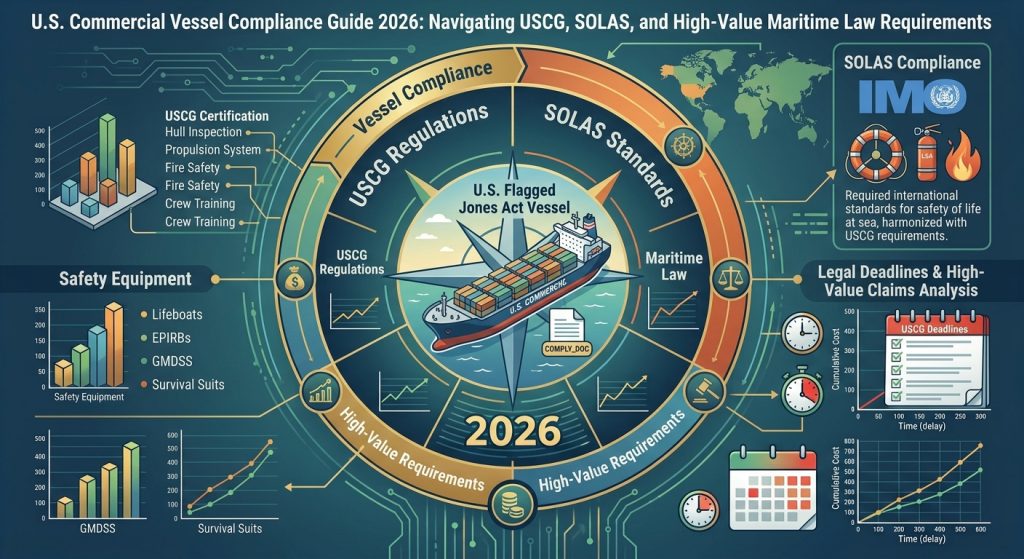
Navigating federal regulations and international maritime frameworks requires precision. For commercial fleet managers, vessel owners, and maritime operators trading in U.S. waters, regulatory oversight is an active operational risk management priority. Non-compliance disrupts global supply chains and triggers severe penalties, port state detentions, and increased insurance premiums.
This compliance guide details regulatory mandates across United States Coast Guard (USCG) standards, International Maritime Organization (IMO) conventions, and high-CPC legal exposure areas.
The U.S. Maritime Legal Architecture: USCG, Jones Act, and SOLAS
Commercial vessel operations within U.S. Exclusive Economic Zones (EEZ) and coastal waters fall under overlapping jurisdiction between domestic statutory authorities and international treaty obligations.
┌───────────────────────────────────────────┐
│ U.S. Maritime Compliance Oversight │
└─────────────────────┬─────────────────────┘
│
┌─────────────────────────────────────┼─────────────────────────────────────┐
│ │ │
▼ ▼ ▼
┌──────────────────────────────┐ ┌──────────────────────────────┐ ┌──────────────────────────────┐
│ United States Coast Guard │ │ International Treaties (IMO) │ │ Statutory & Legal Frameworks │
│ (USCG / CFR) │ │ (SOLAS, MARPOL, STCW) │ │ (Merchant Marine / Jones Act)│
└──────────────┬───────────────┘ └──────────────┬───────────────┘ └──────────────┬───────────────┘
│ │ │
▼ ▼ ▼
┌──────────────────────────────┐ ┌──────────────────────────────┐ ┌──────────────────────────────┐
│ • 33 & 46 CFR Inspections │ │ • Life-Saving Appliances │ │ • U.S. Flag & Crew Requirements
│ • Port State Control (PSC) │ │ • Environmental (ECA/APPS) │ │ • Jones Act Liability │
│ • COFR & VRP Certification │ │ • SMS & Flag State Audits │ │ • Maintenance & Cure Standard│
└──────────────────────────────┘ └──────────────────────────────┘ └──────────────────────────────┘
1. Title 33 and Title 46 of the Code of Federal Regulations (CFR)
The USCG enforces vessel safety, design, and operational standardizations. Title 33 CFR addresses navigation, navigable waters, and water pollution response, while Title 46 CFR governs shipping regulations, inspection standards, safety equipment, and crewing mandates.
- Certificate of Inspection (COI): Required for all commercial U.S.-flagged vessels, validating structural integrity, machinery reliability, and safety equipment readiness.
- Port State Control (PSC): Foreign-flagged vessels calling at U.S. ports undergo USCG PSC inspections to ensure full alignment with international safety standards before entering U.S. commerce.
2. The Merchant Marine Act of 1920 (The Jones Act)
The Jones Act (46 U.S.C. § 55102) requires goods transported by water between U.S. ports to be carried on U.S.-built, U.S.-owned, and U.S.-flagged vessels operated by U.S. citizens or permanent residents. Beyond cabotage protection, Section 33 of the Act grants injured seafarers a statutory negligence cause of action against employer fleet operators, elevating employer liability standards above traditional workers’ compensation models.
3. International Safety Treaties: SOLAS, MARPOL, and STCW
Trans-oceanic commercial operations require full adherence to core IMO frameworks:
- SOLAS (Safety of Life at Sea): Mandates technical standards for ship construction, fire protection, life-saving appliances, and radio communications.
- MARPOL (Prevention of Pollution from Ships): Regulates operational and accidental discharge under six technical annexes covering oil, noxious substances, sewage, garbage, and air emissions (including Emission Control Areas).
- STCW (Standards of Training, Certification, and Watchkeeping): Establishes baseline qualification standards for masters, officers, and watch personnel on commercial vessels.
Maritime Safety Equipment Mandatory Fleet Specifications
The USCG and SOLAS outline specific safety gear requirements based on vessel tonnage, route, and crew complement. Substandard safety equipment is one of the leading causes of USCG port state detention.
| Equipment Category | Applicable Standard | Commercial Vessel Requirement | Maintenance / Inspection Cycle |
| Personal Life-Saving Appliances | USCG Approval / SOLAS LSA Code | Type I PFDs or SOLAS Immersion Suits for 100% of crew plus remote stations. | Monthly visual checks; annual servicing for inflatable units. |
| Inflatable Liferafts & Launching | SOLAS Chapter III / 46 CFR | Capacity for 100% to 200% on-board complement depending on vessel classification. | Annual servicing by authorized stations; Hydrostatic Release Unit (HRU) replacement. |
| Emergency Radio Equipment | GMDSS / FCC / 47 CFR Part 80 | Category 1 406 MHz EPIRBs, Search and Rescue Transponders (SART/AIS-SART). | Monthly self-test; annual operational test; battery replacement per expiry. |
| Firefighting Systems | SOLAS Chapter II-2 / 46 CFR | Fixed CO2/Water mist suppression systems, EEBDs, SCBA sets, and emergency fire pumps. | Quarterly inspections; annual hydro-testing and agent weigh-ins. |
Environmental and Operational Compliance in U.S. Waters
Commercial operators navigating U.S. coastal routes face stringent environmental regulations monitored by the USCG and the U.S. Environmental Protection Agency (EPA).
┌────────────────────────────────────────────────────────────────────────────────────────┐
│ Key U.S. Environmental Compliance Pillars │
├───────────────────────────────┬───────────────────────────────┬────────────────────────┤
│ Ballast Water Management │ Vessel Response Plans │ Air Emission Standards │
│ (33 CFR 151) │ (VRP / 33 CFR 155) │ (MARPOL Annex VI) │
├───────────────────────────────┼───────────────────────────────┼────────────────────────┤
│ • USCG-Type Approved BWMS │ • Oil Spill Removal Org (OSRO) │ • 0.10% Fuel Sulfur Limit in ECA │
│ • Ballast Water Exchange Log │ • Qualified Individual (QI) │ • IMO Tier III NOx Engines │
│ • NBIC Data Reporting │ • Salvage & Firefighting Sec │ • Exhaust Gas Cleaning Logbook │
└───────────────────────────────┴───────────────────────────────┴────────────────────────┘
Ballast Water Management Standards
Under 33 CFR Part 151, commercial vessels operating in U.S. waters must manage ballast water to prevent non-indigenous species introductions.
- USCG Type-Approved Ballast Water Management Systems (BWMS): Operators must install and operate a USCG-type approved treatment system.
- National Ballast Information Clearinghouse (NBIC): Detailed logging and mandatory reporting of all ballast operations prior to entering U.S. ports.
Vessel Response Plans (VRP) and COFR
Under 33 CFR Part 155, tank and non-tank vessels exceeding 400 gross tons operating in U.S. waters must maintain an approved Vessel Response Plan (VRP).
- OSRO Alignment: Executed contracts with USCG-approved Oil Spill Response Organizations (OSROs).
- SMFF Capabilities: Contractual agreements for Salvage and Marine Firefighting (SMFF) services.
- Certificate of Financial Responsibility (COFR): Issued by the USCG National Pollution Funds Center, verifying financial capabilities to cover potential discharge liability under the Oil Pollution Act of 1990 (OPA 90).
Risk Mitigation, Marine Insurance, and High-CPC Legal Exposures
Commercial fleet management requires managing core exposures to control Hull & Machinery (H&M) and Protection & Indemnity (P&I) liability rates.
┌──────────────────────────────────────────┐
│ Commercial Vessel Risk Hierarchy │
└────────────────────┬─────────────────────┘
│
┌─────────────────────────────┴─────────────────────────────┐
│ │
▼ ▼
┌─────────────────────────────────┐ ┌─────────────────────────────────┐
│ Contractual Liability │ │ Operational Loss Exposure │
├─────────────────────────────────┤ ├─────────────────────────────────┤
│ • Charterparty Disputes │ │ • Maintenance & Cure Claims │
│ • Cargo Damage & Demurrage │ │ • Environmental Discharge Fines │
│ • Towage & Salvage Risk │ │ • Hull Damage & Collision Ops │
└─────────────────────────────────┘ └─────────────────────────────────┘
High-CPC Legal Domain Overview
Top-tier commercial maritime advertisers spend significantly on search terms related to maritime law and maritime litigation. Understanding these fields helps manage liabilities:
- Jones Act Negligence Claims: Unlike standard worker compensation models, seafarers can sue vessel operators directly for negligence. Operators must maintain documented safety management systems (SMS) to demonstrate a safe work environment.
- Unseaworthiness Doctrine: An absolute duty owed by shipowners to provide a vessel and gear reasonably fit for intended purpose. Defective equipment or inadequate crewing creates strict liability exposure.
- Maintenance and Cure Obligations: General maritime law obligates vessel operators to provide medical care (“cure”) and daily living stipends (“maintenance”) to seafarers injured while in service of the ship, regardless of fault.
Frequently Asked Questions (FAQ)
What are maritime laws, and how do they govern commercial vessel operations in the United States?
Maritime laws encompass distinct federal statutes, general maritime legal principles, and international treaties that govern nautical activities, navigation, marine commerce, and ocean resource management. In the U.S., Article III, Section 2 of the Constitution grants federal courts jurisdiction over maritime matters. Operational enforcement is managed by the USCG, federal agencies, and international bodies like the IMO.
What is the primary difference between a maritime lawyer and a traditional personal injury attorney?
A maritime lawyer specializes in admiralty jurisdiction, general maritime law, federal statutes like the Jones Act, the Death on the High Seas Act (DOHSA), and the Longshore and Harbor Workers’ Compensation Act (LHWCA). Traditional personal injury attorneys focus on state tort law, which does not apply on navigable waters or within maritime employment contracts.
Which maritime code requires shipping companies to investigate incidents to increase safety?
The International Safety Management (ISM) Code (enforced via SOLAS Chapter IX) requires shipping companies to implement a Safety Management System (SMS). The ISM Code mandates systematic procedures for reporting, analyzing, and investigating accidents and non-conformities to prevent recurrence and improve operational safety.
What is maritime security, and how does it affect U.S. commercial port operations?
Maritime security involves protecting vessels, ports, and offshore infrastructure against illegal acts, terrorism, piracy, and smuggling. In the U.S., the Maritime Transportation Security Act of 2002 (MTSA) and the International Ship and Port Facility Security (ISPS) Code govern security standards. Requirements include background checks via Transportation Worker Identification Credentials (TWIC), facility security plans, and vessel security assessments.
How do USCG commercial vessel safety equipment requirements differ based on vessel type?
USCG safety equipment specifications vary according to vessel tonnage, service classification (e.g., passenger, cargo, towing), and trading area (coastwise vs. ocean-going). Larger ocean-going cargo vessels require approved SOLAS liferafts, immersion suits for all crew members, fixed fire suppression systems, and GMDSS communication suites. Smaller coastwise vessels follow Title 46 CFR Subchapter C or T guidelines, which allow scaled equipment configurations based on route distance from shore.
What are the financial consequences of non-compliance with USCG or MARPOL regulations in U.S. waters?
Non-compliance can result in:
- Operational Suspension: USCG issues of Form CG-835 detentions, preventing the vessel from sailing.
- Civil and Criminal Fines: MARPOL violations prosecuted under the Act to Prevent Pollution from Ships (APPS) carry criminal fines exceeding millions of dollars and potential imprisonment for responsible officers.
- Commercial Costs: Demurrage charges, loss of charter contracts, and potential P&I club coverage denial.
U.S. Commercial Vessel Operator Guide: Jones Act Compliance & Risk Mitigation Checklist
Operating commercial vessels in U.S. navigable waters requires strict compliance with federal maritime law. Under Section 33 of the Merchant Marine Act of 1920 (commonly known as the Jones Act, codified at 46 U.S.C. § 30104), commercial vessel owners and fleet operators face a unique legal regime.
Unlike land-based employers governed by state workers’ compensation systems, Jones Act employers are subject to fault-based negligence claims and strict liability under the Doctrine of Unseaworthiness.
This operational guide and interactive compliance framework provides fleet managers, safety officers, and legal teams with a structured checklist to mitigate liability, ensure seaworthiness, and protect crew members.
1. Statutory Foundations: The Legal Exposure Hierarchy
To effectively manage risk, operators must understand the three distinct legal remedies available to injured seafarers under general maritime law and federal statute:
┌──────────────────────────────────────────┐
│ Seafarer Injury Legal Remedies │
└────────────────────┬─────────────────────┘
│
┌─────────────────────────────┼─────────────────────────────┐
│ │ │
▼ ▼ ▼
┌─────────────────────────┐ ┌─────────────────────────┐ ┌─────────────────────────┐
│ The Jones Act │ │ Unseaworthiness Doctrine│ │ Maintenance & Cure │
│ (46 U.S.C. § 30104) │ │ (General Maritime Law) │ │ (General Maritime Law) │
├─────────────────────────┤ ├─────────────────────────┤ ├─────────────────────────┤
│ • Negligence-based │ │ • Strict liability │ │ • No-fault obligation │
│ • “Slightest” causation │ │ • Absolute duty to provide│ │ • Medical care (Cure) │
│ • Jury trial rights │ │ a fit vessel & crew │ │ • Living stipend (Maint)│
└─────────────────────────┘ └─────────────────────────┘ └─────────────────────────┘
Key Legal Standards Defined:
- Jones Act Negligence: Operators are liable if employer negligence played any part, no matter how small, in causing the seaman’s injury (the legal standard of “slightest causation”).
- Unseaworthiness: A non-delegable, absolute duty owed by shipowners to ensure that the vessel, its equipment, appliances, and crew complement are reasonably fit for their intended purpose. Fault is irrelevant; a defective piece of equipment or understaffed crew creates liability.
- Maintenance & Cure: An absolute, no-fault duty to provide daily living expenses (“maintenance”) and necessary medical care (“cure”) from the onset of injury or illness until the seafarer reaches Maximum Medical Improvement (MMI).
2. Comprehensive Operational Checklist
Print or integrate the following multi-point checklist into your fleet’s Safety Management System (SMS) and pre-voyage auditing workflows.
Phase 1: Seaman Status & Crew Qualification Standards
- [ ] 30% Rule Verification: Verify that crew members meet the legal criteria for “seaman status” (i.e., a connection to a vessel in navigation that is substantial in both duration and nature, typically spending at least 30% of working time aboard).
- [ ] STCW & Credential Audits: Confirm all crew hold valid United States Coast Guard (USCG) Merchant Mariner Credentials (MMC) with appropriate endorsements for their operational billets.
- [ ] Pre-Employment Medical Examinations (PEMEs): Conduct standardized, role-specific physical evaluations and baseline functional capacity evaluations (FCEs) prior to assignment to establish pre-existing conditions.
- [ ] Drug & Alcohol Testing Protocols: Enforce USCG-mandated chemical testing programs (46 CFR Part 16) including pre-employment, random, serious marine incident (SMI), and reasonable cause testing.
Phase 2: Vessel Seaworthiness & Physical Equipment Audits
- [ ] Walkway & Deck Safety: Enforce non-skid deck coatings, immediate clean-up protocols for oil/water spills, and clear egress pathways to reduce slip, trip, and fall hazards (the leading cause of Jones Act litigation).
- [ ] Rigging & Lifting Equipment Inspection: Maintain certified logbooks for all cranes, winches, wire ropes, blocks, and tackle. Ensure load tests are current and certified under OSHA/USCG rules.
- [ ] Personal Protective Equipment (PPE) Mandate: Provide, enforce, and log the use of task-appropriate PPE (impact gloves, hard hats, eye protection, USCG-approved Type I/III PFDs, fall protection harnesses).
- [ ] Guarding & Machinery Maintenance: Verify all rotating shafts, belts, and hazardous machinery feature functional safety guards. Establish strict Lockout/Tagout (LOTO) protocols for maintenance.
Phase 3: Safety Management System (SMS) & Operational Risk Assessments
- [ ] Job Safety Analyses (JSAs): Require mandatory JSA completion prior to starting non-routine or hazardous shipboard activities (e.g., heavy lifts, enclosed space entry, hot work).
- [ ] Near-Miss Reporting Program: Maintain a no-blame near-miss reporting system. Track, trend, and address root causes to correct hazards before an injury occurs.
- [ ] Enclosed Space Entry Compliance: Enforce 29 CFR 1915 / 46 CFR standards for gas testing, ventilation, atmospheric monitoring, and dedicated standby watch personnel.
- [ ] Bridge & Engine Room Resource Management: Implement formal watchstanding procedures and fatigue management plans to prevent human error due to exhaustion.
Phase 4: Post-Incident Response & Claims Management Protocols
- [ ] Immediate Medical Attention: Provide prompt, unrestricted access to quality medical treatment. Never restrict an injured seaman’s right to seek emergency care.
- [ ] Timely Form CG-2692 Filing: Submit USCG Form CG-2692 (Report of Marine Casualty, Commercial Diving Incident, or OCS-Related Casualty) within 5 days for qualifying incidents.
- [ ] Evidence Preservation Protocols: Immediately secure the incident site, take high-resolution photographs, isolate and lock down involved equipment, and collect detailed witness statements.
- [ ] Prompt Maintenance & Cure Administration: Initiate maintenance and cure payments promptly upon notice of injury to prevent punitive damage claims for arbitrary or capricious denial.
3. Maintenance & Cure Administration Matrix
Managing medical care and living stipends correctly prevents costly legal escalation. Use this operational matrix to guide post-incident claims handling:
| Action Area | Operator Obligation | Critical Risk / Pitfall to Avoid |
| Medical Provider Selection | The seafarer has the legal right to select their own treating physician. | Do not force the employee to see only company doctors; doing so can be deemed interference under general maritime law. |
| Maintenance Rate Calculation | Pay a reasonable daily rate covering basic room and board (housing, utilities, food). | Avoid outdated standard rates (e.g., $8/day); courts routinely award actual documented living expenses ($30–$100+/day). |
| Cure Payment Schedule | Pay all necessary and reasonable medical expenses related to the injury. | Delaying approval for necessary surgeries or diagnostic tests can trigger punitive damages and attorney fees. |
| Termination of Benefits | Continue payments until the treating physician certifies the seaman has reached Maximum Medical Improvement (MMI). | Stopping payments merely because an employee returns to work elsewhere or files a lawsuit is legally impermissible. |
4. Operational Risk Audit Summary Table
| Risk Category | High-Risk Indicators | Primary Mitigation Action | Regulatory / Legal Reference |
| Equipment Safety | Missing safety guards, worn cables, non-functioning emergency stops. | Mandatory daily pre-shift inspections; strict Lockout/Tagout (LOTO). | 46 CFR Subchapter M / SOLAS Ch. II-2 |
| Deck Conditions | Worn non-skid surfaces, standing grease/oil, inadequate lighting. | Scheduled re-coating; immediate spill remediation logs; LED upgrades. | USCG Navigation & Vessel Inspection Circulars (NVIC) |
| Crew Complement | Operating short-handed, excessive overtime, fatigued crew. | Strict adherence to minimum safe manning certificates (COI) and rest hours. | 46 U.S.C. § 8104 / STCW Convention |
| Incident Documentation | Delayed reporting, unpreserved physical evidence, missing JSA logs. | Standardized incident response kits on every vessel; immediate scene lock-down. | 46 CFR Part 4 (Marine Casualties) |
Recent Comments