
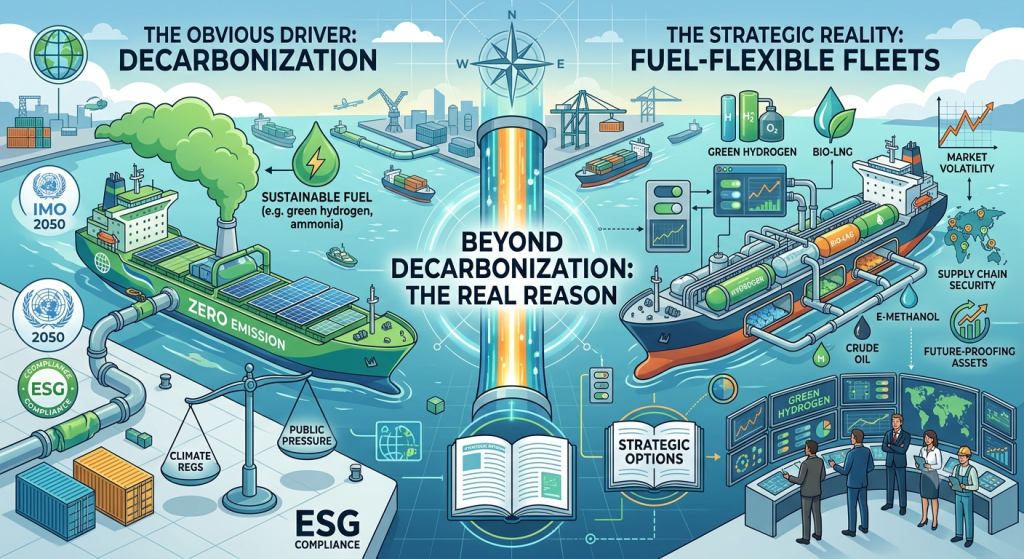
The systemic capital migration toward dual-fuel and fuel-flexible tonnage is fundamentally driven by balance sheet preservation and structural liability mitigation rather than environmental altruism. In an operational environment disrupted by strict emissions penalties, unstable geopolitical corridors, and aggressive multi-jurisdictional sanctions enforcement, fuel flexibility represents the primary mechanism to insulate asset yield from catastrophic operational disruptions.
The Economic Impact
For institutional investors, shipowners, and C-suite executives across major maritime hubs like the USA, UAE, Singapore, and the UK, single-fuel exposure has transitioned from a standard operational parameter into a critical financial liability. Relying entirely on traditional Heavy Fuel Oil (HFO) or unhedged alternative mono-fuels directly exposes an organization to volatile cash-flow drains and structural asset impairment.
When a vessel lacks the mechanical capacity to pivot between fuel types, its earning potential becomes entirely dependent on regional regulatory compliance and local bunkering infrastructure. If a specific bunkering hub faces severe supply shocks or extreme price spikes, a single-fuel vessel must either absorb unhedged operational premiums or alter its routing, which frequently triggers substantial Arbitration & Litigation Costs due to missed delivery windows under strict charterparty agreements.
Furthermore, capital allocation for fleet renewal increasingly relies on highly structured financing arrangements. Debt syndicates and institutional funds now price structural obsolescence directly into their underwriting models. Shipowners relying on legacy propulsion systems face restricted access to primary capital markets, forcing them to turn away from cost-effective Senior Secured Debt & Mezzanine Financing options. Those left with inflexible assets are pushed toward expensive alternative capital, which drives up their overall cost of capital and depresses the long-term net asset value (NAV) of the fleet.
In terms of daily operations, asset illiquidity and single-fuel vulnerabilities also show up in rising risk transfer costs. Standard insurance wrappers are no longer sufficient to cover modern operational risks, forcing risk managers to utilize secondary derivatives and structured instruments. By establishing a structurally adaptable fleet, operators can negotiate lower Parametric Insurance Premiums, as insurers recognize the vessel’s capacity to adjust its risk profile dynamically in response to market disruptions and fuel availability.
The Compliance & Legal Framework
The modern regulatory environment has evolved from general policy guidance into a strict framework of financial penalties, potential vessel detentions, and criminal exposure. Shipowners can no longer treat compliance as a secondary operational concern; it is a primary driver of structural asset risk.
+—————————————————————————————+
| 2026 GLOBAL MARITIME COMPLIANCE MATRIX |
+—————————————————————————————+
| REGULATORY DRIVER | OPERATIONAL IMPACT | FINANCIAL CONSEQUENCE |
+————————+—————————————+————————+
| EU ETS Phase-In | 100% Carbon Liability | Direct EUA Surrender |
| (Methane & N2O Scope) | Tank-to-Wake Methane Slip Penalties | Unhedged Cash Outflows|
+————————+—————————————+————————+
| Joint War Committee | Expanded Risk Boundaries | Surging War Risk |
| JWLA-033 Circular | Enhanced Regional Surveillance | Breach Premiums |
+————————+—————————————+————————+
| OFAC Sanctions | Deceptive Shipping Controls | Asset Seizures |
| Compliance | AIS & Bunkering Attestation Audits | Capital Freezes |
+—————————————————————————————+
The EU ETS Expansion and Methane Slip Liabilities
The regulatory landscape shifted decisively with the full implementation of the European Union Emissions Trading System (EU ETS) maritime phase-in. Moving beyond the partial compliance caps of previous years, shipping companies must now surrender European Union Allowances (EUAs) covering 100% of verified emissions for intra-EU voyages and 50% for extra-EU voyages.
Critically, the regulatory scope has expanded to encompass non-carbon greenhouse gases, specifically targeting methane () and nitrous oxide (
). This introduces structural financial risk for early adopters of standard liquefied natural gas (LNG) propulsion systems. The regulatory framework penalizes unburned methane emissions, known as methane slip, utilizing conservative default emission factors based on engine design, such as an aggressive 3.1% default for medium-speed Otto dual-fuel engines.
Without fuel-flexible options or verified actual slip monitoring, operators face unexpected EUA liabilities that can quickly add hundreds of thousands of dollars to a single trans-European voyage.
Geopolitical Friction and War Risk Mandates
Operational flexibility is further constrained by shifting geopolitical boundaries defined by international underwriting bodies. The Joint War Committee (JWC) of the Lloyd’s Market Association regularly updates its listed areas of perceived enhanced risk. The implementation of recent updates, including the comprehensive JWLA-033 circular, expanded the designated high-risk zones across critical choke points in the Middle East, including the Persian Gulf, Gulf of Oman, and the Red Sea.
Operating within these jurisdictions requires strict compliance with updated coverage mandates. Failure to secure specialized coverage before entering these zones exposes the asset to immediate exclusion clauses, risking devastating financial losses from Asset Seizure & Hull War Risk events without insurance backing.
Sanctions Enforcement and Third-Party Risk
Concurrently, the U.S. Department of the Treasury’s Office of Foreign Assets Control (OFAC) has escalated its enforcement mechanisms regarding marine transport and supply-chain transparency. Under current mandates, OFAC Sanctions Compliance demands absolute transparency throughout the maritime supply chain, focusing closely on ship-to-ship (STS) transfers, dark fleet activity, and complex maritime ownership structures.
[Bunkering & Route Execution]
│
▼
[Deceptive Shipping Screening (AIS/STS)]
│
▼
[Compliance Audit Phase] ───► (Failure) ───► [Immediate Asset Seizure]
│ & Global Bank Account Freezes
▼ (Pass)
[Unrestricted Fleet Operations]
Any vessel utilizing bunkering providers or cargo entities tied to blocked persons or sanctioned regions faces swift asset freezes. In this high-stakes environment, fuel-flexible fleets give operators the agility to adjust bunkering plans and routes away from high-risk or compromised supply chains, avoiding catastrophic regulatory penalties and operational standstills.
Strategic Recommendations
Step 1: Structural Capital Restructuring
C-suite executives must immediately realign their long-term fleet renewal programs to transition away from legacy, mono-fuel assets. When structuring capital deployment for newbuild orders or extensive retrofits, corporate treasurers should insulate their balance sheets by utilizing a combination of asset-backed Senior Secured Debt & Mezzanine Financing.
By dispersing financing layers, organizations can maintain liquidity reserves to manage potential compliance spikes while ensuring the new vessels feature modular engine spaces capable of transitioning from LNG and conventional distillates to green methanol or ammonia without requiring structural hull conversions.
Step 2: Implementation of Actual Slip Verification and Technical Optimization
To protect earnings against the full financial impact of the EU ETS expansion, operators must move away from conservative regulatory default values. Fleet managers should immediately install certified, continuous emissions monitoring systems (CEMS) to verify actual, load-dependent methane and nitrous oxide emission profiles.
Documenting verified actual slip factors that outperform regulatory defaults allows companies to directly lower their annual EUA surrender obligations, protecting operating margins from unhedged regulatory penalties.
Gasum
Step 3: Mitigating Technology and Autonomous Navigation Liabilities
As multi-fuel operations grow more complex, fleets are increasingly adopting automated energy management and AI-driven navigation systems, particularly when routing through high-risk corridors like the Red Sea. However, integrating these automated systems introduces unique legal exposures. Executives must establish clear contractual protections and update their liability frameworks to address potential automated routing errors or system failures.
+—————————————+
| AI/Automated Navigation Framework |
+—————————————+
│
▼
[Dynamic Route & Fuel Optimization]
│
▼
+———————————————–+
| Red Sea / High-Risk Corridor Entry Audits |
+———————————————–+
│
┌─────────────────────────┴────────────────────────┐
▼ ▼
[System-Generated Route Error] [Successful Transit Execution]
│ │
▼ ▼
[Hull War Risk/Exclusion Breach] [Optimized Fuel Consumption]
│ [Lowered EUA Liability Costs]
▼
[Structural Litigation Exposure]
If an automated system accidentally steers a vessel into an exclusion zone defined by the Joint War Committee (JWC) Circulars, the owner can face immediate coverage lapses. Corporate legal teams must proactively update their charterparty terms to clearly assign liability between the technology providers, vessel operators, and charterers before deployment.
Mitigating systemic maritime risk in a highly volatile operational environment requires deep, expert integration of legal, financial, and technical strategies. To successfully navigate evolving carbon pricing structures, complex sanctions risk, and changing war risk boundaries, institutional investors and vessel owners must rely on top-tier Professional Advisory Services. Aligning your operations with specialized corporate risk underwriters ensures your organization can secure tailored coverage wrappers, reduce exposure to structural litigation, and maintain access to primary credit facilities amid shifting global trade dynamics.
Frequently Asked Questions (FAQ)
How do fuel-flexible fleets directly mitigate ESG Disclosure Liability for institutional investors?
Institutional investors face strict carbon accounting and non-financial reporting mandates across the US, UK, and Europe. Operating single-fuel assets that rely on high-carbon legacy fuels or unverified dual-fuel systems exposes companies to severe misstatement risks under expanding sustainability reporting frameworks.
Fuel-flexible vessels allow operators to switch to lower-emission alternatives as infrastructure matures, ensuring verifiable reductions in Scope 1 emissions and significantly lowering the risk of regulatory penalties or investor lawsuits linked to ESG Disclosure Liability.
Why are standard Hull & Machinery (H&M) policies insufficient against 2026 maritime risks?
Traditional H&M policies are designed for standard marine accidents and mechanical breakdowns; they do not cover geopolitical interference, regulatory enforcement actions, or targeted asset arrests. If a vessel is detained due to non-compliance with international sanctions or environmental mandates, standard hull policies typically apply exclusion clauses.
To protect against unexpected detentions or losses in high-risk zones, operators must secure specialized coverage that accounts for Asset Seizure & Hull War Risk and matches current international security mandates.
Lloyd’s Market Association
What are the operational risks of AI-driven navigation in high-risk zones like the Red Sea?
Automated and AI-driven navigation tools optimize voyages by continuously adjusting headings and fuel consumption based on real-time sea conditions and security alerts. However, if an automated navigation algorithm misinterprets a security threat or charts a course through a restricted zone listed under active Joint War Committee (JWC) Circulars, the vessel may inadvertently void its specialized war risk coverage.
This exposure creates a complex risk environment where owners can face significant recovery costs and structural liability disputes if a security incident occurs within a excluded zone.
How does the integration of alternative fuels affect a shipowner’s access to capital markets?
Modern ship finance syndicates increasingly evaluate the long-term regulatory compliance of an asset before allocating capital. Legacy, single-fuel vessels face accelerating technical obsolescence and decreasing residual values, making them high-risk options for traditional lenders.
In contrast, investing in modular, fuel-flexible fleets reassures lenders that the asset can remain compliant with future environmental regulations, unlocking competitive pricing through Senior Secured Debt & Mezzanine Financing packages.
Recent Comments