
The global maritime industry is currently executing the most capital-intensive industrial transition in its history. The International Maritime Organization’s (IMO) revised strategy to achieve net-zero greenhouse gas (GHG) emissions by or around 2050 requires an estimated $1 trillion to $1.4 trillion in capital expenditure. This massive financial mobilization is not just about retrofitting engines or building dual-fuel ammonia vessels; it represents a fundamental rewiring of how commercial shipping accesses institutional capital.
Historically, ship finance was a relationship-driven, asset-backed lending exercise based on corporate balance sheets, charterparty cash flows, and vessel scrap values. Today, capital allocation is governed by strict Environmental, Social, and Governance (ESG) mandates. Major global ship finance banks—controlling hundreds of billions in senior secured debt—are now signatories to the Poseidon Principles, directly linking the availability and cost of capital to a shipowner’s carbon trajectory.
This transition has accelerated the deployment of two primary structured finance instruments:
- Sustainability-Linked Loans (SLLs): Corporate credit facilities where the interest rate margin fluctuates based on the borrower’s ability to meet predefined ESG Key Performance Indicators (KPIs), most notably the Carbon Intensity Indicator (CII).
- Green Bonds and Transition Bonds: Fixed-income securities issued in public capital markets, specifically ring-fenced to fund eligible “green” maritime assets, such as methanol-ready newbuilds or zero-emission port infrastructure.
This whitepaper provides a structural analysis for C-Suite executives, Chief Financial Officers (CFOs), and shipping investors on navigating the Poseidon Principles, structuring maritime SLLs, and aligning corporate fleet strategies with the EU Taxonomy for Sustainable Activities to secure optimal capital pricing.
1. The Poseidon Principles: The New Benchmark for Ship Finance
Launched in 2019, the Poseidon Principles represent a global framework for integrating climate considerations into lending decisions to promote international shipping’s decarbonization. The framework is currently adopted by over 30 leading ship finance banks, jointly representing over 65% of the global senior secured ship finance portfolio.
The Core Mechanism: Climate Alignment
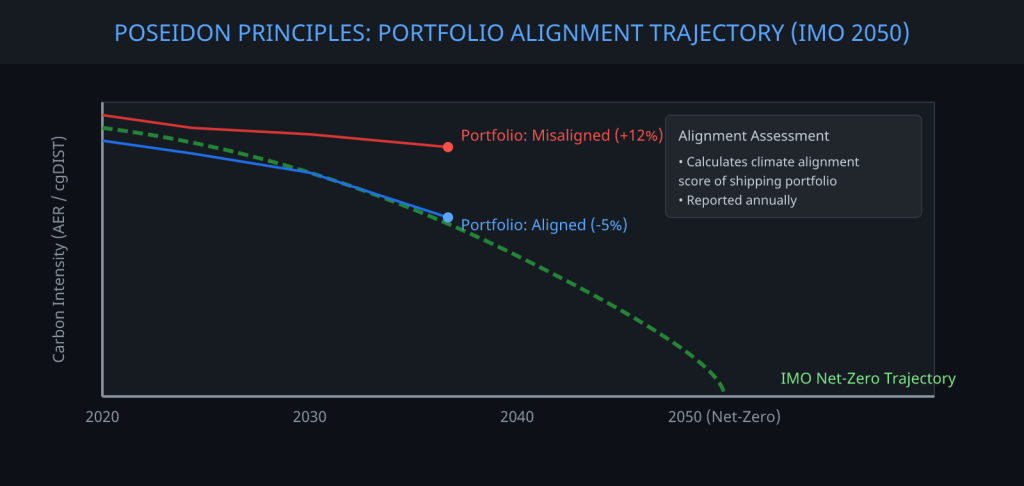
The Poseidon Principles mandate that signatory financial institutions quantitatively assess and publicly disclose the climate alignment of their shipping portfolios on an annual basis.
- The Metric: Alignment is measured using the Annual Efficiency Ratio (AER) or Capacity Gross Tonne Distance (cgDIST), mirroring the IMO’s Data Collection System (DCS).
- The Trajectory: These metrics are plotted against decarbonization trajectories required to meet the IMO’s updated net-zero 2050 targets.
- The Portfolio Score: A bank calculates an overall “alignment score.” A score of +5% indicates the portfolio is 5% above (worse than) the required decarbonization curve, while a score of -5% indicates the portfolio is overperforming the climate target.
The Commercial Impact on Shipowners
Banks must improve their portfolio alignment scores to meet their own corporate net-zero pledges and satisfy institutional shareholder demands. Consequently, they are actively de-risking their portfolios of high-carbon assets.
For shipowners, this means:
- Capital Scarcity for High-Emitters: Vessels operating on heavy fuel oil (HFO) with poor CII ratings (D or E) face significantly higher borrowing costs, lower loan-to-value (LTV) ratios, or outright rejection from top-tier European and Asian lenders.
- Capital Abundance for Transition Assets: Owners of dual-fuel LNG, methanol-ready, or highly optimized eco-vessels benefit from oversubscribed credit facilities, tighter margins, and favorable covenants.
2. Structuring Maritime Sustainability-Linked Loans (SLLs)
Unlike Green Loans—which strictly mandate that the proceeds be used only for specific green projects (e.g., installing rotor sails)—Sustainability-Linked Loans (SLLs) can be used for general corporate purposes (e.g., refinancing debt, working capital, or standard fleet expansion).
The defining feature of an SLL is the pricing mechanism: the loan’s interest rate margin is dynamically linked to the borrower’s achievement of predetermined, ambitious, and independently verified ESG targets.
The SLL KPI Architecture
A properly structured maritime SLL adheres to the Sustainability-Linked Loan Principles (SLLP) published by the Loan Market Association (LMA). Structuring requires defining rigorous Key Performance Indicators (KPIs) and associated Sustainability Performance Targets (SPTs).
Plaintext
┌──────────────────────────────────────────────────────────────────────────────┐
│ COMMON MARITIME SLL KPIs & SUSTAINABILITY TARGETS │
├──────────────────────────────┬───────────────────────────────────────────────┤
│ ENVIRONMENTAL KPIs (E) │ SUSTAINABILITY PERFORMANCE TARGET (SPT) │
├──────────────────────────────┼───────────────────────────────────────────────┤
│ Fleet Carbon Intensity │ Minimum 5% annual reduction in AER/CII across │
│ │ the financed fleet, outperforming IMO baseline│
├──────────────────────────────┼───────────────────────────────────────────────┤
│ Zero-Carbon Fuel Adoption │ 15% of total fleet energy consumption derived │
│ │ from sustainable biofuels or e-methanol by yr3│
├──────────────────────────────┼───────────────────────────────────────────────┤
│ SOCIAL KPIs (S) │ SUSTAINABILITY PERFORMANCE TARGET (SPT) │
├──────────────────────────────┼───────────────────────────────────────────────┤
│ Crew Welfare & Safety │ 20% reduction in Lost Time Injury Frequency │
│ │ (LTIF) or expanded cadet training programs │
├──────────────────────────────┼───────────────────────────────────────────────┤
│ GOVERNANCE KPIs (G) │ SUSTAINABILITY PERFORMANCE TARGET (SPT) │
├──────────────────────────────┼───────────────────────────────────────────────┤
│ Supply Chain Auditing │ 100% of tier-1 shipyards and bunker suppliers │
│ │ audited for ESG/anti-corruption compliance │
└──────────────────────────────┴───────────────────────────────────────────────┘
The Margin Adjustment Mechanism (The “Ratchet”)
The financial incentive is driven by a two-way pricing ratchet applied to the loan’s margin (e.g., Secured Overnight Financing Rate (SOFR) + 250 basis points).
- Target Achieved (Margin Discount): If the independent auditor confirms the shipowner hit the Annual Carbon Intensity reduction target, a margin discount is applied for the following 12 months (e.g., -5 to -10 basis points).
- Target Missed (Margin Premium): If the fleet fails to meet the target, a margin penalty is applied (e.g., +5 to +10 basis points).
- Use of Premium Proceeds: Many modern SLLs stipulate that if a penalty is triggered, the additional interest paid to the banks must be ring-fenced by the bank and donated to verified maritime decarbonization research initiatives, rather than absorbed as pure profit.
3. The Role of Green Bonds and Transition Capital Markets
While commercial bank debt remains the bedrock of ship finance, major maritime players (e.g., Maersk, NYK Line, Seaspan) are increasingly tapping global debt capital markets through Green Bonds.
Green Bond Frameworks
To issue a Green Bond, a shipping company must develop a formal Green Finance Framework aligned with the International Capital Market Association (ICMA) Green Bond Principles. This framework defines exactly what constitutes an “Eligible Green Asset.”
In shipping, eligible assets typically include:
- Newbuild vessels capable of operating on zero-carbon fuels (ammonia, hydrogen).
- Energy Efficiency Technologies (EETs) such as air lubrication systems, Flettner rotors, and advanced hull coatings.
- Shore power (cold ironing) infrastructure.
The EU Taxonomy Challenge
For European issuers and investors, maritime Green Bonds are increasingly heavily scrutinized against the EU Taxonomy for Sustainable Activities. The EU Taxonomy sets highly stringent technical screening criteria. Currently, to be considered aligned with the EU Taxonomy, a vessel must generally demonstrate zero direct tailpipe CO2 emissions, or fall under very narrow transitional criteria until 2025.
Because true zero-emission vessels are not yet commercially viable at scale for deep-sea shipping, the market is pivoting toward Transition Bonds. These bonds recognize that shipping is a “hard-to-abate” sector and provide capital specifically earmarked for interim decarbonization steps (e.g., LNG dual-fuel retrofits) that drastically lower emissions, even if they do not immediately reach absolute zero.
4. Operationalizing Sustainable Finance: The CFO’s Playbook
Securing transition finance requires shipping CFOs to integrate operational data natively with financial reporting. The era of the siloed technical department and finance department is over.
Step 1: Second Party Opinions (SPOs)
Before syndicating an SLL or issuing a Green Bond, the borrower must secure a Second Party Opinion (SPO) from a specialized ESG rating agency (e.g., Sustainalytics, DNV, ISS ESG). The SPO provides investors with independent verification that the proposed KPIs are material, ambitious, and scientifically aligned with IMO/Paris Agreement targets.
Step 2: Verifiable Telemetry & DCS Data
SLL pricing is adjusted annually based on data. Shipowners must ensure that their Vessel Performance Monitoring (VPM) systems produce highly accurate, tamper-proof fuel consumption data. If the data submitted for the Annual Efficiency Ratio (AER) calculation is delayed, disputed by the verifier, or found to be inaccurate, the shipowner will automatically trigger the margin penalty clause.
Step 3: Covenant Protection
CFOs must carefully negotiate SLL clauses to protect against uncontrollable external factors. For example, if a vessel is forced to reroute via the Cape of Good Hope due to Red Sea security risks, the increased voyage distance and speed will negatively impact the vessel’s CII rating. Borrowers must negotiate “force majeure” or “exceptional voyage” carve-outs in their SLL KPIs to avoid unfair financial penalties driven by geopolitical crises.
Conclusion: Capital as a Catalyst
The integration of the Poseidon Principles and Sustainability-Linked Loans into maritime finance is not a temporary trend; it is a permanent structural shift in capital allocation. Banks and institutional investors have effectively become the enforcement mechanism for global decarbonization, moving faster and with more immediate impact than regional regulatory bodies.
For shipowners, the mandate is clear: absolute carbon intensity must decrease, and ESG reporting must become as rigorous as financial accounting. Those who proactively structure their balance sheets around verifiable transition strategies will secure the cheapest and deepest pools of capital, while those who delay will face stranded assets and punitive borrowing costs in an increasingly regulated maritime economy.
Deep-Dive Frequently Asked Questions (FAQs)
Q1: What happens if a shipowner misses their KPI targets on a Sustainability-Linked Loan? Do they default?
Answer: No. Missing an ESG target in a properly structured SLL does not trigger an Event of Default or allow the banks to accelerate the loan. It strictly triggers a pricing adjustment—the margin premium (penalty). The borrower simply pays a higher interest rate for that specific year until the next testing period.
Q2: How do the Poseidon Principles differ from the IMO CII regulations?
Answer: The IMO’s Carbon Intensity Indicator (CII) is a mandatory operational regulation; a vessel that repeatedly scores a “D” or “E” must submit a corrective action plan to its flag state. The Poseidon Principles are a private financial framework used by banks to measure their portfolio alignment. However, both rely on the exact same underlying data (AER/cgDIST), meaning a poor CII score directly translates to a poor Poseidon Principles alignment score for the lending bank.
Q3: Can a shipowner secure a Green Loan to install exhaust gas cleaning systems (scrubbers)?
Answer: Generally, no. Scrubbers reduce sulfur oxides (SOx) to comply with IMO 2020 regulations, but they do not reduce carbon emissions (and can slightly increase fuel consumption). Under ICMA Green Loan Principles and strict ESG frameworks, scrubbers are widely considered a compliance tool for fossil fuels, not an “Eligible Green Asset” contributing to climate change mitigation.
Q4: Why would a bank offer a discount on a loan just because a shipowner reduces emissions?
Answer: Banks face immense regulatory pressure (e.g., from the European Central Bank) and pressure from their own shareholders to decarbonize their balance sheets. High-carbon assets carry high “transition risk”—meaning they may become obsolete or un-charterable before the loan is repaid. By incentivizing shipowners to decarbonize via SLLs, the bank is actively reducing the underlying credit risk of the loan and improving its own corporate ESG profile.
Q5: What is the difference between an AER and an EEOI metric in ship finance?
Answer: The Annual Efficiency Ratio (AER) measures carbon emitted per unit of a vessel’s theoretical carrying capacity over distance (assuming the ship is always fully loaded). It is the metric used by the IMO and the Poseidon Principles. The Energy Efficiency Operational Indicator (EEOI) measures carbon emitted per unit of actual cargo carried over distance. Some charterers prefer EEOI as it accounts for ballast (empty) voyages, but AER remains the primary metric for structured finance reporting.
For technical advisory on structuring maritime Sustainability-Linked Loans, developing Green Bond Frameworks, or optimizing fleet CII data for capital markets, contact Oitha Marine’s Ship Finance Advisory Division.
Recent Comments