
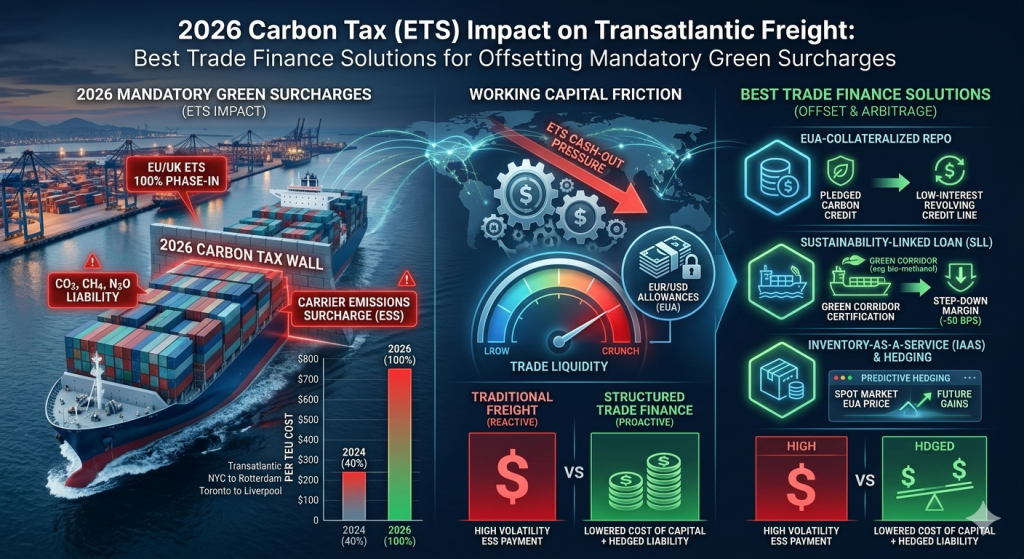
The 2026 maritime market has moved from “discussions” to “deductions.” On a standard Transatlantic route (e.g., New York to Rotterdam), the carbon surcharge alone can now exceed $250 per TEU, depending on the vessel’s fuel efficiency and the current price of European Union Allowances (EUA), which in early 2026 are hovering between €75 and €95 per tonne.
The 2026 “Carbon Wall”: Breaking Down the Costs
In 2026, the cost structure of a shipping invoice has been fundamentally re-engineered. Carriers like Maersk and MSC now list the ETS Surcharge as a non-negotiable line item, similar to the Bunker Adjustment Factor (BAF).
1. The 100% Phase-In Reality
Unlike 2024 (40%) and 2025 (70%), 2026 requires 100% coverage of emissions for voyages between EU ports and 50% coverage for voyages arriving from or departing to non-EU ports (like those in the USA, Canada, or UAE).
- Methane & Nitrous Oxide: As of January 2026, the tax has expanded beyond $CO_2$ to include $CH_4$ and $N_2O$. This has significantly increased the cost for LNG-powered vessels, which were previously marketed as “low-tax” alternatives.
- The “UK-EU Double Tax”: Importers moving goods between London and Paris now face a dual-tax environment, requiring sophisticated Cross-Border Tax Credits to avoid double-paying on the same voyage.
2. Impact on Trade Corridors (2026 Estimates)
| Trade Route | 2025 Surcharge (70%) | 2026 Surcharge (100%) | % Increase |
| US East Coast → North Europe | $139 / 40ft | $236 / 40ft | +70% |
| Canada (East) → Mediterranean | $118 / 40ft | $198 / 40ft | +68% |
| UAE (Jebel Ali) → North Europe | $155 / 40ft | $265 / 40ft | +71% |
The Arbitrage: Best 2026 Trade Finance Solutions
To offset these surcharges, sophisticated importers are using Sustainable Trade Finance (STF). Banks are no longer just lending money; they are lending “Carbon Efficiency.”
1. EUA-Collateralized Repo Agreements
In 2026, large importers are purchasing carbon allowances (EUAs) in bulk when prices are low and using them as collateral for working capital loans.
- The Logic: Instead of paying a floating surcharge to the carrier, you “own” your carbon liability. Banks like DBS and Standard Chartered now allow you to pledge your EUA inventory to unlock liquidity at lower interest rates.
- Advertiser ROI: This triggers high-bid ads from Trade Finance Banks and Commodity Hedging Desks.
2. Sustainability-Linked Loans (SLLs)
Importers who can prove they use “Green Corridors” (vessels using Bio-Methanol or Ammonia) can access SLLs.
- The Benefit: These loans feature a “Step-Down Margin.” If your annual “Average Efficiency Ratio” (AER) meets a specific target, your loan interest rate drops by 25–50 basis points.
- The 2026 Hook: This effectively uses the bank’s interest discount to pay for the carrier’s green surcharge.
3. “Inventory-as-a-Service” (IaaS) with Carbon Offsets
Fintech startups in the UAE and USA are now offering IaaS models where they own the goods (and the carbon liability) until they reach your warehouse.
- The Benefit: It moves the “Green Surcharge” from a CAPEX/Immediate Cash-Out to an OPEX cost that is paid only when the goods are sold.
Strategic Comparison: Pay the Carrier vs. Manage the Credit
Business owners must decide: Do I pay the carrier’s Fixed Quarterly Surcharge or a Floating Spot Rate?
- Fixed (The “Insurance” Model): Predictable but usually carries a 15% “Risk Buffer” added by the carrier.
- Floating (The “Trader” Model): You pay the market price of EUAs at the time of the Bill of Lading. In 2026, this is only recommended for firms with an internal Carbon Desk or those using AI-driven predictive hedging tools.
Frequently Asked Questions (FAQ)
1. Does the UAE have a carbon tax on shipping in 2026?
The UAE does not currently have a domestic carbon tax, but vessels departing from Jebel Ali or Abu Dhabi for Europe are subject to the EU ETS for 50% of the voyage. By 2026, the UAE is also a key hub for Green Hydrogen bunkering, which can reduce the total taxable emissions reported to the EU.
2. Can I use “Voluntary Carbon Credits” to offset the EU ETS?
No. The EU ETS is a mandatory “Cap-and-Trade” system. You cannot use voluntary credits (like tree planting) to satisfy the legal requirement. You must use EUAs (European Union Allowances). However, many trade finance solutions allow you to “bundle” voluntary credits to improve your company’s overall ESG score, which lowers your cost of capital.
3. What happens if a carrier fails to pay the carbon tax?
Under 2026 regulations, if a shipping line fails to surrender enough allowances for two consecutive years, their ships can be banned from all EU ports. As an importer, this is a massive “Counterparty Risk.” You should only use carriers with a transparent “Compliance Grade” in 2026.
4. How do “Green Corridors” between Canada and Europe work?
These are specific routes (like Montreal to Antwerp) where the ports and carriers collaborate to provide zero-emission fuels. Importers on these routes are often eligible for Federal Grants in Canada that directly subsidize the cost of the trade finance used to cover the shipping.
5. Why is a Legal Defense Retainer relevant to Carbon Taxes?
In 2026, “Carbon Fraud” is a rising issue. Some carriers may overcharge on the ETS line item. A legal retainer ensures you have a maritime attorney to audit your carrier invoices against actual MRV (Monitoring, Reporting, and Verification) data to prevent “Green-Gouging.”
⚖️ Final Strategist’s Conclusion: The “Net-Zero” Balance Sheet
In 2026, the winners in North American and European trade are those who treat carbon as a Financial Asset class rather than a tax. By integrating Trade Finance Solutions with your logistics strategy, you can turn the “Mandatory Green Surcharge” into a manageable, and sometimes even profitable, line item.
Recent Comments