
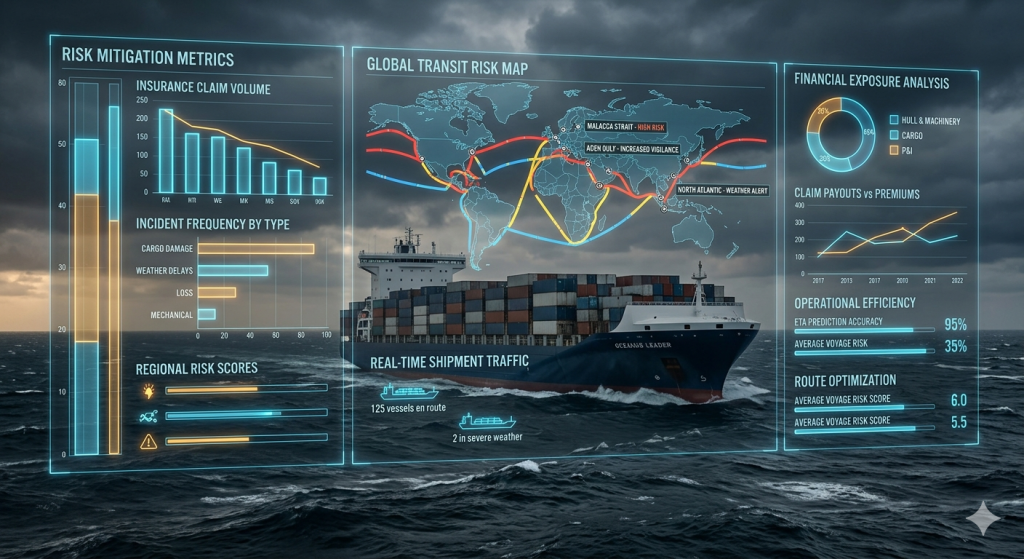
In the Q2 2026 risk landscape, U.S. cargo insurance has evolved from a standard procurement cost into a volatile financial metric capable of causing sudden balance sheet impairment. For institutional investors and C-suite executives across the USA, UK, Singapore, and the UAE, navigating premium hikes requires a comprehensive understanding of changing underwriting frameworks, where a single compliance gap can lead to immediate policy cancellation, loan defaults, and unrecoverable cargo loss.
The Economic Impact: Premium Hyperinflation and Capital Stack Vulnerability
The “Million-Dollar Problem” facing maritime logistics in 2026 is the rapid increase in transit risk pricing. Cargo insurance can no longer be evaluated as an isolated operating expense; it has a direct impact on asset valuation, credit facilities, and investor ROI.
The Threat of Technical Default
When cargo rates spike due to heightened geopolitical risk or environmental compliance penalties, the financial impact ripples through a company’s capital structure. Most institutional maritime operations are underpinned by complex debt facilities.
If a major cargo shipment is delayed, rerouted, or detained due to underwriting disputes, it can trigger strict “Material Adverse Change” (MAC) clauses embedded in credit agreements. This can prompt primary commercial banks to freeze revolving lines or accelerate Senior Secured Debt & Mezzanine Financing agreements.
Forcing a company to replace stable senior debt with alternative credit at high premiums can quickly compress a portfolio company’s internal rate of return (IRR).
The True Cost of Supply Chain Adjustments
Rerouting vessels away from high-risk corridors like the Red Sea or the Persian Gulf involves significant hidden costs. Long-distance detours—such as bypassing the African cape—do more than just extend transit times and increase fuel consumption.
In 2026, these extended routes expose operators to the full burden of the EU ETS Phase-In costs for methane slip. These unbudgeted environmental penalties can add hundreds of thousands of dollars to a single voyage’s operating costs.
Failing to properly account for and report these emissions exposures creates immediate ESG Disclosure Liability, which can lead to shareholder litigation and significant, unrecoverable Arbitration & Litigation Costs.
+————————————————————-+
| 2026 CARGO OPERATIONAL RISK WATERFALL |
+————————————————————-+
| Geopolitical / Regulatory Event |
| -> Extended Rerouting Execution |
| -> Compounding EU ETS Methane Surcharges |
| -> Unexpected Cash Flow Constraints |
| -> Debt Covenant Violation / Credit Facility Freeze |
+————————————————————-+
The Compliance/Legal Framework: The 2026 Risk Environment
The regulatory grid governing U.S.-bound cargo in 2026 demands absolute precision. Underwriters are utilizing real-time digital tracking and strict liability frameworks to shift the financial burden of geopolitical disruptions directly onto cargo owners and ship operators.
I. The Expanded Mandate of JWLA-032
The bedrock of cargo and transit risk rating in 2026 is governed by the Joint War Committee (JWC) Circulars, most notably the recent updates under JWLA-032. The 2026 revisions have expanded the boundaries of listed high-risk zones, reflecting changing threat environments.
Under the JWLA-032 framework, hull and cargo underwriters hold the right to issue a 24-hour notice of cancellation for standard transits entering these expanded areas. To maintain coverage, operators must pay significant breach premiums.
Operating without these explicit war-risk endorsements places the shipowner in default of both cargo transport contracts and primary financing covenants, elevating the risk of administrative detention or Asset Seizure & Hull War Risk policy voidance.
II. OFAC Enforcement and Strict Cargo Provenance
In 2026, compliance with the Office of Foreign Assets Control has moved to an automated, molecular level. OFAC Sanctions Compliance is no longer evaluated solely on the immediate counterparty listed on a bill of lading.
Regulators use data analytics to trace the origin of raw materials, bunker fuels, and blended crude products back to the source. If a U.S.-bound cargo shipment is found to be mixed with products from a sanctioned state or entity at an intermediate transshipment hub, the cargo is subject to immediate seizure.
Underwriters treat sanctions violations as a baseline exclusion, meaning the policy is voided ab initio, leaving the investor to absorb the full loss along with any subsequent legal fines.
[Upstream Source Vetting] —> [Transshipment Hub] —> [U.S. Port Entry Checkpoint]
|
[Automated OFAC Scan & Trace]
|
+—————–+—————–+
| |
v v
[Verified Compliant] [Non-Compliant Taint]
(Clear to Dock) (Immediate Asset Seizure)
III. AI-Driven Routing and Underwriting Liability
To manage the dual challenges of avoiding kinetic conflict zones and minimizing emissions penalties, modern fleets rely on automated voyage optimization software. However, this has introduced a new layer of risk: AI-driven navigation liability in the Red Sea and other high-risk lanes.
If an autonomous system modifies a vessel’s course to optimize fuel consumption but inadvertently crosses into a JWC-listed zone without an pre-approved waiver, the algorithm’s choice can void standard cargo insurance coverage. Defining whether the software developer, the ship operator, or the cargo owner bears the financial responsibility for an automated deviation remains a complex legal issue, often leading to costly international arbitration.
Strategic Recommendations: 3 Actionable Steps to Lower Insurance Costs
I. Restructure Transit Risks via Parametric Insurance Hedges
Traditional all-risk cargo policies are often ill-equipped to handle the fast-moving disruptions of modern supply chains. Executives should restructure their insurance portfolios by integrating Parametric Insurance Premiums alongside standard indemnity cover.
Parametric policies utilize verifiable data triggers—such as a documented port closure, an administrative customs hold, or a JWC listed-area reclassification—to execute immediate payouts without requiring a lengthy claims adjustments process. This immediate liquidity helps maintain cash flow, allowing you to service your Senior Secured Debt and manage ongoing operational expenses during extended transit delays.
II. Implement Digital Cargo Provenance Protocols
To mitigate the threat of policy exclusions and administrative cargo seizures, establish strict verification protocols across your supply chain. Do not rely on basic paper certificates provided by intermediate suppliers.
Mandate the use of tamper-evident digital tracking and independent laboratory testing for bulk commodities at all major transshipment points. Ensuring that your cargo’s supply chain is transparent and fully auditable protects your firm against strict-liability OFAC Sanctions Compliance violations and helps lower your baseline insurance premiums.
III. Incorporate Environmental Risk into Charter-Party Agreements
Address your ESG Disclosure Liability directly within your maritime contracts. Ensure that your charter-party agreements include updated clauses that clearly allocate the financial burden of emissions penalties, including the EU ETS Phase-In costs for methane slip.
By establishing which party is responsible for carbon tax liabilities during unexpected rerouting events, you protect your balance sheet from unbudgeted operational surcharges and reduce your exposure to shareholder-driven ESG litigation.
Professional Advisory for Sophisticated Marine Underwriting
Managing cargo transit risk in today’s environment requires a sophisticated risk management partner. Navigating shifting Joint War Committee (JWC) Circulars, complex compliance regimes, and rising premium rates requires deep technical and legal expertise. Traditional, off-the-shelf cargo policies are no longer sufficient to protect international investments from sudden regulatory interventions or Asset Seizure & Hull War Risk events.
At Oitha Marine, we provide the Professional Advisory Services and Specialized Insurance Cover required to insulate your supply chain from systemic disruptions. Whether you are restructuring financing across Senior Secured Debt & Mezzanine Financing or managing complex Arbitration & Litigation Costs, our underwriter-led risk solutions help ensure your cargo remains secure, compliant, and insurable.
FAQ: 2026 U.S. Cargo Insurance & Risk Mitigation
Q: How does the JWLA-032 circular impact cargo insurance rates for standard commercial routes?
A: The JWLA-032 update expanded the active boundaries of high-risk listed areas. If your cargo moves through or near these reclassified zones, underwriters can apply significant breach premiums or suspend coverage with 24 hours’ notice, forcing cargo owners to pay higher rates to maintain transit indemnity.
Q: Can a cargo owner rely on an international supplier’s compliance warranties to avoid OFAC penalties?
A: No. Under current enforcement standards, OFAC Sanctions Compliance operates on a strict liability basis. If a cargo shipment is found to be contaminated with sanctioned material, regulatory agencies will execute an Asset Seizure, regardless of any intermediate supplier warranties.
Q: What is the primary benefit of deploying Parametric Insurance Premiums over standard all-risk cargo policies?
A: Standard cargo policies require physical damage to the asset and a lengthy claims adjustment process before releasing funds. Parametric coverage triggers immediate liquidity based on objective data parameters, such as an administrative port delay, helping you maintain cash flow and meet your Senior Secured Debt obligations.
Q: How do methane slip penalties affect cargo owners who do not own the transport vessel?
A: If a charter agreement lacks clear cost-allocation clauses, vessel operators can pass the EU ETS Phase-In costs for methane slip down to the cargo owner via regulatory surcharges. This can create unexpected expenses and increase your overall ESG Disclosure Liability if omitted from corporate reporting.
Q: Who bears the liability if an AI navigation system causes a cargo delay by avoiding a conflict zone?
A: If the automated deviation was executed without a pre-approved underwriting waiver, the insurer may deny coverage for any resulting cargo degradation or business interruption. This frequently leads to complex disputes over Arbitration & Litigation Costs between the software provider, shipowner, and cargo charterer.
6. Extended Analysis: Mastering Risk and Capital Preservation
The Changing Landscape of Marine Underwriting
The criteria used to assess marine cargo risks have undergone a fundamental shift. Historically, underwriters evaluated risk based on hull age, vessel tonnage, and the historical safety records of the operating crew. In today’s environment, data metrics dominate the underwriting process.
+———————————————————————–+
| MODERN CARGO UNDERWRITING MATRIX |
+———————————————————————–+
| Historical Risk Factors: Hull Age, Tonnage, Crew History |
| Modern Risk Parameters: Real-Time Emissions Data, AI Optimization, |
| Multi-Tier Supply Chain Transparency |
+———————————————————————–+
Insurers now integrate real-time emissions data, algorithmic optimization parameters, and multi-tier supply chain data into their pricing models. A fleet that cannot provide verified, digital transparency across its entire logistics network will face higher baseline premiums, or find itself excluded from standard international coverage.
Protecting Your Capital Stack from Cargo Seizure
For institutional fund managers, protecting cargo assets is directly tied to preserving equity value. If a high-value cargo shipment is seized or detained at a port of entry due to an unaddressed compliance issue, the financial damage extends beyond the loss of those specific goods.
+————————————————————+
| REGULATORY SEIZURE CONTAGION MODEL |
+————————————————————+
| Cargo Contamination Discovered |
| -> Port Authority Executes Asset Seizure |
| -> Standard Cargo Insurance Policy Suspended |
| -> Working Capital Credit Lines Frozen |
| -> Cross-Default Clauses Triggered Across Parent Fund |
+————————————————————+
A major enforcement action can trigger cross-default clauses across a company’s entire financing structure. If a primary operating subsidiary is flagged for a serious compliance failure, lenders have the right to freeze working capital lines across all related entities. This can turn a single transit disruption into a broad liquidity crisis for an entire investment fund.
The Role of Specialized Advisory Services
As compliance frameworks tighten, relying on traditional insurance brokers is often insufficient for enterprise-scale operations. Managing modern supply chain risks demands specialized advisory support that links geopolitical analysis with structured financial hedges.
By conducting thorough risk audits, implementing digital tracking solutions, and utilizing modern parametric insurance products, you protect your logistics network from regulatory disruptions. Oitha Marine provides the underwriter-led guidance and risk transfer structures required to protect your investments, helping your capital stack remain stable and your global operations compliant.
Recent Comments