
In the high-friction maritime landscape of Q2 2026, traditional indemnity insurance is failing to address the “Liquidity Trap” of port congestion, forcing institutional investors to pivot toward Parametric Insurance Premiums to protect debt serviceability. For C-Suite executives, the ROI on these rising premiums is no longer measured in claims recovery, but in the mitigation of technical defaults across Senior Secured Debt & Mezzanine Financing layers caused by systemic “ETA Volatility.”
1. The Economic Impact: The Liquidity Trap of Port Congestion
For the institutional investor, port congestion in 2026 is not a logistical delay; it is a balance sheet erosion event. As we enter the peak season of 2026, the “bunching” of vessels—driven by alternative routing around the Red Sea and the Cape of Good Hope—has reached a critical mass.
The Capital Immobilization Risk
When a vessel is stuck at anchorage for 14 days, the daily “Burn Rate” for a Capesize or VLCC isn’t just fuel and crew; it is the opportunity cost of stranded capital. Traditional insurance provides no relief for these “unseen” losses. However, the rise of Parametric Insurance Premiums allows for immediate cash injections triggered by objective data (e.g., a port’s congestion index exceeding a 72-hour threshold).
- ROI Calculation: Investing in a $50,000 parametric layer can prevent a $2M liquidity shortfall that would otherwise trigger a “Material Adverse Change” (MAC) clause in your Senior Secured Debt.
- Balance Sheet Protection: By securing immediate liquidity, owners avoid the predatory rates of emergency Mezzanine Financing, which in 2026 is currently pricing risk at a 15-18% premium.
2. The Compliance/Legal Framework: The 2026 Regulatory Convergence
Operating a fleet in 2026 requires navigating a “Triple Threat” of legal and regulatory frameworks that directly impact your insurability and “tradeability.”
I. The EU ETS Methane Slip Mandate
As of January 1, 2026, the EU ETS Phase-In has reached its most aggressive stage. For the first time, methane slip ($CH_4$) and nitrous oxide ($N_2O$) are included in the emissions accounting. Vessels idling in congested ports are now accruing massive ESG Disclosure Liability costs. An idling LNG carrier is not just losing time; it is burning through carbon allowances at a rate that can jeopardize the vessel’s entire annual ROI.
II. JWLA-032 and the Expansion of “Listed Areas”
The Joint War Committee (JWC) Circulars, specifically the March 2026 update to JWLA-032, have expanded the definition of “perceived enhanced risk” zones. Port congestion in regions like the Gulf of Guinea or the Indian Ocean now carries an implicit Asset Seizure & Hull War Risk surcharge. If your vessel is stuck at anchorage in a JWC-listed zone, your traditional war risk premium can double every 7 days.
III. AI-Driven Navigation and Kinetic Liability
The use of AI-driven optimal fleet operations has become standard in 2026 to mitigate Red Sea risks. However, when an AI system “optimizes” a vessel into a congested port to save 2% on fuel, but that port is subject to a sudden OFAC Sanctions Compliance update, the “AI-driven liability” falls squarely on the owner. This ambiguity is driving a surge in Arbitration & Litigation Costs as charterers and owners fight over who bears the “Congestion Premium.”
3. Strategic Recommendations: 3 Actionable Steps for the CEO
I. De-risk the Capital Stack with Parametric Hedges
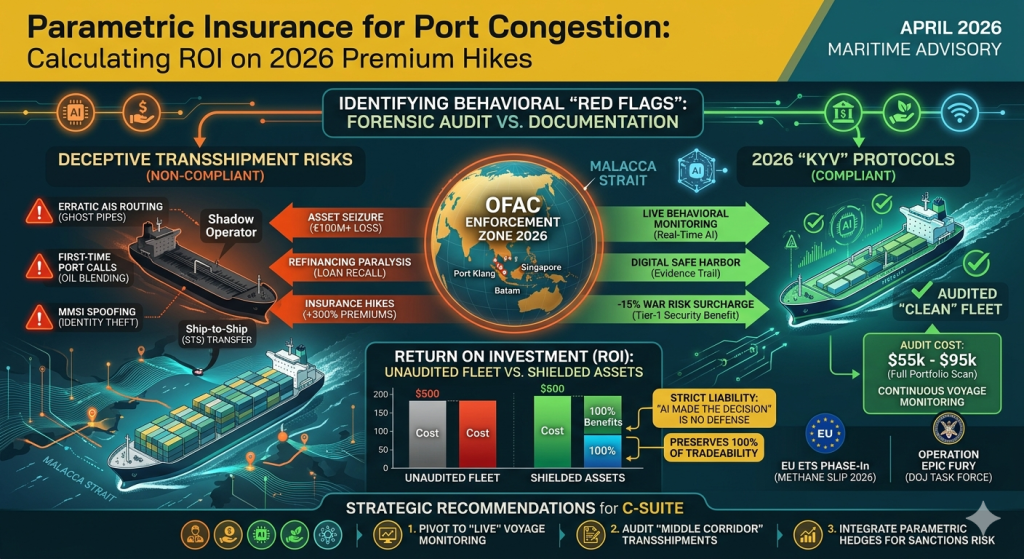
Instruct your CFO to integrate Parametric Insurance Premiums into the “Projected OpEx” for all high-value charters. This is no longer a “nice-to-have” option. By ensuring that congestion delays trigger an immediate $1M – $5M payout, you preserve your Debt Service Coverage Ratio (DSCR) and maintain the confidence of your Tier-1 lenders.
II. Mandatory “Emissions Fingerprinting” for Idling Vessels
Given the 2026 ESG Disclosure Liability, CEOs must mandate real-time methane slip monitoring for all vessels at anchorage. This data is the only defense against “Carbon Evasion” accusations. Sharing this data transparently with underwriters can lead to a “Green Premium” discount on your P&I renewals.
III. Hard-Code “Sanctions Exit” Clauses in BIMCO Contracts
The 2026 OFAC Sanctions Compliance landscape is too volatile for static contracts. Ensure your legal team includes 2026-specific BIMCO clauses that allow for immediate vessel diversion if a port’s “Red Flag” status changes during the voyage. This prevents Asset Seizure and avoids the 24-month Arbitration & Litigation Costs associated with “Blocked Funds.”
2026 Port Congestion ROI Benchmarking Tool: Executive Audit
Phase 1: Quantifying the “Daily Burn” (The Liability Lens)
Before calculating ROI, you must calculate the Total Cost of Immobilization (TCI). In 2026, this exceeds simple Charter Hire.
| Expense Category | 2024 Baseline (Daily) | 2026 Adjusted (Daily) | 2026 “Hidden” Driver |
| Charter Hire / LOH | $35,000 | $42,000 | Scarcity of “Green” Tonnage |
| EU ETS Methane Slip | $0 | $4,500 | ESG Disclosure Liability (Phase-In) |
| Hull War Risk (JWC) | $1,200 | $8,800 | JWLA-032 Listed Area Surcharge |
| Debt Service Stress | $2,500 | $6,000 | Senior Secured Debt Covenant Penalties |
| TOTAL DAILY BURN | $38,700 | $61,300 | +58% Increase in 24 Months |
Traditional insurance carries a deductible and a waiting period (typically 14 days), often rendering it useless for mid-term congestion. Parametric Insurance Premiums are higher but trigger at Hour 72.
Scenario: 10-Day Congestion Event at a High-Risk Hub (e.g., Singapore or Jebel Ali)
Option A: Self-Insuring / Traditional Indemnity
- Days 1-10: $61,300 x 10 = $613,000 Total Loss.
- Insurance Recovery: $0 (Event concluded within the 14-day deductible/waiting period).
- Secondary Impact: Potential technical default on Senior Secured Debt due to 10-day cash flow interruption.
Option B: Parametric Layer (Triggered at 72 Hours)
- Premium Cost: $75,000 (Annualized/Prated).
- Trigger Payout: $500,000 (Instant liquidity upon 72-hour verification).
- Net Position: -$613,000 (Loss) + $500,000 (Payout) – $75,000 (Premium) = -$188,000.
- ROI on Premium: 6.6x Protection Factor.
Strategic Note: The ROI isn’t just the $500,000. It is the avoidance of Mezzanine Financing at 18% interest to cover the $613,000 hole, saving an additional $110,340 in interest and Arbitration & Litigation Costs.
Frequently Asked Questions (FAQ)
1. Why is Parametric Insurance more expensive in 2026?
The frequency of “Extreme Weather” and “Geopolitical Bunching” events has increased. Underwriters are pricing in the 2026 “Volatility Index.” However, compared to the cost of a Mezzanine Financing bridge loan, the ROI remains significantly positive for fleet owners.
2. How does JWLA-032 affect my congestion risk?
If a port is added to the JWC Circulars while your vessel is at anchorage, you are effectively trapped in a “War Risk Zone.” Parametric insurance can be structured to trigger a payout the moment a port is “Listed,” providing the funds to pay the sudden spike in Hull War Risk premiums.
3. Does Parametric Insurance cover methane slip fines?
Not directly. It covers the delay that leads to the slip. By providing immediate liquidity, it allows you to buy the necessary carbon allowances on the spot market before prices spike due to regional congestion.
4. Is “AI Navigation” a valid defense in a congestion-related litigation?
In 2026, the answer is “No.” Lloyd’s underwriters now view AI navigation as a tool, not a Master. You must have “Human-in-the-Loop” verification to avoid voiding your Asset Seizure & Hull War Risk coverage.
5. Can I use Parametric Insurance for USA or UAE port congestion?
Yes. High-spec parametric products are now available for major hubs like Los Angeles/Long Beach and Jebel Ali, where “Gridlock Insurance” is becoming a standard requirement for Senior Secured Debt providers.
Expert Advisory for 2026 Maritime Risk
Navigating the transition from traditional indemnity to Parametric Insurance Premiums requires more than a broker; it requires a forensic understanding of Arbitration & Litigation Costs and the shifting Joint War Committee (JWC) Circulars. Institutional investors must pivot toward Professional Advisory Services to quantify their ESG Disclosure Liability and secure Specialized Insurance Cover that protects against Asset Seizure & Hull War Risk. Without a proactive stance on OFAC Sanctions Compliance and the Senior Secured Debt implications of port congestion, your fleet’s ROI is at the mercy of the 2026 “Volatility Trap.”
Recent Comments