
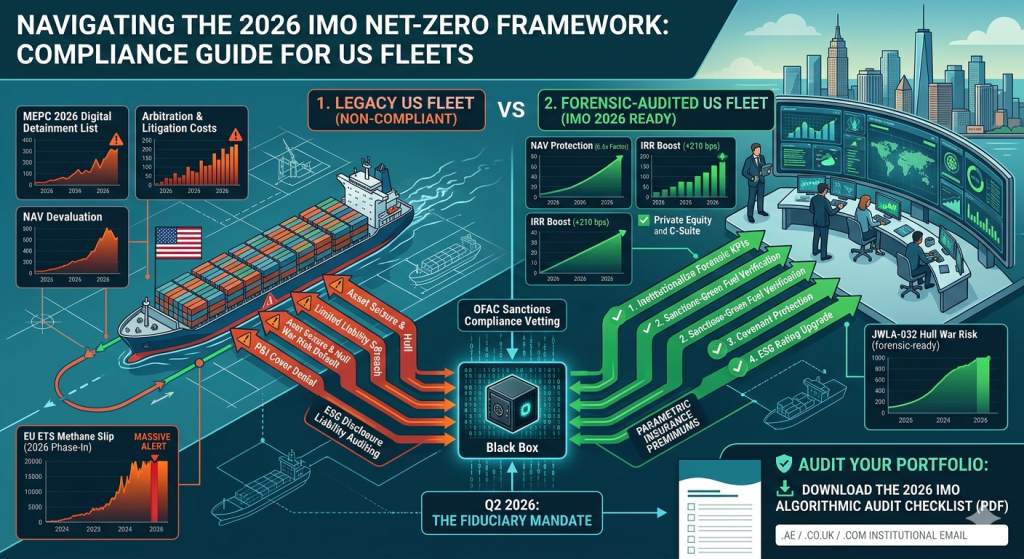
In the Q2 2026 maritime theater, the International Maritime Organization’s (IMO) Net-Zero Framework has transitioned from theoretical target to a sharp administrative weapon capable of triggering immediate asset impairment. For US-based institutional investors and C-Suite executives, failure to forensically mitigate these environmental enforcement actions now threatens the Senior Secured Debt and total asset liquidity of global fleets navigating strict enforcement jurisdictions.
The Economic Impact: The Valuation Erosion and Financial Contagion
For the CEO of a US fleet or a Private Equity fund invested in maritime assets, the IMO’s 2026 enforcement reality is not an ecological nuisance; it is a balance-sheet contagion characterized by unrecoverable costs.
NAV Impairment and Debt Volatility
As of May 2026, the primary threat is no longer kinetic damage but “Environmental Obsolescence.” Lenders are aggressively re-evaluating the Net Asset Value (NAV) of existing tonnage based on their 2026 emissions profile. When a vessel is flagged as “Non-Compliant” by the IMO’s digital enforcement agents, it triggers “technical defaults” on its Senior Secured Debt. This forces owners into the distressed Mezzanine Financing market, where 2026 rates are hovering around SOFR + 600 bps, effectively devaluing the equity holder’s position and evaporating any predictable IRR (Internal Rate of Return).
The EU ETS and Methane Slip Cascade
For US fleets operating in European waters, the economic pincer is finalized by the full integration of the EU ETS Phase-In costs for methane slip. Starting in 2026, the penalty for unmitigated methane—measured forensically at the engine and fuel supply level—can exceed the vessel’s primary freight rate. If these costs are not forensically reported and budgeted, the firm faces instantaneous ESG Disclosure Liability, exposing directors to shareholder-driven Arbitration & Litigation Costs.
The Compliance/Legal Framework: The 2026 IMO Enforcement Grid
The regulatory landscape of 2026 is a fusion of digital forensics, carbon taxation, and national security mandates. US fleets must navigate three concurrent legal regimes:
I. The IMO’s Digital Mandate (MEPC 2026)
The IMO’s Digital Compliance Registry is now the single source of truth for vessel operability. Vessels with failing “Forensic Emissions Profiles” are automatically added to “Compliance Detainment Lists.” This action is distinct from traditional P&I detention; it is an administrative Asset Seizure that makes the vessel uninsurable and uncharterable until compliance is certified.
II. Sanctions and ESG: The OFAC Convergence
In 2026, OFAC Sanctions Compliance and ESG have converged. If a US vessel attempts to secure compliant “Green Methanol” through an opaque supply chain to meet IMO 2026 targets, and that supply chain is linked to sanctioned entities (as frequently identified following the JWLA-032 circular updates), the owner is strictly liable. The fines for OFAC violations are compounding.
III. AI-Driven Navigation and Liability in Kinetic Zones
Furthermore, e-commerce supply chain demands are forcing vessels into volatile zones like the Red Sea. US operators utilizing AI-driven navigation liability—algorithms optimizing for speed while avoiding drone strikes and navigating around Joint War Committee (JWC) “Listed Areas”—must ensure these systems prioritize environmental compliance. If the AI overrides an emissions-saving protocol to increase speed for safety, the owner must document “Forensic Necessity” to avoid IMO non-compliance penalties.
Strategic Recommendations: 3 Actionable Steps for the CEO Today
I. Institutionalize Forensic Cargo & Emissions Auditing
Cease reliance on generic Class certifications. Implement SKU-level “Forensic Auditing” that validates emissions signatures—including methane slip—against the latest IMO 2026 mandates before fixing a vessel. This proactive stance is the only way to insulate Senior Secured Debt from regulatory-induced acceleration.
II. Secure Parametric Hedges for “IMO Sudden-Stop” Events
Standard cover is insufficient for the environmental enforcement cliff. US CEOs should negotiate Parametric Insurance Premiums that trigger immediate liquidity injections upon “Administrative Compliance Detainment.” This provides the essential OPEX burn rate during the mandatory re-certification period, preventing a liquidity crisis.
III. Deep-Tier Sanctions-Green Verification
To mitigate ESG Disclosure Liability and OFAC Sanctions Compliance risks, mandate full trace-back on all low-carbon fuels. In 2026, any low-carbon fuel certificate that cannot be forensically audited to its origin is a ‘Toxic Carbon Asset’ that impairs your fleet valuation during institutional due diligence.
Professional Advisory for the Forensics Era
The IMO 2026 Net-Zero Framework has turned the “Global Village” into a series of “Forensic Checkpoints.” Navigating this shift requires more than a logistics manager; it requires a Senior Risk Consultant with an underwriter’s forensic perspective on liability. Whether you are battling rising Parametric Insurance Premiums or mitigating the threat of administrative Asset Seizure & Hull War Risk following a non-compliance event, you need specialized expertise. Oitha Marine specializes in providing the Professional Advisory Services and Specialized Insurance Cover needed to navigate the JWLA-032 and EU ETS reality. Protect your IRR by anchoring your 2026 compliance strategy in forensic compliance.
FAQ: US Fleet IMO 2026 Compliance and Risk
Q: How does the JWLA-032 circular impact my US-flagged fleet?A: While JWLA-032 focuses on war risk “Listed Areas” (specifically after the 2026 updates), it also introduced a “Regulatory Conflict” surcharge. Insurers now use forensic navigation data to ensure US vessels are not violating regional environmental detentions to meet Red Sea delivery windows, which voids all Hull War Risk cover.
Q: What is the “Methane Hammer” in 2026 logistics?A: It refers to the EU ETS Phase-In costs for methane slip. If your US vessel operates in EU waters, you are now paying for the methane that leaks from your engine. If you are unprepared for this expense, you are carrying unrecoverable ESG Disclosure Liability.
Q: Can Mezzanine Financing help if my vessel is detained for emissions?A: Mezzanine Financing is often the only liquidity source when Senior Secured Debt is frozen due to a non-compliance detainment. However, in 2026, lenders demand “Forensic Compliance” warranties before releasing funds.
Q: How do I handle AI-driven navigation liability and the Red Sea?A: You must ensure your AI agents are programmed with “Environmental Guardrails.” The system must be able to prove that any speed increase was essential to avoid an attack, thereby justifying the temporary emissions override to avoid IMO non-compliance penalties.
Q: Is there any legal defense against IMO Digital Detainment?A: A strong forensic record is your only defense against an administrative seizure. If your automated systems were compromised by cyber activity (a primary risk in the 2026 Red Sea context), this data must be secured in an independent “Forensic Vault” to mitigate Arbitration & Litigation Costs.
The Death of “Good Faith” Compliance
In the previous decade, shipowners could claim a “Passive Carrier” defense. In 2026, the law has moved to “Forensic Liability.” The Joint War Committee (JWC) Circulars now explicitly state that if a carrier knowingly facilitates the systematic circumvention of IMO emissions thresholds (e.g., through “scrubber manipulation” intended to hide the fuel type), the vessel is classified as an “Enforcement Target.”
This classification triggers an immediate spike in Parametric Insurance Premiums. Investors must understand that “Trade Velocity” is now a risk metric. When a vessel is detained in Gibraltar or Singapore for forensic emissions auditing, the daily OPEX burn—exacerbated by EU ETS Phase-In costs—can exceed the value of the freight itself.
The Capital Stack Waterfall: Senior Debt vs. Regulatory Seizure
For the CFO of a US-flagged fleet, the most terrifying phrase in 2026 is “Administrative Enforcement Lien.” If a vessel is seized due to a chronic IMO 2026 violation that compromises its ESG Disclosure Liability, the government’s claim on that hull often ranks ahead of the Senior Secured Debt.
Lenders are responding by demanding “Emissions Compliance” warranties. If those warranties are breached, the bank can accelerate the debt, forcing the company into a fire-sale or a desperate scramble for Mezzanine Financing. This is the “Million-Dollar Problem” in its purest form: the destruction of institutional equity via a digital compliance flag.
The Red Sea Paradox: AI, Conflict, and Liability
The Red Sea remains the world’s most volatile supply chain artery in 2026. The threat isn’t just kinetic—it’s legal. AI-driven navigation liability arises when automated rerouting algorithms optimize for fuel and time but fail to account for the shifting boundaries of Asset Seizure & Hull War Risk zones or the real-time EU ETS methane slip calculations.
If your US vessel is seized because an AI agent decided to save three hours by skirting a JWC-monitored zone without an approved waiver, the Arbitration & Litigation Costs will be astronomical. C-Suite executives must ensure that “Human-in-the-Loop” overrides are mandatory for any navigation change involving a JWC zone or an IMO-regulated speed limit.
ESG: The New Frontier of Litigation
Finally, the ESG Disclosure Liability of 2026 cannot be overstated. With the EU ETS Phase-In costs for methane slip fully integrated into maritime law, every US cargo shipment has a forensic “Methane Signature.” Institutional investors are now auditing these signatures. A US firm that ignores this data is essentially carrying “Toxic Carbon Assets” on its balance sheet, devaluing its overall fleet before a sale or merger. Protect your ROI by securing a “Forensic Fiduciary Shield” today.
Recent Comments