
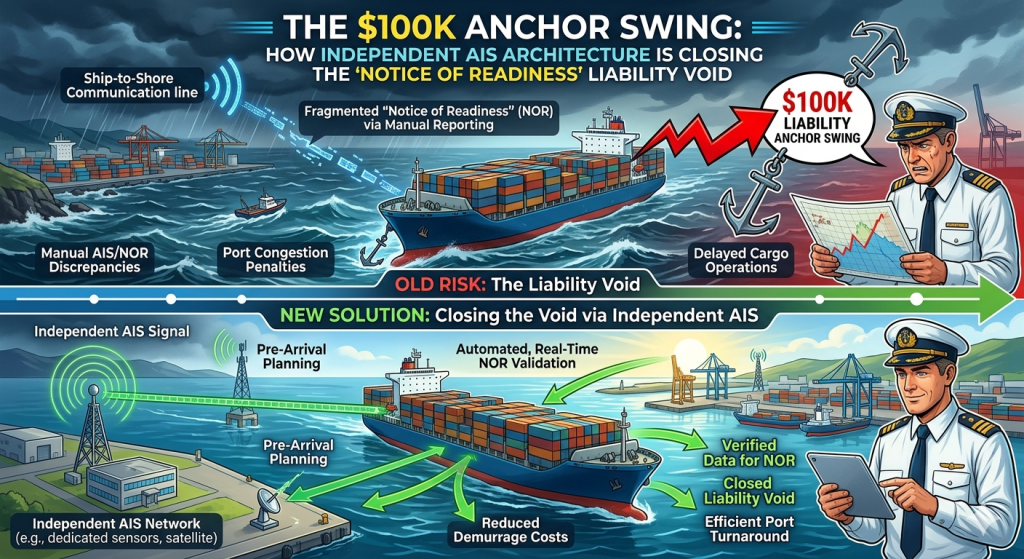
In the high-stakes maritime commerce of Q2 2026, minor kinetic discrepancies at a port’s commercial boundary can instantly translate into six-figure structural losses due to systemic gaps in traditional Notice of Readiness (NOR) tracking. For institutional investors, private equity sponsors, and charterers operating across the USA, UK, Singapore, and the UAE, deploying independent Automatic Identification System (AIS) architecture is no longer a technological luxury; it is a critical tool required to eliminate demurrage leakage, prevent technical loan defaults, and mitigate regulatory compliance exposure.
The Economic Impact: Demurrage Leaks, Balance Sheet Erosion, and Capital Stack Strain
The “Million-Dollar Problem” facing modern shipping portfolios is the financial vulnerability found at the intersection of contract law and telemetry data. When a capesize bulk carrier or a VLCC arrives at a congested port’s anchorage, the master tenders a Notice of Readiness (NOR) to signal that the vessel is physically and legally ready to load or discharge cargo.
This action stops the transit clock and starts the laytime clock. However, traditional onboard AIS transponders frequently suffer from positional drifting, signal degradation, or manual data entry errors.
The Cost of Visual and Positional Drift
If a vessel swings on its anchor line by just a few hundred meters, or if its onboard transponder experiences data lag, it can appear to fall outside the designated port limits defined in the charter party. Charterers and port authorities use these minor data discrepancies to invalidate the master’s NOR.
Losing a single NOR dispute due to tracking anomalies can erase laytime claims, forcing shipowners and investors to absorb massive, unrecoverable demurrage losses that routinely exceed $100,000 per voyage.
+————————————————————-+
| THE ANCHOR SWING DEMURRAGE LEAK cascade |
+————————————————————-+
| Vessel Swings on Anchor Line / Suffers AIS Data Lag |
| -> Appears Outside Charter-Party Port Geofence |
| -> Counterparty Automatically Rejects Tendered NOR |
| -> Laytime Fails to Commence / Charterer Avoids Demurrage |
| -> $100K+ Cash Flow Loss Directly Absorbed by Owner |
+————————————————————-+
Credit Covenants and Capital Stack Contagion
For asset managers managing leveraged portfolios, these recurring, unrecovered demurrage leaks do more than just compress quarterly yield. In 2026, continuous operational losses compress a shipping entity’s Net Operating Income (NOI), directly threatening debt service coverage ratios (DSCR).
Under the stringent terms governing modern marine credit facilities, a sustained drop in cash flow can trigger technical defaults. This allows commercial lenders to execute restrictive clauses embedded within Senior Secured Debt & Mezzanine Financing agreements.
If your primary lenders freeze revolving credit lines or accelerate debt repayment schedules because of unhedged operational leakage, the parent fund is forced to secure emergency high-interest capital, destroying the target internal rate of return (IRR).
Shifting War Risks and Algorithmic Vulnerabilities
The legal environment governing maritime tracking data in 2026 connects contract enforcement with geopolitical risk management and strict climate penalties. Courts and international arbitration panels are increasingly relying on independent, third-party satellite data to resolve commercial and regulatory disputes.
+————————————————————-+
| 2026 TELEMETRY COMPLIANCE MATRIX |
+————————————————————-+
| JWLA-032 Listed Zone —> High-Risk Insurance Surcharges |
| AIS Spoofing / Drop —> Immediate OFAC Vetting Audit |
| EU ETS Methane Slip —> Reportable ESG Liability |
+————————————————————-+
I. The Geopolitical Shield: JWLA-032 and Asset Protection
The primary driver of maritime insurance risk in 2026 is governed by the Joint War Committee (JWC) Circulars, specifically the rigid frameworks established under the JWLA-032 protocol. The 2026 updates have expanded the active boundaries of listed high-risk zones to address evolving security threats.
Under JWLA-032, hull and cargo underwriters use automated satellite tracking to monitor fleet movements continuously. If a vessel’s primary onboard AIS system drops its signal or transmits inaccurate data while waiting at an anchorage near a listed zone, underwriters may treat the data gap as a breach of navigation warranties.
If a vessel is attacked, detained, or damaged during an unverified tracking window, insurers can declare the primary Asset Seizure & Hull War Risk policy void ab initio, leaving the investor to face a catastrophic total asset loss alone.
II. The Red Sea AI Liability Loop
To maintain continuous operations through high-risk choke points while managing crew safety, many modern fleets rely on autonomous voyage systems. However, this introduces AI-driven navigation liability in the Red Sea and other volatile corridors.
If an autonomous system modifies a vessel’s speed or anchorage position to avoid a perceived threat but fails to align that adjustment with the exact geographic coordinates stipulated in the charter party, the master’s NOR tender becomes legally invalid.
If the autonomous system’s choices result in a commercial dispute, defining whether the software developer, the ship manager, or the owner bears the financial responsibility for the invalid NOR requires complex legal review, driving up international Arbitration & Litigation Costs.
III. The Environmental Dimension: Carbon Accounting and Reporting
In 2026, anchorage delays also carry environmental penalties. While a vessel sits at anchor waiting for an invalidated NOR to be resolved, its auxiliary engines and boilers continue to run, generating emissions that face immediate taxation.
Under current rules, the EU ETS Phase-In costs for methane slip and carbon emissions apply to vessels idling within or trading into European waters. Prolonged delays caused by administrative tracking disputes can result in significant, unbudgeted environmental surcharges.
Failing to properly account for these stationary emissions profiles in your corporate reports creates an immediate ESG Disclosure Liability. This exposure can trigger automated divestment mandates from institutional sustainability funds and invite enforcement actions from financial regulators.
IV. The OFAC Sanctions Nexus in AIS Architecture
Furthermore, maintaining independent and accurate AIS data is critical for national security compliance. The Office of Foreign Assets Control uses advanced satellite tracking to identify dark-fleet activity and unlawful ship-to-ship transfers.
Under current enforcement rules, robust OFAC Sanctions Compliance requires clear proof of a vessel’s historical positions. If a vessel’s onboard AIS system is blocked, spoofed by external actors, or experiences severe data corruption at a congested anchorage, the asset can be flagged as suspicious.
This flag can trigger immediate port state detentions or administrative asset freezing, exposing the parent fund to heavy financial and reputational penalties.
[Vessel at Anchorage] —> [Onboard AIS Corrupted / Spoofed]
|
v
[Automated OFAC Sanctions Alert]
|
+——————–+——————–+
| |
v v
[Independent AIS Proof] [No Secondary Data Proof]
(Vessel Cleared to Dock) (Immediate Asset Seizure)
Strategic Recommendations: 3 Actionable Steps for the CEO
I. Deploy Redundant, Cloud-Based Independent AIS Architecture
Do not rely exclusively on standard onboard transponders to verify your fleet’s positions. Implement an independent, multi-source satellite tracking framework that continuously cross-references your fleet’s positions with third-party orbital data.
By utilizing independent AIS telemetry that cannot be altered or degraded by local interference, your legal and operations teams can provide auditable proof of a vessel’s exact arrival time and location. This data allows you to successfully defend challenged NOR tenders, protecting your cash flows from costly demurrage leaks and ensuring you maintain compliance with your Senior Secured Debt covenants.
II. Restructure Voyage Cash Risks via Parametric Insurance Hedges
Traditional hull and cargo policies do not cover the indirect financial losses caused by prolonged anchorage delays or contractual NOR disputes. Executives should integrate specialized Parametric Insurance Premiums into their fleet operating budgets.
These parametric policies utilize objective data triggers—such as a verified port congestion index or an administrative customs hold—to execute immediate cash payouts without requiring a lengthy claims adjustment process. This immediate liquidity helps keep your operations funded, ensuring you can meet your ongoing lease and debt obligations during extended port delays.
III. Update Charter-Party Clauses for Algorithmic and Data Realities
Instruct your legal counsel to update your standard charter-party agreements with specific data-sharing clauses. Clearly stipulate that independent, satellite-verified AIS data will serve as the primary authority for validating NOR timelines, overriding any localized transponder anomalies.
Additionally, include specific clauses that clearly allocate financial liability for delays caused by AI-driven navigation liability or automated routing decisions. Establishing these terms before a transit occurs reduces your exposure to unexpected legal liabilities and helps lower potential Arbitration & Litigation Costs.
5. Targeted Ad-Slot Hook: Specialized Advisory Services for High-Value Maritime Risk
Navigating the technical and regulatory complexities of modern maritime commerce requires a partner with deep risk management expertise. Managing shifting Joint War Committee (JWC) Circulars, complex carbon regulations, and strict international trade compliance demands specialized advisory support. Traditional, off-the-shelf marine policies are no longer adequate to protect high-value maritime investments from sudden regulatory interventions, environmental penalties, or Asset Seizure & Hull War Risk events.
At Oitha Marine, we provide the Professional Advisory Services and Specialized Insurance Cover required to protect your fleet from these systemic disruptions. Whether you are restructuring financing across Senior Secured Debt & Mezzanine Financing or defending your firm against unexpected subrogation claims involving ESG Disclosure Liability, our underwriter-led risk solutions help ensure your fleet remains compliant, efficient, and fully insurable.
FAQ: 2026 NOR Tracking, AIS Architecture & Risk Mitigation
Q: How does a minor anchor swing cause a $100K financial loss under modern charter parties?
A: If a vessel swings on its anchor line and crosses out of the designated port geofence due to wind or tide, the charterer can argue the vessel was not technically within port limits when the NOR was tendered. If the NOR is ruled invalid, laytime does not commence, forcing the shipowner to absorb days of uncompensated port delays.
Q: What is the connection between the JWLA-032 circular and a vessel’s AIS data integrity?
A: The JWLA-032 update enforces strict tracking rules for vessels operating near volatile areas. If your vessel’s AIS system experiences data lag or dropouts within these zones, underwriters may treat it as a breach of navigation warranties, potentially voiding your Asset Seizure & Hull War Risk coverage.
Q: Can a shipowner use Parametric Insurance Premiums to cover unrecovered demurrage losses?
A: Yes. Specialized parametric policies can be structured to trigger immediate cash payouts based on verifiable data parameters, such as a vessel’s days spent at anchor past a set threshold, helping to protect corporate cash flow during protracted contractual disputes.
Q: How do methane slip penalties affect a vessel while it is waiting at an anchorage?
A: If a dual-fuel vessel experiences incomplete combustion in its auxiliary engines or boilers while idling at anchor, it faces significant levies under the EU ETS Phase-In costs for methane slip. These unbudgeted environmental expenses increase your overall ESG Disclosure Liability if omitted from corporate reporting.
Q: Who bears the liability if an AI voyage system causes a vessel to miss its laycan window?
A: If the charter party does not contain clear algorithmic allocation clauses, the shipowner is generally held responsible for the delay. This frequently leads to complex international disputes over Arbitration & Litigation Costs between the owner, charterer, and the autonomous software provider.
6. Extended Analysis: Data Integrity and Institutional Capital Preservation
The Evolution of Marine Risk Management
The metrics used to evaluate maritime credit and operational risk have undergone a fundamental shift. Historically, underwriters and lenders focused primarily on tangible assets, assessing hull age, structural condition, and crew safety records. In today’s market, data integrity and compliance transparency dominate the underwriting process.
+———————————————————————–+
| MODERN MARITIME UNDERWRITING MATRIX |
+———————————————————————–+
| Historical Risk Factors: Hull Age, Tonnage, Structural Integrity |
| Modern Risk Parameters: Real-Time Data Integrity, Sanctions Vetting|
| Continuous Carbon Accounting Accuracy |
+———————————————————————–+
Lenders and insurers now integrate real-time tracking accuracy, multi-tier compliance records, and continuous carbon data into their underwriting models. A shipping enterprise that cannot provide auditable, independent proof of its fleet’s positions and emissions profiles will face higher baseline premiums, or find itself excluded from standard international coverage.
Protecting Your Portfolio from Regulatory Sanctions
For institutional fund managers, maintaining accurate tracking data is directly tied to preserving equity value. If a vessel’s primary tracking system experiences severe data corruption or unexplained gaps at a congested anchorage, the financial damage extends beyond immediate port delays.
+————————————————————+
| SANCTIONS COMPLIANCE CONTAGION MODEL |
+————————————————————+
| AIS Data Discrepancy Flagged at Port Entry |
| -> Port Authority Executes Temporary Asset Seizure |
| -> Primary Cargo and Transit Insurance Suspended |
| -> Working Capital Credit Lines Frozen |
| -> Cross-Default Clauses Triggered Across Parent Fund |
+————————————————————+
A major enforcement action can trigger cross-default clauses across a company’s entire financing structure. If a primary operating subsidiary is flagged for a serious compliance failure, lenders have the right to freeze working capital lines across all related entities. This can turn a single tracking disruption into a broad liquidity crisis for an entire investment fund.
Conclusion: Building a Resilient Risk Framework
The maritime industry has entered an era where compliance and financial survival are inextricably linked. The 2026 operational mandates and geopolitical shifts are active risks that can quickly impair unhedged capital stacks. By utilizing independent AIS frameworks, managing algorithmic risks, and employing modern parametric hedges, you protect your fleet from these systemic liabilities.
Oitha Marine offers the underwriting expertise and structured solutions required to guide your portfolio through these changing markets. Protect your assets, safeguard your returns, and build a compliant corporate infrastructure designed to withstand modern operational challenges.
Recent Comments