
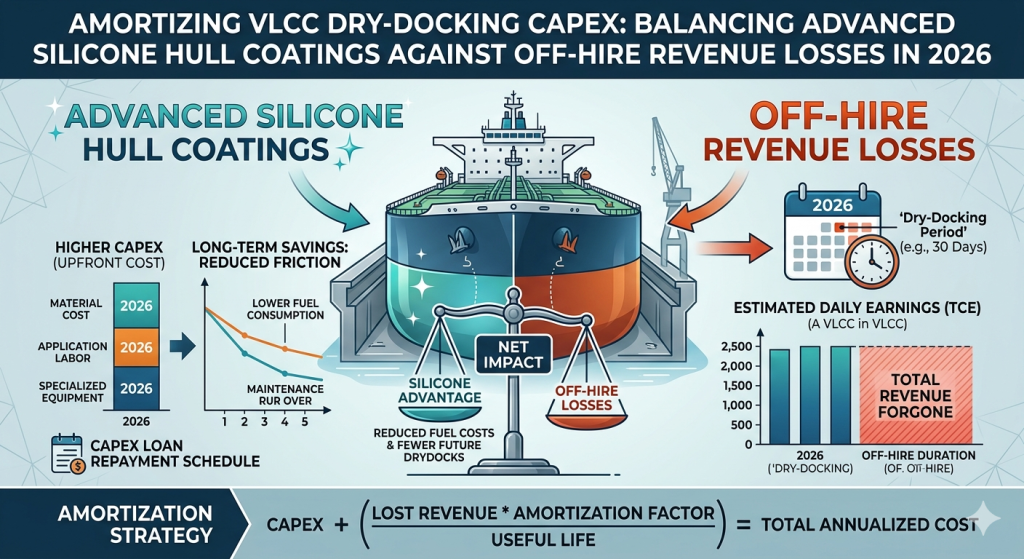
In the high-stakes macroeconomic climate of 2026, Very Large Crude Carrier (VLCC) dry-docking has evolved from a routine technical requirement into a critical capital allocation dilemma. Fleet technical directors and Chief Financial Officers (CFOs) face a complex trade-off: minimizing immediate shipyard capital expenditure (CAPEX) versus mitigating the compounding impact of Off-Hire Revenue Losses and escalating environmental penalties.
By applying advanced financial engineering to technical operational decisions—specifically the choice between conventional biocidal antifouling and premium silicone foul-release coatings—owners can optimize their Senior Secured Debt covenants, minimize ESG Disclosure Liability, and protect asset valuation during mandatory intermediate and special class surveys.
The Economic Impact: Amortization Dynamics and Revenue Forfeiture
For a standard 300,000 deadweight ton (DWT) VLCC, a scheduled five-year special survey dry-docking in 2026 is a multi-million dollar event that can fundamentally disrupt a shipping company’s corporate balance sheet. The financial shock is driven by two distinct economic forces: direct capital outlays and the temporary elimination of revenue-generating capability.
1. Visualizing the 60-Month Amortization Curve
Under International Financial Reporting Standards (IFRS 16) and US GAAP, major vessel overhaul costs are capitalized and systematically amortized over the subsequent 60-month operating cycle. The selection of a hull coating system directly impacts this depreciation schedule.
- Conventional Biocidal Systems: Low initial product cost, but susceptible to steady hydrodynamic performance degradation. Fuel consumption increases by an average of 4.5% per annum due to micro-foul accumulation, translating to higher daily operating expenses (OPEX).
- Premium Silicone Foul-Release Systems: High initial application cost (often a 250% premium over conventional biocides), but maintains hull roughness parameters near newbuild standards. This system compresses fuel burn by 6% to 10% across the 5-year cycle, altering the slope of the amortized cost-benefit line.
2. Quantifying Off-Hire Revenue Losses
The hidden killer of maritime ROI is the opportunity cost of vessel downtime. In the 2026 tanker market, spot and Time Charter Equivalent (TCE) rates dictate the true cost of shipyard stays.
A standard VLCC dry-docking requires between 21 and 35 shipyard days, depending on steel renewals, tank blasting, and mechanical overhauls.
If a VLCC is fixed on a TCE of $65,000 per day, a 30-day shipyard stay results in a top-line revenue forfeiture of $1,950,000. If unexpected complications extend the stay—such as improper curing times required for low-grade paints in humid environments—every additional day directly erodes the debt-service capacity of the asset.
[VLCC 60-Month Capital Allocation Matrix]
├── Direct Dry-Docking CAPEX (Shipyard Tariffs & Steel Repair)
├── Coating System Investment (Conventional vs. Premium Silicone)
└── Off-Hire Revenue Loss (Days Out of Service × Daily TCE Rate)
The Compliance and Legal Framework: 2026 Regulatory Compulsion
The decision to invest in advanced hull coatings is no longer purely commercial. In 2026, a series of international statutory mandates have legally formalized the relationship between hull smoothness and corporate financial liability.
1. The IMO Carbon Intensity Indicator (CII) and Asset Depreciation
By 2026, the International Maritime Organization’s (IMO) CII framework has tightened its correction factors. Vessels rating in the ‘D’ or ‘E’ bands face immediate mandatory corrective action plans before they can legally obtain their Statement of Compliance.
A VLCC utilizing an inferior hull coating that suffers from biofouling will see its fuel consumption increase rapidly. This structural inefficiency degrades its CII rating, forcing early operational speed limits, reducing its charter market value, and accelerating physical asset depreciation.
2. The EU ETS and FuelEU Maritime Methane/CO2 Surcharges
For any VLCC calling at European Union ports in 2026, 100% of emissions on intra-EU voyages and 50% of emissions on voyages starting or ending in the EU must be covered by European Union Allowances (EUAs).
- At an estimated 2026 price of €90 per ton of CO2, an inefficient hull system that wastes an extra 5 tons of fuel per day during a laden transit from the US Gulf to Rotterdam imposes an unhedged tax penalty on the operator.
- Advanced silicone coatings act as an immediate regulatory hedge, directly lowering the fleet’s ESG Disclosure Liability by mathematically reducing total carbon output per ton-mile.
3. Hull War Risk and Class Survey Sanction Profiles
Dry-docking selection also involves legal risks regarding location. Utilizing shipyards within specific jurisdictions can trigger compliance reviews under OFAC Sanctions Compliance guidelines if those yards deal with sanctioned components, steel suppliers, or shadow-fleet operators.
Furthermore, changing routes to reach a cheaper shipyard might require crossing areas highlighted by the Joint War Committee (JWC) Circulars, which can cause a sudden spike in Hull War Risk premiums during the deadweight positioning transit.
Financial Comparison: Conventional Antifouling vs. Premium Silicone (2026 Projections)
To illustrate the long-term cash flow effects, the following table models a standard 310,000 DWT VLCC undergoing a 5-year Special Survey dry-docking under Q2 2026 market conditions.
| Cost Component | Conventional Biocidal Coating | Premium Silicone Foul-Release |
| Initial Surface Prep & Material CAPEX | $280,000 | $750,000 |
| Required Shipyard Application Days | 4 Days (Standard Curing) | 6 Days (Multi-coat Precision) |
| Associated Off-Hire Revenue Loss | $260,000 (Base) | $390,000 (Extended Application Stay) |
| Average Speed/Fuel Degradation (Y1-Y5) | +4.5% Hull Friction Per Annum | < 1.0% Hull Friction Per Annum |
| Estimated 5-Year Fleet Fuel Cost Change | + $2,100,000 | – $3,400,000 (Savings vs Base Hull) |
| EU ETS Allowance (EUA) Exposure | High Volatility Risk | Mitigated Framework |
| Total 60-Month Net Financial Impact | -$2,080,000 | +$2,260,000 |
Strategic Recommendations: Asset Protection for C-Suite Executives
To protect capital investments and maximize cash flow during the 2026 operating cycle, corporate management should implement three core strategies:
I. Tie Hull Performance Directly to Debt Covenants
When negotiating refinancing or restructuring packages involving Senior Secured Debt or Mezzanine Financing, technical data should be integrated directly into the financial terms. Owners should present verified hull-efficiency projections from silicone applications to lenders to secure lower interest margins via Sustainability-Linked Loan (SLL) frameworks.
II. Use Parametric Deductibles for Shipyard Delays
Mitigate the financial risk of extended shipyard stays by integrating Parametric Insurance Premiums into your operational insurance portfolio. If adverse weather or localized port disruption delays coating application beyond the scheduled contractual window, a parametric policy can provide immediate cash liquidity to offset the compounding Off-Hire Revenue Losses.
III. Run Dynamic Regional Docking Arbitrage Models
Before committing to a shipyard, technical teams should calculate the “Total Cost of Docking.” This analysis must balance raw shipyard labor tariffs and material costs against positioning fuel burn, carbon taxes incurred during the transit, and localized war risk surcharges. A cheap dry-dock option can quickly become the most expensive choice if it requires a long, un-laden transit that incurs heavy environmental taxes.
The Need for Institutional Marine Advisory
Evaluating the long-term financial impacts of dry-dock CAPEX requires a deep understanding of marine engineering, global environmental law, and corporate finance. As international regulations tighten throughout late 2026, standard accounting models are no longer sufficient to project true fleet returns.
Shipowners, institutional direct lenders, and private equity sponsors are encouraged to secure Specialized Technical Marine Advisory Services and Enterprise Risk Underwriting assets. This proactive approach ensures that major capital investments made during dry-dock stays are structured correctly to limit liability and maximize asset values over the long term.
Frequently Asked Questions (FAQ)
Q1: Why is the initial cost of premium silicone coatings so much higher than conventional options? Answer: Premium silicone foul-release systems require intensive surface preparation, often including full hydro-blasting down to bare steel (SA 2.5 standard). The material formulation itself utilizes advanced polymers that create a non-stick, ultra-smooth surface. This profile prevents marine organisms from securing a permanent attachment without using toxic biocides.
Q2: How does a dry-docking choices impact a shipping company’s ESG Disclosure Liability? Answer: Under modern corporate transparency standards (such as the EU Corporate Sustainability Reporting Directive), institutional investors must publish audited carbon intensity reports for their portfolios. An inefficient hull coating directly increases fuel burn and greenhouse gas output, exposing the company to regulatory scrutiny, investor divestment, and potential greenwashing litigation.
Q3: Can off-hire losses during dry-docking be completely covered by standard marine insurance? Answer: No. Standard Hull & Machinery (H&M) and Loss of Hire policies generally only cover off-hire periods caused by unexpected, accidental damage—such as collisions or mechanical breakdowns. Scheduled dry-docking for class surveys is a planned operational event, meaning the resulting Off-Hire Revenue Losses must be managed entirely via corporate liquidity or specialized parametric risk instruments.
Q4: What is the significance of the 60-month amortization window for maritime assets? Answer: Class societies require major surveys every five years (60 months). Capitalizing these dry-docking costs allows companies to spread the massive cash outflow over the period the vessel actually benefits from the maintenance. This approach prevents a massive corporate earnings drop in the specific quarter the dry-docking occurs.
Q5: How do regional variations in shipyard efficiency impact overall CAPEX? Answer: A low daily labor rate at a shipyard can be a deceptive metric. If a yard lacks automated blasting equipment or modern coating sheds, the vessel may spend twice as long in dry-dock. This delay doubles the Off-Hire Revenue Losses and easily cancels out any savings on initial labor costs.
Recent Comments