
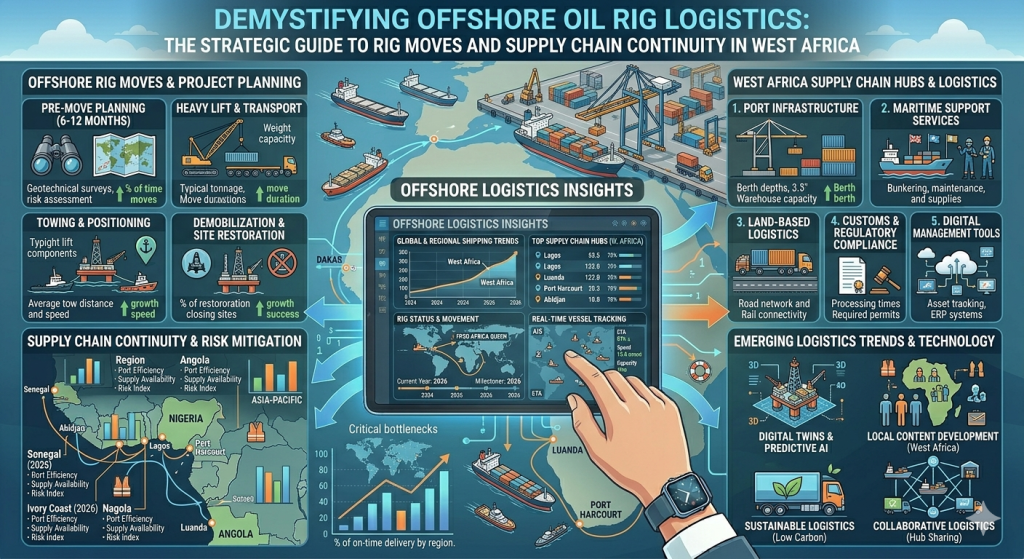
Deploying and maintaining an offshore oil rig is one of the most capital-intensive operational campaigns an energy company can undertake. In high-risk, time-sensitive offshore environments, a drilling platform can cost hundreds of thousands of dollars per day to operate. Any breakdown in the marine supply chain or a delay during a critical asset relocation causes immediate financial losses.
Achieving operational efficiency requires a flawless combination of specialized offshore support vessels (OSVs), strict international safety compliance, and experienced regional logistics management. This technical blueprint outlines the core phases of offshore rig mobilization, examines the critical vessel types required to support continuous production, and reviews the regulatory frameworks necessary for smooth operations in West African waters.
The Logistics of an Offshore Rig Move
An offshore rig relocation—whether shifting a jack-up unit, a semi-submersible platform, or a floating production storage and offloading (FPSO) asset—is a highly complex naval operation. Moving these massive structures requires meticulous planning, precise positioning, and heavy-duty towing capacity.
+——————————————————————-+
| THE TRILOGY OF RIG MOBILIZATION |
+——————-+———————–+———————–+
| Phase 1: Towage | Phase 2: Positioning | Phase 3: Tensioning |
| High bollard-pull | Dynamic positioning | Deploying deepwater |
| vessels move the | assets hold location | anchoring lines to |
| rig safely to site| during installation. | lock the asset down. |
+——————-+———————–+———————–+
The process requires high-specification marine hardware to mitigate environmental and structural risks:
- Ocean Towage Management: Heavy structural units lack independent propulsion systems. High-bollard-pull vessels are required to establish stable tow lines and pull the asset across transit sectors safely.
- Anchor Handling Execution: Once on location, dedicated marine support crews must lay down heavy deepwater anchors in exact pre-plotted configurations to secure the rig against strong offshore currents and swells.
Core Vessels Essential for Offshore Rig Support
An offshore drilling campaign cannot function in isolation. It relies on a continuous, dependable loop of maritime support to transport vital drilling materials, bulk consumables, and technical crews between shore bases and the offshore field.
+——————————————————————-+
| OFFSHORE PRODUCTION SUPPORT FLEET MATRIX |
+———————————–+——————————-+
| PLATFORM SUPPLY VESSELS (PSV) | ANCHOR HANDLING TUGS (AHTS) |
| • Transport of bulk cement/mud | • Rig towing & ocean transport|
| • Fuel, water, and cargo runs | • Precision anchor deployment |
| • Open deck capacity for piping | • High bollard-pull execution |
+———————————–+——————————-+
Platform Supply Vessels (PSV)
PSVs serve as the primary supply link for an active exploration site. These vessels feature large, open cargo decks designed to secure heavy drill pipes, casing lines, and subsea structures. Below deck, they are equipped with specialized industrial tanks to safely transport bulk commodities like dry cement, drilling mud, liquid fuel oil, and fresh water.
Anchor Handling Tug Supply (AHTS) Vessels
AHTS units are the workhorses of the offshore sector. Equipped with powerful towing winches, heavy-duty stern rollers, and exceptional bollard-pull capacity, these vessels handle the punishing physical loads associated with rig positioning, ocean rescue towage, and deepwater anchoring operations.
The Compliance Blueprint for High-Risk Marine Operations
Operating within dynamic maritime zones—such as the Gulf of Guinea or regional offshore basins—requires a disciplined approach to maritime safety and regulatory compliance.
oithamarine.com
+——————————————————————-+
| THE REQUISITE LOGISTICS COMPLIANCE STEPS |
+——————————————————————-+
| 1. Implement OCIMF & OGP Safety Guidelines |
| Establishes verified risk mitigation frameworks for vessels. |
+——————————————————————-+
|
v
+——————————————————————-+
| 2. Enforce Strict Flag-State & Class Vetting |
| Guarantees structural soundness via IACS audited registries. |
+——————————————————————-+
|
v
+——————————————————————-+
| 3. Execute Unified Cabotage & NIMASA Authorizations |
| Eliminates legal disruptions and administrative port delays. |
+——————————————————————-+
To maintain continuous operations without facing severe administrative interruptions, maritime operators must follow a strict three-step compliance path:
1
Adhere to OCIMF and International Safety Standards
Compliance Phase 1
1.Adhere to OCIMF and International Safety Standards:Compliance Phase 1.
Vessel operators must manage all supply and support runs under strict OCIMF (Oil Companies International Marine Forum) guidelines. Maintaining clean vetting files and documented safety management systems reduces risk and ensures smooth approvals from major energy companies.
2
Verify Technical Class and Mechanical Soundness
Compliance Phase 2
2.Verify Technical Class and Mechanical Soundness:Compliance Phase 2.
Every deployed support vessel must maintain an active classification registry with an IACS (International Association of Classification Societies) member. This verification confirms that propulsion systems, dynamic positioning units (DP1/DP2), and structural components meet international standards.
3
Secure Regional Local Content Clearances
Compliance Phase 3
3.Secure Regional Local Content Clearances:Compliance Phase 3.
Navigating local waters successfully requires total compliance with regional cabotage frameworks, including NIMASA guidelines and the NOGICD Act in Nigeria. Operating with locally compliant assets prevents legal delays and administrative port holds that disrupt drilling timelines.
Operational Logistics Execution with Oitha Marine
When managing an intensive offshore project, your choice of marine logistics partner directly impacts your financial performance and project security.
oithamarine.com
Oitha Marine delivers dependable, high-compliance offshore marine solutions tailored for the oil and gas sector across West Africa. As an established, indigenous marine services provider, we combine deep local operational knowledge with global safety standards to support critical offshore energy infrastructure.
Professional Marine Support Solutions
- Offshore Support & Charter Services: We offer high-specification Platform Supply Vessels (PSVs), Anchor Handling Tug Supply (AHTS) vessels, and specialized support craft equipped for both shallow and deepwater operations.
- Rig Move and Towage Coordination: Our team provides reliable towage, positioning, and anchor-handling logistics to execute asset relocations safely and efficiently.
- Safe Crew Transfer & Marine Security: We operate high-speed, air-conditioned Fast Crew Boats (FCBs) for secure personnel transport, supported by professional escort logistics to maintain secure operations.
- End-to-End Offshore Supply Operations: From bunkering services (AGO supply) to delivering freshwater and essential provisions, we keep your offshore operations running smoothly around the clock.
By maintaining strict compliance with OCIMF standards, local content regulations, and international maritime safety laws, Oitha Marine reduces operational risk and protects your project timelines.
Frequently Asked Questions (FAQ)
Q: What types of marine vessels are required to support an offshore oil rig?
A: Offshore drilling platforms rely on a specialized fleet, including Platform Supply Vessels (PSVs) for transporting drilling mud, pipes, and bulk fuel; Anchor Handling Tug Supply (AHTS) vessels for rig positioning, anchor layout, and heavy towage; and Fast Crew Boats (FCBs) for safe, rapid personnel transport.
oithamarine.com
Q: Why is OCIMF compliance critical for offshore vessel charters?
A: OCIMF guidelines establish uniform safety and environmental standards for marine operations. Compliance ensures that support vessels meet the strict safety protocols required by international oil companies (IOCs) and national regulators, minimizing the risk of accidents or operational shut-downs.
oithamarine.com+ 1
Q: What is a rig move, and how does an AHTS vessel facilitate it?
A: A rig move is the technical process of relocating a floating or jack-up drilling platform to a new drilling site. Anchor Handling Tug Supply (AHTS) vessels facilitate this by using high bollard-pull capacity to tow the rig, manage its heavy mooring lines, and deploy its anchoring systems precisely at the new coordinates.
Q: How do dynamic positioning (DP) systems improve safety during offshore supply operations?
A: Dynamic Positioning systems (such as DP1 or DP2) use automated computer controls, thrusters, and GPS data to keep a vessel perfectly on position without anchoring. This technology is vital when operating close to an offshore rig, as it prevents collisions caused by shifting winds, waves, or currents.
Q: How does local cabotage compliance impact offshore logistics in West Africa?
A: Local cabotage laws (such as those managed by NIMASA in Nigeria) require vessels operating in domestic waters to be locally owned, flagged, and crewed. Partnering with a fully compliant indigenous operator like Oitha Marine prevents costly legal detentions, fines, and operational disruptions.
Optimize Your Offshore Supply Chain with Oitha Marine Keep your offshore exploration and production campaigns running on schedule with safe, reliable marine logistics. Contact our 24/7 operations and chartering desk at oithamarine.com or visit our corporate website at www.oithamarine.com to secure certified support vessels or request a customized technical quote.
Recent Comments