
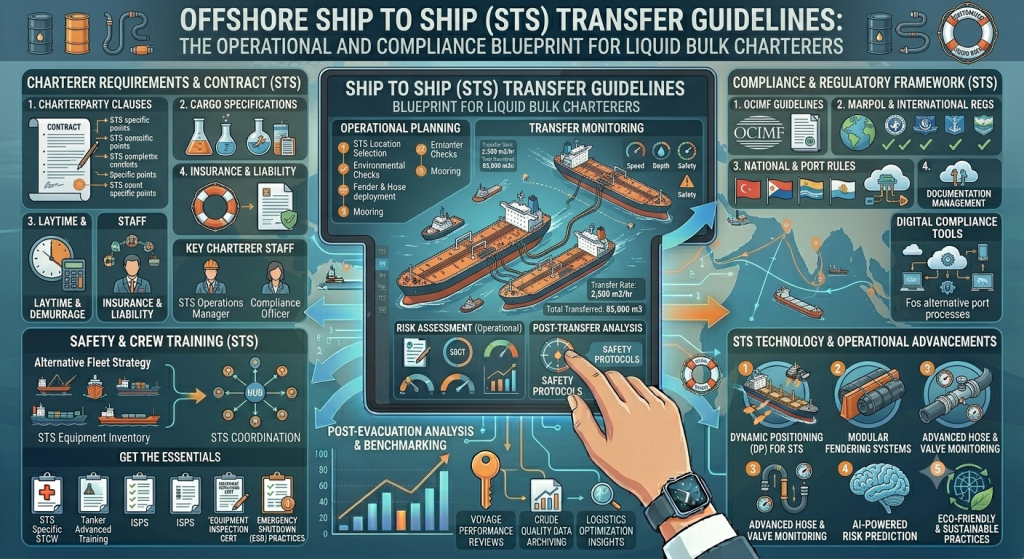
In global energy trade, time is the ultimate arbiter of profit. For oil traders, commercial charterers, and upstream logistics coordinators operating across international trade lanes—and specifically within the high-yield corridors of West Africa—maritime logistics bottlenecks can quickly erode spot arbitrage margins. When draft limitations at regional ports prevent fully laden Suezmax or VLCC (Very Large Crude Carrier) vessels from berthing, or when harbor infrastructure cannot support rapid cargo discharge, the viability of a multi-million dollar transaction hinges on a single operational capability: the ship-to-ship (STS) transfer.
+————————————————————————-+
| THE SHIP-TO-SHIP TRANS-DELIVERY PATTERNS |
+——————-+—————————+————————-+
| Phase 1: Planning | Phase 2: Double-Banking | Phase 3: Cargo Flow |
| POAC risk review | Approach and mooring with | Secure manifold tie-in, |
| and vessel vetting| primary pneumatic fenders | continuous flow-metering |
| under OCIMF rules.| absorb physical kinetic E.| and custody tracking. |
+——————-+—————————+————————-+
An offshore ship-to-ship transfer is a highly complex marine maneuver that requires the safe double-banking of two massive vessels—the Constant Vessel (often a Floating Storage and Offloading, or FSO, asset) and the Maneuvering Vessel—in open water to transfer liquid bulk cargo. Implementing these operations requires a rigorous adherence to safety, engineering, and regulatory standards.
This comprehensive manual provides the structural, operational, and regulatory guidelines necessary to execute safe, efficient, and OCIMF-compliant offshore STS transfers in West African waters.
The Commercial Drivers: Why STS is Key to B2B Margin Protection
From an oil trader’s perspective, an offshore ship-to-ship transfer is not just a technical cargo transfer; it is a financial optimization tool. STS operations serve three major B2B objectives:
- Draft Optimization and Port Access: Major regional ports across West Africa (such as Lagos, Cotonou, and Lomé) often suffer from restrictive channel drafts. By executing an offshore STS transfer, a deep-draft VLCC can discharge a portion of its cargo into smaller, shallow-draft Medium Range (MR) product tankers, allowing them to access restricted ports without risk of grounding.
- Mitigating Demurrage Accumulation: Demurrage charges on large tankers can easily range from $30,000 to over $80,000 per day. When port berths are congested, waiting in anchorage is financially ruinous. Offshore STS allows cargo to be transferred immediately to coastal vessels, bypassing port queues entirely.
- Cargo Blending and Consolidation: Traders frequently use offshore double-banking to consolidate smaller parcels of crude oil or refined petroleum products from different production facilities before dispatching a single, fully loaded supertanker to international markets.
Pre-Operational Planning and Vessel Vetting Protocols
An STS transfer can only proceed after a comprehensive risk assessment and structural vetting campaign. Under international maritime guidelines, the planning phase must address several key operational variables.
+—————————————+
| THE STS PRE-FLIGHT COMPLIANCE |
+—————————————+
|
+——————————-+——————————-+
| |
v v
[HUMAN & MANAGEMENT] [VESSEL CAPABILITY]
• Appoint certified POAC. • Dynamic structural compatibility.
• Draft STS Joint Operations Plan. • Verify manifold layout compatibility.
• Confirm clear communication paths. • Confirm auxiliary winch and mooring ratings.
The Person in Overall Advisory Control (POAC)
The cornerstone of any safe STS transfer is the appointment of a qualified Person in Overall Advisory Control (POAC). The POAC must be a master mariner with verified experience in double-banking maneuvers. They do not replace the command authority of each vessel’s Master, but they act as the unified coordinator managing the approach, mooring, cargo line connection, and emergency response.
Mandatory Vessel Vetting Criteria
Before mobilizing assets, the chartering desk must verify that both tankers comply with the following vetting frameworks:
- OCIMF/SIRE (Ship Inspection Report Programme): Both vessels must hold a clean SIRE profile, with no outstanding high-risk observations regarding mooring equipment, manifold setups, or crew competence.
- Compatibility Analysis: The structural dimensions of both vessels must align. Operators must analyze the length overall (LOA), beam, parallel body length (both in ballast and loaded conditions), and relative manifold heights.
- Mooring Layout Verification: The mooring plan must ensure that the fairleads, chocks, and winches of both vessels align to allow balanced tension distribution.
3. Engineering the Approach: Berthing Kinetics and Mooring Calculations
The critical phase of an STS transfer is the physical berthing of the Maneuvering Vessel alongside the Constant Vessel. This requires precise ship-handling and an understanding of hydrodynamic forces.
Kinetic Energy of Approach and Fender Selection
During the final approach, the impact energy must be fully absorbed by heavy-duty, high-performance pneumatic fenders (typically Yokohama-type fenders). The kinetic energy ($E_k$) generated by the maneuvering vessel’s approach is calculated using the following formula:
$$E_k = \frac{1}{2} M_v v^2 C_b C_m C_c$$
Where:
- $M_v$ represents the displacement mass of the Maneuvering Vessel.
- $v$ represents the approach velocity (which must be kept below $0.15 \text{ m/s}$ to prevent structural overload).
- $C_b$ is the berthing coefficient, accounting for the eccentric point of contact.
- $C_m$ is the virtual mass factor, representing the hydrodynamic water mass moving with the hull.
- $C_c$ is the configuration coefficient, adjusting for the cushioning effect of the open water column between the two hulls.
+————————————————————————+
| Mooring Configuration Layout |
+————————————————————————+
| |
| +————————————————————–+ |
| | CONSTANT VESSEL | |
| +————————————————————–+ |
| \ \ | | | | | | / / |
| \ Springs\ | | | | | | / Springs/ |
| Headlines \ |Breast Lines| |Breast Lines / Sternlines |
| \ | | | | | | / |
| / / \ | | | | | | / \ \ |
| / / \ / \ \ |
| +————————————————————–+ |
| | MANEUVERING VESSEL | |
| +————————————————————–+ |
| |
+————————————————————————+
Mooring Lines Distribution
The double-banked mooring layout must prevent relative movement between the hulls while remaining flexible enough to withstand open-sea swells. A standard high-compliance mooring configuration includes:
- Headlines and Sternlines: Leading far forward and aft to prevent longitudinal movement.
- Breast Lines: Leading perpendicular to the hull axis to control lateral separation and hold the vessels close.
- Spring Lines: Leading nearly parallel to the hull side to counteract the surge forces created by shifting sea currents and wind loads.
Operational Safety, Cargo Flow, and Environmental Safeguards
Once moored securely, the physical cargo transfer operations must follow strict, step-by-step safety and cargo control measures.
+——————————————————————-+
| THE CORE HYDROCARBON HANDLING PATHWAY |
+——————————————————————-+
| 1. Pre-Transfer Safety Meeting and Line Verification |
| Confirming emergency shut-down (ESD) protocols. |
+——————————————————————-+
|
v
+——————————————————————-+
| 2. Vapor Control and Manifold Alignment |
| Ensuring vapor recovery and flange testing is complete. |
+——————————————————————-+
|
v
+——————————————————————-+
| 3. Cargo Flow with Incremental Pump Rate Checks |
| Starting flow slowly to prevent electrostatic hazards. |
+——————————————————————-+
Vapor Management and Electrostatic Safety
The transfer of high-volatile liquid hydrocarbons (such as crude oil or gasoline) generates high levels of explosive vapors. Modern STS operations prioritize safety through two key controls:
- Vapor Balancing: Connecting vapor return lines between the discharging and receiving vessels to equalize internal pressure and prevent volatile organic compounds (VOCs) from venting into the atmosphere.
- Electrostatic Management: Cargo hoses must contain electrical bonding layers, or insulating flanges must be installed at the manifold connections. This breaks any current flow and prevents sparks from static charge build-up during fluid flow.
Emergency Shutdown (ESD) Systems
Both vessels must maintain synchronized Emergency Shutdown (ESD) protocols. In the event of a sudden parting of mooring lines, a localized spill, or a mechanical failure on either tanker, the ESD systems must trigger immediate, automated closing of manifold valves and shut off cargo pump systems within $30 \text{ seconds}$.
Navigating Regional Regulatory Frameworks in West Africa
Executing offshore ship-to-ship transfers in the Gulf of Guinea and wider West African waters requires strict compliance with regional port state authorities and national cabotage laws.
+——————————————————————-+
| THE REQUISITE REGULATORY APPROVAL PATH |
+——————————————————————-+
| 1. Host Nation Maritime Approvals (e.g., NIMASA in Nigeria) |
| Securing operating permits within territorial waters. |
+——————————————————————-+
|
v
+——————————————————————-+
| 2. Local Port Authority Clearance (e.g., NPA / Port-de-Cotonou) |
| Registering designated offshore STS coordinate sectors. |
+——————————————————————-+
|
v
+——————————————————————-+
| 3. Marine Escort and Defense Coordination |
| Securing armed escort support to protect high-value assets. |
+——————————————————————-+
To maintain an unblemished regulatory record, vessel owners and cargo charterers must secure three primary clearances:
Safe and Compliant STS Coordination with Oitha Marine
When executing complex ship-to-ship transfers, your choice of marine logistics partner directly impacts the safety of your crew, the protection of your cargo, and your bottom-line profitability.
Oitha Marine provides turnkey, high-compliance offshore STS coordination and maritime support services across the West African region. Combining local operational expertise with international safety standards, we deliver reliable, risk-mitigated logistics solutions for the global energy sector.
Our Comprehensive STS Support Services
- Certified POAC Appointees: We provide highly experienced, Master Mariner POACs to coordinate and oversee all double-banking maneuvers.
- Specialized Marine Asset Chartering: Our fleet includes high-performance Platform Supply Vessels (PSVs), Anchor Handling Tug Supply (AHTS) vessels, and certified towing tugs equipped for double-banking maneuvers.
- High-Specification Fendering Equipment: We arrange certified Yokohama pneumatic fenders and heavy-duty cargo hoses to ensure safe vessel contact and reliable transfer operations.
- Security and Escort Logistics: We coordinate with local naval forces to provide navy-approved escort vessels, ensuring secure transit and protection for your high-value cargo operations.
By maintaining strict compliance with OCIMF standards, local content regulations, and international safety laws, Oitha Marine reduces operational risk and protects your project timelines.
Frequently Asked Questions (FAQ)
Q: What is an offshore ship-to-ship (STS) transfer, and why is it used?
A: An offshore STS transfer is the physical transfer of liquid cargo (such as crude oil or refined products) directly between two deepwater tankers at sea. It is used to bypass shallow port draft limitations, avoid port delays and demurrage costs, or consolidate cargo for international export.
Q: What role does the POAC play during an STS transfer?
A: The Person in Overall Advisory Control (POAC) is a certified master mariner responsible for coordinating the entire STS operation. They manage the safety briefing, direct the maneuvering vessel’s approach, supervise the mooring configuration, and monitor the entire cargo transfer to ensure safety compliance.
Q: What are the main hazards associated with offshore double-banking?
A: The primary hazards include vessel collisions during approach, mooring line failure from sea swells, static electricity discharges during fuel transfer, and environmental spills due to hose damage. These risks are managed through fender systems, compatibility checks, and automated emergency shut-down (ESD) systems.
Q: What is the purpose of the Configuration Coefficient ($C_c$) in berthing calculations?
A: The configuration coefficient adjusts for the “water cushion” effect. When two large hulls come together parallel to each other, the water trapped between them compresses, creating a natural cushioning force. Calculating this coefficient ensures operators select fenders with the correct absorption ratings.
Q: How does Oitha Marine support B2B cargo security during Gulf of Guinea transfers?
A: We manage security risks by coordinating with local naval forces to secure approved security escort vessels. We also ensure full compliance with regional maritime authorities, including NIMASA, to guarantee smooth regulatory approvals and prevent costly delays.
Partner with West Africa’s High-Intent STS Coordinator Protect your margins and ensure safe, compliant double-banking operations. Contact Oitha Marine’s 24/7 commercial operations desk at oithamarine.com or visit our corporate office at 1, Funmi Okere Str, Maryland Estate, Lagos, Nigeria to request a customized technical quote.
Recent Comments