
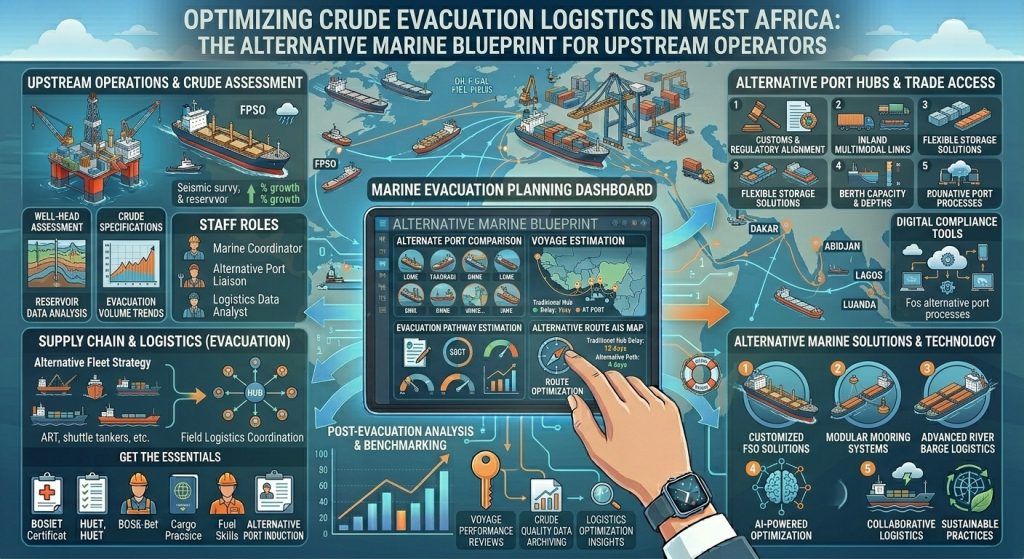
The monetization of upstream energy assets depends entirely on midstream infrastructure reliability. In the highly dynamic West African oil and gas corridor—stretching across the hydrocarbon-rich basins of Nigeria, Ghana, Angola, Gabon, and the Republic of Congo—the underlying challenge for Exploration and Production (E&P) companies is not finding oil, but safely moving it.
While heavy upstream investments drive drilling campaigns, midstream vulnerabilities often lead to deferred production. For decades, regional production has relied on aging terrestrial pipelines. However, issues like pipeline vandalism, oil theft, community unrest, and technical constraints have forced operators to seek alternatives.
+——————————————————————-+
| THE MIDSTREAM REVENUE PROTECTION LIFECYCLE |
+——————-+———————–+———————–+
| 1. Production | 2. Alternative Route | 3. Market Delivery |
| Wellhead extraction| Fluid barging and STS | Deepwater FSO/FPSO |
| stays continuous | transshipment bypasses| terminals execute the |
| without shut-ins. | terrestrial choke points.| international export. |
+——————-+———————–+———————–+
To prevent production shut-ins and secure export revenue, upstream producers, national oil companies (NOCs), and independent marginal field operators are turning to Alternative Crude Evacuation (ACE) frameworks. Deploying specialized marine logistics networks allows operators to bypass vulnerable pipeline infrastructure and maintain steady production.
Defining Crude Evacuation Logistics in West Africa
Crude evacuation logistics in West Africa refers to the operational systems, marine hardware, and regulatory approvals required to move stabilized crude oil from inland fields, swamp wells, and offshore platforms to processing hubs, storage facilities, or international export terminals.
Traditional evacuation routes rely heavily on trunklines like the Trans-Forcados or Trans-Niger pipelines in Nigeria. When these lines experience downtime due to force majeure or technical failure, producers face storage caps and are forced to shut in wells, leading to significant revenue losses.
+——————————————————————-+
| TRADITIONAL VS. ALTERNATIVE EVACUATION |
+———————————+———————————+
| PIPELINE NETWORKS (Traditional) | MARINE OFFSHORE LOGISTICS (ACE) |
| • Fixed routing vulnerable to | • Dynamic routing using shallow-|
| interdiction and vandalism. | draft hulls and tug assets. |
| • Single-point failures trigger | • Modular scalability matched |
| immediate field shut-ins. | directly to asset output. |
+———————————+———————————+
Alternative Crude Evacuation utilizes a flexible combination of specialized shallow-draft barges, heavy-duty tugboats, coastal product tankers, and offshore storage units to transport wet or dry crude through river channels out to deepwater export hubs. This approach reduces dependence on fixed infrastructure and offers a reliable route to market for stranded or marginal fields.
Technical Operations: The Marine Cargo Evacuation Value Chain
Implementing an alternative marine evacuation campaign requires specialized maritime equipment and a clear understanding of offshore cargo handling.
+——————————————————————-+
| THE CORE HYDROCARBON HANDLING CORRIDOR |
+——————————————————————-+
| 1. Field Gathering & Stabilization |
| Separating water and gas at the wellhead storage point. |
+——————————————————————-+
|
v
+——————————————————————-+
| 2. Shallow-Draft Estuary Barging |
| Transporting crude through shallow creeks via heavy-duty tugs. |
+——————————————————————-+
|
v
+——————————————————————-+
| 3. Deepwater STS Transshipment & Export |
| Transferring cargo directly to FSOs or international tankers. |
+——————————————————————-+
The process moves through three critical operational phases:
1.Field Gathering and Stabilization Management:Phase 1.
Extracted crude must undergo primary processing at a localized flow station or early production facility (EPF). Here, associated gas and produced water are separated to meet export specifications, including basic sediment and water (BS&W) limits and API gravity standards, before the oil enters the marine transit loop.
2.Shallow-Draft Estuary Barging Operations:Phase 2.
Because many West African marginal assets sit in shallow swamp environments or coastal creeks, deep-draft ocean tankers cannot access the loading points. Operators deploy specialized, double-hulled inland barges pushed or pulled by high-tonnage tugboats to safely transport the crude through tidal channels.
3.Offshore Ship-to-Ship (STS) Transshipment and Terminal Delivery:Phase 3.
Once the barges reach open water, the crude is transferred via high-capacity export pumps to a larger coastal tanker or pumped directly into a Floating Storage and Offloading (FSO) vessel or an FPSO. From there, ocean-going tankers load the oil for global distribution.
Managing Midstream Vetting, Insurance, and Safety Risks
Handling crude oil via alternative marine routes introduces distinct operational risks, including cargo loss, environmental contamination, and navigational hazards. Managing these risks requires a strict approach to vetting and safety compliance.
Operational Standard: Mitigating offshore transport risks requires total alignment with global vetting frameworks, including active SIRE logging and strict adherence to OCIMF safety standards.
The Technical Vetting Matrix
When arranging alternative logistics, chartering managers and underwriters evaluate three core pillars:
- OCIMF and SIRE Compliance: All vessels must maintain clean inspection records under the Oil Companies International Marine Forum (OCIMF) and the Ship Inspection Report Programme (SIRE). Clean records demonstrate a strong safety culture and lower insurance costs.
- IACS Classification: Deployed assets must be classed by a member of the International Association of Classification Societies (IACS) to verify structural integrity, hull thickness, and mechanical reliability.
- Hydrocarbon Accounting and Custody Transfer Precision: Precise flow-metering systems and strict standard operating procedures (SOPs) are required during loading and offloading to prevent commercial discrepancies and ensure transparent custody transfers.
Driving Commercial Logistics with Oitha Marine
Success in West Africa’s energy logistics sector requires deep regional knowledge, regulatory compliance, and high-specification marine assets.
Oitha Marine provides specialized, high-compliance marine logistics and alternative crude evacuation solutions designed for the West African oil and gas sector. As an established operator, we combine local field expertise with global safety standards to support continuous production and protect your midstream revenue.
Our Upstream Support Solutions
- Alternative Crude Evacuation (ACE) Services: We provide turnkey barging, towage, and coastal transport solutions to bypass pipeline bottlenecks and ensure continuous asset monetization.
- High-Specification Tanker Chartering: Our commercial desk manages a versatile fleet, including MR Product Tankers, Aframax, and Suezmax vessels, tailored for regional coastal movements and international exports.
- Compliant Ship-to-Ship (STS) Transshipments: We coordinate offshore liquid bulk transfers across regional hubs, including Lagos, Warri, Port Harcourt, Bonny, Escravos, and offshore Benin and Lomé, under strict safety protocols.
- Offshore Support Fleet Operations: We deploy modern Platform Supply Vessels (PSVs), Anchor Handling Tug Supply (AHTS) vessels, and Fast Crew Boats (FCBs) to support drilling platforms and offshore production facilities.
By maintaining strict compliance with OCIMF guidelines, local content frameworks (including NIMASA and the NOGICD Act), and international safety standards, Oitha Marine helps you reduce risk, lower policy premiums, and keep your production moving.
Frequently Asked Questions (FAQ)
Q: What is crude evacuation logistics in West Africa, and why is it evolving?
A: It refers to the midstream systems used to transport crude oil from production fields to storage and export terminals. The sector is evolving rapidly as operators deploy alternative marine methods—like barging and ship-to-ship (STS) transfers—to bypass pipeline disruptions, theft, and technical constraints.
Q: How does Alternative Crude Evacuation (ACE) protect upstream revenues?
A: ACE protects revenues by decoupling production from fixed pipeline networks. If a primary export trunkline suffers a breakdown or security interruption, an operator using alternative marine logistics can continue transporting crude via barges and coastal tankers, avoiding production shut-ins.
Q: What are the primary equipment requirements for an estuary crude barging campaign?
A: A standard estuary campaign requires specialized double-hulled liquid cargo barges designed to prevent environmental leaks, high-bollard-pull shallow-draft tugboats for shallow channel navigation, high-capacity export pumping systems, and custody-transfer metering units to track cargo volumes accurately.
Q: Why do international underwriters prioritize OCIMF and SIRE vetting for alternative evacuation assets?
A: Alternative evacuation involves multiple cargo transfers in dynamic marine environments, which increases the risk of operational accidents or spills. Underwriters rely on OCIMF guidelines and SIRE inspection reports to verify that a vessel operator adheres to strict, audited safety protocols before issuing insurance coverage.
Q: How does Oitha Marine ensure regulatory compliance across West African coastal regions?
A: Oitha Marine maintains full alignment with regional maritime authorities, including NIMASA in Nigeria, local content boards, and cabotage registries. Operating fully compliant, technically vetted assets allows us to eliminate administrative delays and ensure seamless logistics delivery for our clients.
Optimize Your Upstream Value Chain with Oitha Marine
Protect your production timelines and secure reliable routes to market with high-compliance marine logistics. Contact our 24/7 commercial chartering and operations desk at oithamarine.com or visit our corporate office at 1, Funmi Okere Str, Maryland Estate, Lagos, Nigeria to discuss your alternative crude evacuation requirements.
Industrial Context: Midstream Supply Chain Challenges
To gain a clearer understanding of the midstream challenges and structural infrastructure bottlenecks impacting regional energy production across sub-Saharan Africa, you can watch this report on it. This video highlights the complex operational and environmental realities that make alternative marine logistics essential for regional producers.
Recent Comments